
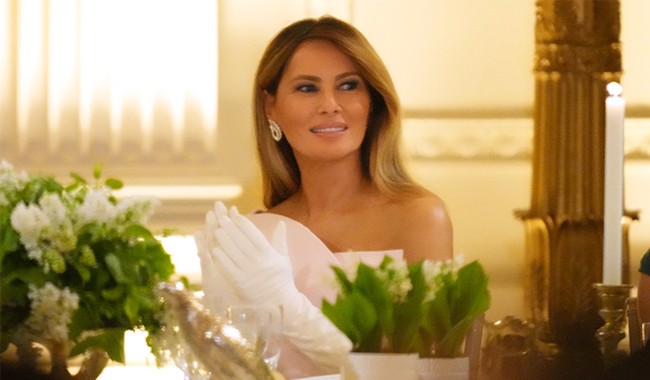
The media’s fixation on the women around President Trump reached a new peak this week, with attention on an executive assistant and renewed questions about the First Lady’s public presence; Melania responded at a Rose Garden event with a light, pointed remark that refocused the conversation on her foster care work and the children she serves. This article covers the wave of coverage, the odd scrutiny of staff, Melania’s deliberate public role, and the initiative she highlighted when she returned to the White House podium.
Mainstream outlets have spent days dissecting the lives and loyalties of people who work for or are related to the president, and the coverage has often felt invasive rather than informative. One young staffer was dragged into a swirl of speculation and insinuation that had nothing to do with her job performance. The frenzy revealed less about governance and more about a media appetite for manufactured drama.
Alongside that obsession came the familiar question about the First Lady’s whereabouts, as if her private decisions required constant justification. Melania Trump had been tending to family obligations while also taking part in official events tied to America 250. She quietly carried out projects and appearances that mattered to her, not to the rumor mill, and that balance is exactly what leadership often requires.
The first lady’s public style has always leaned toward selectivity: she chooses a few causes and makes tangible moves rather than staying in the spotlight for its own sake. Her “Fostering the Future” initiative is a prime example, and it got center stage when she returned to the Rose Garden to speak about the issue. That focus helped shift attention from gossip to concrete outcomes for foster kids.
At the Rose Garden event she didn’t offer a long speech or seek sympathy. She acknowledged the chatter in a single, perfectly delivered line: “I heard you missed me.” She followed up with, “Here I am,” to laughter and applause, which cut through the media noise and left the room on a clear, human note. The brief exchange showed she understands how to handle headlines without getting pulled into them.
“I heard you missed me,” she said alongside President Trump at a Rose Garden event for her “Fostering the Future” initiative.
“Here I am,” she added to laughter and applause from the audience.
The event also had a concrete philanthropic announcement: a substantial donation to support scholarships for foster children at two major Midwestern universities. That kind of result is the opposite of theatricality; it’s measurable help that follows through on the promise of advocacy. When media cycles obsess over where someone is, they distract from outcomes like these that make a real difference in young lives.
Melania arrived at the podium flanked by a modest security and protocol presence, not a show of celebrity pageantry, which reinforced the point. Her approach is strategic; she uses visibility sparingly and to spotlight causes she cares about rather than to feed 24/7 commentary. That discretion often leaves room for speculation, but it also preserves the dignity and purpose of her initiatives.
The reports that tried to turn absence into crisis missed the context: the first lady had been actively engaged in reunification work and humanitarian efforts tied to the war in Ukraine. Those efforts included reuniting children with families and coordinating support where needed, a quiet string of actions that rarely makes sensational headlines. Her presence at a White House event highlighted that steady, service-oriented track record.
Critics who make marital or personal jabs as a shortcut to cheap headlines distract from the policy and people-centered work happening behind the scenes. The real story here is not gossip or manufactured scandal; it’s the outcomes being produced for foster children and families through scholarships and programs. The more coverage can focus on substance, the better for the public interest.
When the media hyperfixates on appearance, schedule, or relationships, it treats public servants as characters rather than as adults doing difficult work. Melania’s short, pointed comeback returned the conversation to the tangible items she brought to the table: initiatives, partnerships, and funding for kids in need. That pivot is a useful reminder of how public attention can be redirected toward results.
Her style remains understated but effective, and this week’s Rose Garden moment showed how a few words can disarm noise and steer attention where it belongs. The optics of her return served a purpose beyond image management; they underscored an ongoing commitment to foster children and to practical steps that support their future. Quietly, deliberately, she put the focus back where it should be: on the children themselves.
https://x.com/nypost/status/2090560480334991863



Add comment