
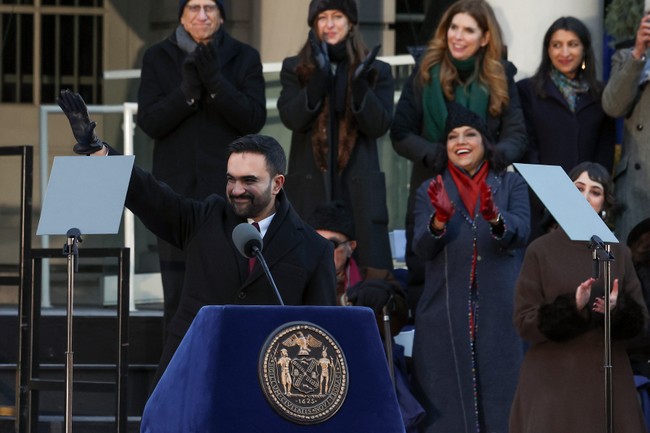
The piece argues that the press applied a double standard when it raked Elon Musk over a brief onstage arm gesture while largely ignoring identical gestures by newly elected New York City politician Zohran Mamdani, and it frames that inconsistency as symptomatic of a biased media that protects the left and attacks conservatives.
Remember the furor over Elon Musk’s arm motion at a Washington, D.C. event on January 20, 2025? A second-long straight-arm gesture prompted an international media meltdown that turned into a narrative about “a Heil Hitler salute.” “I never imagined we would see the day when what appears to be a Heil Hitler salute would be made behind the Presidential seal,” wrote thankfully retiring Rep. Jerry Nadler (NY-15) . Headlines and opinion pieces ran with the idea that the moment proved something sinister about Musk, and mainstream outlets treated the image as if it carried definitive meaning.
An identical point bears repeating: Zohran Mamdani, now serving in New York City government, has been photographed and recorded using the same straight-arm motion on multiple occasions. That fact raises a simple question the press refuses to treat like a question: why did one man get wall-to-wall condemnation while the other earned little more than a shrug? The answer many conservatives see is obvious — the press amplifies attacks that fit the left’s agenda and mutes incidents that do not.
When the media chose to obsess over Musk, comment sections and editorial pages flooded with outrage, comparisons and moralizing. “80 Years After Auschwitz, Elon Musk Keeps the Fascist Salute Alive,” read one opinion headline, and the Associated Press framed the incident as a gesture “embraced by right-wing extremists regardless of what he meant.” Yet when identical behavior appears from a progressive politician, coverage and commentary drop to near silence, signaling a selective moral outrage.
That selective outrage has real consequences. When the press insists on defining the public narrative for one side and protecting another, voters see through it. They recognize that the news landscape operates with different standards depending on who is on stage. Once that truth settles in, trust erodes and large swaths of the public tune out the media’s moral judgments, which only deepens the divide between institutions and citizens.
Conservative voices pointed out the inconsistency immediately, and critics called out the press for a two-tiered system of outrage. Disgraced politicians and pundits who piled on Musk were quick to condemn him, yet the same fervor did not follow for figures whose politics they favor. That selectivity isn’t accidental; it’s a symptom of a media culture that elevates partisan narratives over even-handed reporting and context.
Elon Musk himself weighed in on the larger pattern, calling the sustained assault “a relentless propaganda campaign.” In an interview he noted that “politics is a blood sport,” and that opponents will manufacture attacks to damage public perception. The claim resonates with Republicans who have watched the drip of sensational allegations against conservatives while comparable episodes on the left draw little consequence.
Political coverage often treats statements and gestures as binary proof instead of messy human actions. That tendency distorts public debate and encourages headline-driven outrage rather than sober analysis. Conservatives argue that holding all politicians to the same standard would improve public discourse and reduce the toxic cycle where one side weaponizes media outlets to hobble opponents.
Examples of the media leaping in lockstep are not hard to find. In past moments when a Republican used colorful language about industry or politics, outlets immediately ran alarmist headlines suggesting calls for violence or moral collapse. Yet nearly identical rhetoric or behavior from the left rarely triggers comparable interrogation, revealing a pattern rather than isolated errors in judgment by individual reporters.
The fallout of this unequal treatment is political as well as cultural. It reinforces tribalism, fuels skepticism about institutions, and hands Democrats a powerful advantage: when the press defends your side, mistakes become forgivable and inconvenient episodes get minimized. Conservatives see this as an unfair tilt that must be called out forcefully so voters can judge actions on facts, not spin.
Even some civil society groups pushed back when the initial Musk story inflated into a moral horror show, and the debate exposed how easily narratives can be built and sustained regardless of context. That matters because once the press loses credibility, its ability to hold power accountable diminishes for everyone, including those it claims to protect.
Editor’s Note: Zohran Mamdani is an avowed Democratic Socialist whose ideas are toxic to the American way.


Add comment