
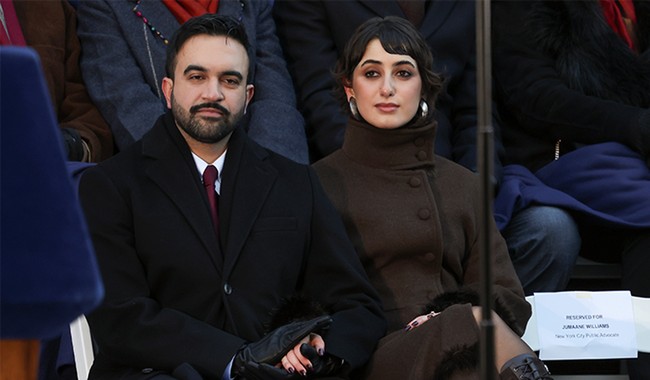
I’ll show how Mamdani’s defense of his wife’s online history unravels, document her real influence on his campaign, recap the controversy around the Gracie Mansion protest IEDs and his reactions, quote primary-source material verbatim, and place the embedded media where they appeared.
Zohran Mamdani’s attempt to cast his wife as a private, uninvolved figure falls apart under scrutiny. He insisted she was “a private person who has held no formal position on my campaign or in my City Hall,” but reporting and firsthand descriptions tell a different story. When your closest partner is described publicly as a de facto adviser, insisting otherwise looks like damage control. Voters deserve straight talk about influence and responsibility from anyone who would run a city as complex as New York.
The controversy widened after revelations that Rama Duwaji engaged with social media content related to the October 7 Hamas attacks. The posts in question allegedly showed sympathy for the attackers and included a heart reaction on a post that labeled the rapes as a “mass rape hoax.” Those actions matter because they speak to judgment and public posture at moments of extreme human suffering. In public life, private clicks and shares can become public trust issues when they signal political and moral judgments.
Compounding the optics, Mamdani’s public responses to violent unrest near Gracie Mansion raised eyebrows. An attempted IED attack during competing protests drew attention to the mayor’s priorities when his first statement condemned white supremacy rather than addressing allegations that the suspects had Islamist motives. That sequencing felt odd to many observers who expect elected leaders to speak plainly about violent acts and their alleged inspirations. The public wants clarity on threats and consistency from its leaders.
Beyond statements, there’s direct evidence of Duwaji’s role in her husband’s political operation. A profile described her as “the de facto adviser” to Mamdani’s 2025 mayoral campaign and detailed hands-on responsibilities that included messaging, aesthetics, and mentoring. That portrait undercuts claims that she had no formal or informal influence. Whether labeled “formal” or not, shaping a campaign’s voice, visuals, and strategy is influence, pure and simple.
Mamdani’s camp hadn’t anticipated the [primary] election to be called so early, let alone that night, but when the results were tallied in his favor, everything shifted. Mamdani quickly rewrote the speech he had planned, while an adviser began straight-talking with Duwaji: She was going onstage as the likely next First Lady. “I felt like I was walking through a fog,” she told me earlier this month on the eve of her move to Gracie Mansion. “My friend came in from D.C. that day, and she got to experience that moment of seeing me — my brain — literally develop. I was like, Okay, I’m locking in.”
Suddenly, she was the de facto adviser to the most headline-grabbing political candidate of 2025, strategizing over morning chai and shaping the look and feel of the campaign, whether coaching him on his Arabic pronunciations for what would become a viral campaign video (she’s a native speaker; he isn’t) or shaping the playful graphic design of the campaign. (The flare on the Z and the serif on the R? Those were her ideas.)
[…]
“Speaking out about Palestine, Syria, Sudan — all these things are really important to me,” she says. “I’m always keeping up to date with what’s going on, not just here but elsewhere. It feels fake to talk about anything else when that’s all that’s on my mind, all I want to put down on paper,” she says. “Everything is political; it’s the thing that I talk about with Z” —Duwaji’s nickname for her husband — “and my friends, the thing that I’m up to date with every morning, which is probably not great for my mental health.”
That passage reads like a roadmap of influence: strategic discussion, daily political debate, and direct input on campaign material. If a spouse is in the room for those conversations and shaping key elements, claiming no influence strains credulity. Accountability in public office requires recognizing gray areas, not erasing them with a talking point about “formal” titles.
For many on the right, the comparison to other political spouses is straightforward: if judicial or political figures are judged in part by what those closest to them say or do, the same standard should apply to Mamdani. Influence isn’t only a checkbox on an organizational chart; it’s patterns of behavior, proximity to decision-making, and public-facing actions. Treating it as anything less invites political double standards.
The stakes are real: New York’s mayoral office carries national influence and local consequence. When a mayor downplays or misstates the role of a close adviser, it doesn’t just look evasive — it raises questions about judgment, transparency, and who’s shaping policy behind the scenes. Voters and watchdogs will press for clarity, and that pressure is only likely to grow as more details circulate.
Ultimately, this saga is about credibility. Mamdani can insist on one narrative, but documented accounts and public behavior tell another. When officials choose obfuscation over candor, they make themselves and the city harder to defend when controversy hits. New Yorkers deserve better than spin; they deserve straightforward answers about influence, responsibility, and the people who help run their city.

Add comment