
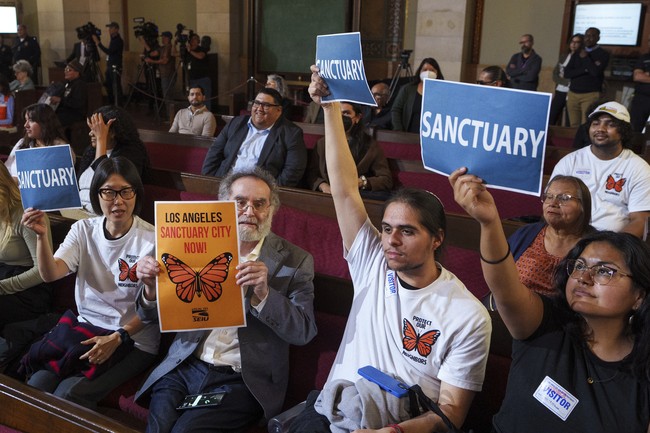
The Los Angeles City Council’s DSA wing is pushing a measure to let noncitizens vote in city elections, and this article lays out who is behind it, what it would change, the legal and political hurdles, and why many Republicans see it as a dangerous shift away from citizenship-based voting rights.
The proposal, spearheaded by Councilman Hugo Soto-Martinez, would ask voters to give the council authority to allow noncitizens to participate in city elections, including mayoral, council, and school board races. Soto-Martinez frames the idea as helping immigrant communities who he says have been under assault. The push is part of a broader DSA strategy to reshape local power in Los Angeles by expanding the electorate beyond traditional citizens.
Opponents argue this is more than a local policy tweak; it undermines the core meaning of citizenship. Ira Mehlman of the Federation for American Immigration Reform says the move “undermines the whole concept of citizenship, and what it means to be a member of American society.” From a Republican perspective, voting is a civic right tied to the responsibilities and privileges of citizenship, and loosening that link risks diluting legitimate political representation.
The proposal faces several procedural and legal hurdles before it could take effect. First the council must vote to place the measure on the ballot, then voters would have to approve it in November, and if approved the council still would need to pass an ordinance to implement the change. Legal challenges are likely: similar efforts in other cities have already met court roadblocks, and state constitutional questions could arise that would invite litigation.
City Councilmember Hugo Soto-Martínez, who represents an Echo Park-to-Hollywood district, released a proposal Wednesday to ask voters in the Nov. 3 election to give the council the power to let noncitizens vote in city elections, including those for mayor and City Council, as well as for Los Angeles Board of Education seats.
The proposal faces multiple hurdles that could derail it. The council must vote to put the measure on the ballot and after that, voters would have to approve it. If passed by voters, the council would still need to pass an ordinance revising city election law.
Soto-Martínez, whose parents were at one time undocumented, said his proposal would help L.A.’s immigrant communities at a time when they are under assault from the Trump administration, which has launched immigration raids around the country and sought to revoke birthright citizenship.
“After my parents immigrated here from Mexico, they worked hard, paid taxes, and raised their kids in our public schools, but for decades they had no say in the decisions shaping their community until they became citizens,” Soto-Martínez said.
The proposal, which was also signed by Councilmember Ysabel Jurado, now heads to the council’s rules committee for consideration.
Locally, the political stakes are high. Soto-Martinez is a DSA organizer who unseated a moderate in CD-13, and the council now includes multiple members aligned with his faction. The DSA’s gains have shifted council politics and put city governance on a more activist track, which Republican critics say prioritizes ideological experiments over practical services and public safety.
There are mixed responses even among those who oppose the measure for different reasons. Dylan Kendall, a rival to Soto-Martinez, rejects the bill but not because she supports strict citizenship requirements; she worries that creating official lists of noncitizen voters could expose undocumented people to federal enforcement. That paradox highlights how fraught and complex the issue is on the ground in Los Angeles.
The legal landscape outside L.A. already offers warnings: New York City tried a similar change and had it struck down by the state supreme court. In California, San Francisco has allowed noncitizen voting for school board races, and Oakland voters approved a measure in 2022 that has not yet been implemented. Local outcomes vary and courts remain a major gatekeeper for changes that intersect with state and federal law.
Ira Mehlman, spokesperson for the Federation for American Immigration Reform, said his organization would fight such a proposal, arguing that it “undermines the whole concept of citizenship, and what it means to be a member of American society.”
Mehlman, whose group favors stronger enforcement of federal immigration laws, said L.A. should not allow people to “just show up from the outside and have an equal voice in how the city is run.”
“That is a privilege and a right that is reserved for citizens,” he said.
Beyond legal questions, the move would reshape political incentives. If noncitizens can vote, candidates and parties will tailor outreach and policy promises to new blocks of voters who do not share the same legal obligations as citizens. Critics warn this creates a disjointed accountability loop where those making civic claims are not necessarily bound to the same civic responsibilities.
Supporters argue inclusion improves representation for communities whose members live, work, and pay taxes in the city, even if they are not citizens. Deputy Atty. Gen. Marissa Roy and other DSA-aligned figures have voiced support, saying local protections can shield immigrant voters from federal interference. Backers believe the move extends democratic participation to people who are affected by city policies but currently lack a voice.
[Kendall] said she fears it would lead to the creation of “a new government list of noncitizen voters at the very moment Trump’s ICE brigade is looking for more ways to track, target, and kidnap undocumented people.”
“What he’s proposing now sounds less like protecting our community and more like asking people to sign onto a public list that exposes undocumented neighbors to greater danger,” she said.
Practical politics will decide whether this idea advances. The council will vote on whether to place it before voters, and if it reaches the ballot the campaign will force Los Angeles to confront deep questions about citizenship, community, and who gets to shape local government. For Republicans and anyone who ties voting tightly to citizenship, this proposal is a flashpoint that demands opposition.
The debate in Los Angeles is emblematic of a national struggle over immigration, civic identity, and electoral rules. The DSA’s push tests how far local governments can reach when they try to redefine the franchise, and the outcome will matter not only for Angelenos but for how other cities weigh similar moves in coming years.
Noncitizens secured the right to vote in school board races in San Francisco. Oakland voters approved a similar move in 2022 but it has not yet been implemented, according to Ballotpedia.
Meanwhile, voters in Santa Ana rejected a proposal in 2024 to let noncitizens cast ballots in that city’s local races.


Add comment