
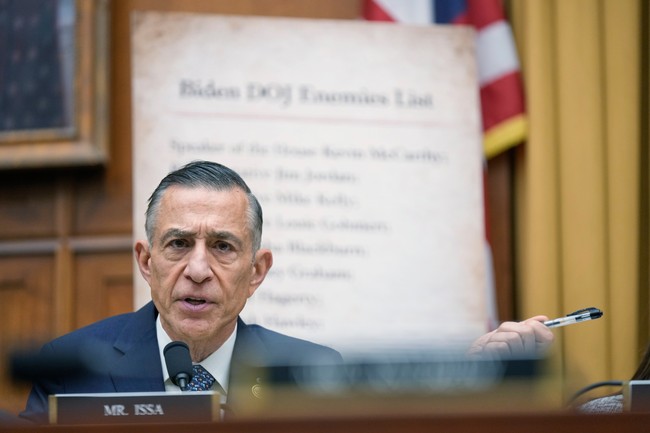
Rep. Darrell Issa announced he will leave Congress at the end of his current term, creating an open and suddenly competitive House seat in Southern California after mid-decade redistricting reshaped the district’s lines and political profile.
Issa confirmed his retirement and endorsed San Diego County Supervisor Jim Desmond as his preferred successor in the new 48th Congressional District. The decision comes after months of weighing his future and follows a long career in business and public service that kept him visible in Southern California politics for decades.
Redistricting altered the district significantly, bringing in coastal and suburban areas that diluted the Republican edge the seat once enjoyed. Under the revised map, the district shifted toward the center and even leaned left enough to back Kamala Harris over Donald Trump in the last presidential election, changing the electoral math Issa once took for granted.
Issa has served in and out of Congress for much of the past quarter century, first winning a House seat in 2000 after a 1998 Senate run and later gaining national attention as chairman of the House Oversight Committee. His oversight role produced a series of high-profile probes and helped build his reputation among conservative voters and activists who valued his willingness to pursue accountability.
Issa made his endorsement clear when he named Desmond as his choice to carry the Republican banner in the newly drawn district. “Today I’m announcing my enthusiastic endorsement of Supervisor Jim Desmond for Congress to represent California’s new 48th district,” Issa said. “Jim is not only a personal friend, he’s a true patriot, a Navy veteran, a successful businessman, and has a 20-year record of public service.”
The endorsement signals a push to keep the seat in Republican hands despite the tougher terrain. Desmond’s background as a local official and veteran will be presented as continuity with Issa’s brand of conservative governance, focused on public safety, fiscal responsibility, and local control rather than big federal programs and expansion of bureaucratic power.
Issa framed his retirement as a personal choice after a long run in both business and public life. “This decision has been on my mind for a while and I didn’t make it lightly,” Issa said. “After a quarter century in Congress and before that a quarter century in business, it’s the right time for a new chapter and new challenges.”
His timing recalls earlier moments when shifting maps and political waves pushed him to step back, as he did in 2018 when a challenging environment led him to leave temporarily. He returned in 2020 after winning a different seat, showing that strategic retreat and comeback are part of modern political life for seasoned legislators.
But this departure looks different because the redrawn district removed the structural GOP advantage that once made the seat reliably Republican. The new configuration turns the race into a genuine battleground, where turnout, candidate quality, and messaging will determine the outcome rather than simple partisan baseline numbers.
Republicans interested in holding the district will stress local issues, veterans’ service, and economic recovery themes that resonate with suburban voters troubled by cost-of-living spikes and public-safety concerns. Expect a campaign that emphasizes pragmatic conservatism and the kind of local problem solving that has worked for Republican candidates in similar coastal suburban districts.
Democrats see opportunity and will likely mount a strong challenge, making next year’s contest a test of whether Republicans can translate their local appeal into votes under the new map. For now, Issa’s exit and Desmond’s endorsement set the stage for an intense, closely watched campaign that could shape the regional balance in Southern California.



Add comment