
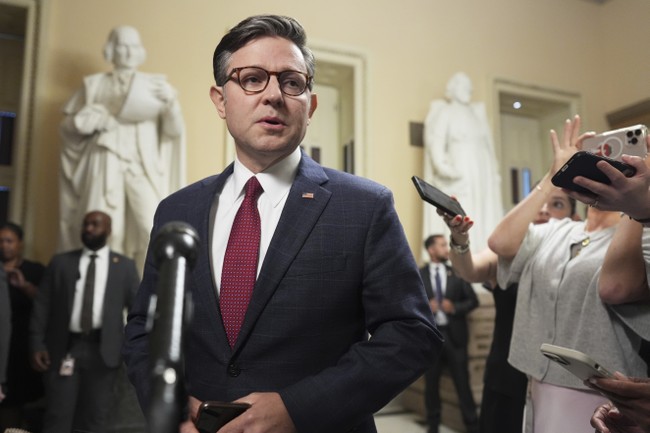
Speaker Mike Johnson has decided not to allow a House vote to extend the COVID-era Obamacare subsidies that expire at year end, choosing instead to pursue a Republican-crafted healthcare alternative; this move has angered some moderates but aligns with a broader push to stop open-ended taxpayer subsidies and craft a replacement that restricts coverage for illegal immigrants.
Congress is facing a deadline as enhanced Obamacare subsidies are set to expire on Dec. 31, and House Republicans now plan to advance their own healthcare package rather than renew the temporary payments. Speaker Johnson says he will not permit an amendment vote to extend the subsidies and wants the House to focus on policy that, in his view, better controls costs and corrects problems Democrats created. That decision has exposed a divide inside the GOP between members in competitive districts and leadership intent on offering a distinct alternative.
Speaker Mike Johnson (R-La.) said there will not be an amendment vote on extending expiring ObamaCare enhanced subsidies as part of a House Republican health care bill this week, in a move that is infuriating moderate Republicans who had been pushing to go on the record about the subsidies.
Johnson said at a press conference Tuesday that about a dozen Republican members in competitive districts are “fighting hard to make sure that they reduce costs for all of their constituents.”
“Many of them did want to vote on this ObamaCare COVID-era subsidy the Democrats created,” Johnson said. “We looked for a way to try to allow for that pressure release valve, and it just was not to be.”
From a conservative standpoint, continuing a supposedly temporary subsidy undermines fiscal discipline and rewards Washington dependency. Temporary was the intention, and letting a time-limited measure become permanent by stealth is poor policy and poor stewardship of taxpayer dollars. Republicans arguing for a clean repeal or a structural fix see the subsidy extension as a political patch, not a solution to skyrocketing premiums and long-term cost pressures.
Rep. Mike Lawler (R-N.Y.), one of the members who had been pushing for a vote to extend the subsidies that expire Dec. 31, fumed at the decision as he emerged from a House Republican Conference meeting Tuesday morning.
“I think it’s idiotic not to have an up-or-down vote on this issue,” Lawler said, adding: “It is political malpractice.”
Those who represent swing districts say an up-or-down vote would let them show constituents they tried to preserve financial help, and they argue that letting the subsidies lapse will raise out-of-pocket costs for middle-class families. Republicans counter that patching a broken law with ongoing subsidies only delays the necessary reforms and further entrenches federal involvement in health care. The core GOP message remains repeal and replace, with emphasis on market-based fixes and returning power to states and patients.
House leadership says work is already underway on a replacement plan meant to tackle cost drivers, improve transparency, and limit federal expansion. A consistent condition cited by GOP leaders is assurance that illegal immigrants will not be eligible for taxpayer-funded coverage under any new framework. That point has become politically charged and will likely draw sharp criticism from Democratic governors and progressive leaders who favor broader access.
Spending more money to prop up a failing policy is an easy target for Republicans who favor limited government. Extending a subsidy created amid emergency conditions during a pandemic sets a precedent for turning temporary fixes into permanent entitlements. Conservatives argue this dynamic fuels inflationary pressure, pads federal spending, and diminishes incentives for structural reform in the private insurance market.
Practically speaking, the House must balance immediate voter concerns with a longer-term policy agenda that differentiates Republicans from Democrats. The strategy of refusing a quick subsidy extension forces debate over trade-offs and priorities rather than allowing a one-off continuation to avoid controversy. If the GOP alternative can be written to contain costs and protect citizens from coverage expansion to non-citizens, leaders hope they can present a credible, principled choice to voters.
The controversy underscores how politically combustible healthcare policy has become, especially when short-term relief collides with principles of fiscal restraint. For rank-and-file Republicans, the task is to deliver an alternative that is both politically viable and consistent with conservative principles: lower costs, increased choice, and reduced federal footprint. Whether Johnson’s approach proves strategically sound will depend on the substance of the replacement and the party’s ability to sell it to skeptical members and voters.


Add comment