
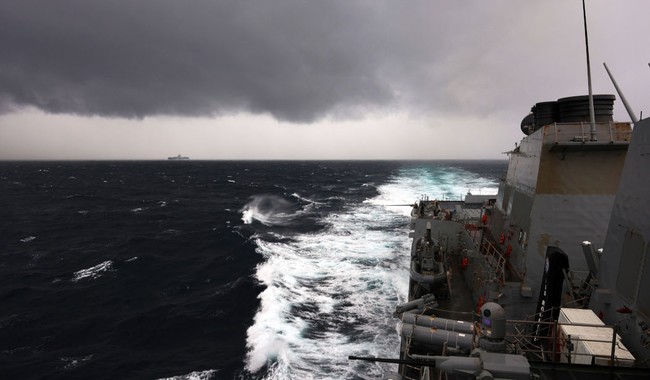
Short summary: President Donald Trump launched “Project Freedom” to help commercial vessels transit the Strait of Hormuz, CENTCOM detailed the military support and denied Tehran’s claim it struck a U.S. ship, and U.S. assets will position to protect shipping while avoiding unnecessary escalation.
President Donald Trump announced that the United States would help ships stuck in the Persian Gulf transit the Strait of Hormuz, calling the effort “Project Freedom” and describing it as a “humanitarian gesture.” The idea is straightforward: facilitate safe movement for commercial vessels and make clear that hostile acts will be met with force. Trump’s warning to the Iranian regime is simple and direct — try to interfere and face consequences. That clarity matters when global energy flows and regional stability are on the line.
U.S. officials have described Project Freedom as a coordinated effort involving governments, shipping companies, and insurers to clear a path for vessels to exit the region. The initiative blends diplomatic work with military positioning so merchant captains have options and up-to-date information about safe routes. CENTCOM emphasized the mission will “restore freedom of navigation for commercial shipping through the Strait of Hormuz,” signaling a defensive posture tied to robust capability. The goal is to reduce the incentive for Iran to believe it can drive up costs or block trade without pushback.
CENTCOM spelled out significant resources that will support the operation, including guided-missile destroyers, more than 100 land and sea-based aircraft, multi-domain unmanned platforms, and up to 15,000 service members. That scale is meant to deter attacks while avoiding a direct escort posture that would invite confrontation. U.S. forces will be “in the vicinity” of shipping lanes to offer information and rapid response options if Iran acts aggressively. It’s an approach built to protect the flow of oil and commercial goods without recklessly creating targets.
There are practical routes ships can take, and some vessels have already made it through hugging the Oman coast, a sign that not every corridor is mined or under threat. With coordination, merchant ships can signal U.S. forces, alter transmissions, and take routes that reduce exposure to Iranian mines or missile threats. The U.S. can provide situational awareness and cover that’s harder for Tehran to hit quickly or accurately. That mix of technology, positioning, and diplomatic backing increases the odds of safe passage.
CENTCOM publicly denied a claim from Iranian sources that the regime struck a U.S. vessel near Jask, calling the story falsehood and propaganda. CENTCOM spokesman Cpt. Tim Hawkins told media outlets bluntly, “They made this up. It’s not true.” Iran’s semi-official outlets initially floated the report, saying two missiles hit an unidentified U.S. ship, but no corroborating evidence has appeared. CENTCOM’s denial matters because misinformation can escalate confusion and create pressure for rash responses.
Officials described a new Maritime Freedom Construct intended to pair diplomatic action with military coordination, and they said the mission is essential because roughly a quarter of the world’s seaborne oil trade and large volumes of fuel and fertilizer move through the strait. CENTCOM commander Adm. Brad Cooper is quoted as saying, “Our support for this defensive mission is essential to regional security and the global economy as we also maintain the naval blockade.” Those are not empty words; they underline how critical the corridor is for markets and allies.
The military support will not necessarily translate into physical escorts alongside every tanker, but presence, intelligence sharing, and the ability to respond rapidly are the core offerings. That reduces the chance U.S. ships become sitting targets while still providing meaningful protection for commercial traffic. For merchant captains, the choice to accept assistance may come down to risk tolerance and whether they want to rely on U.S. coordination. The administration is making the option available and making clear the price of aggression.
Tehran’s past behavior shows it will try propaganda aimed at sowing doubt and fear, hoping to deter commercial movement and boost leverage. Project Freedom takes that gamble away by making commercial transit predictable and defensible, and by signaling that the United States will back up commercial freedom with credible force. If Iran wants to test resolve, it will find a prepared opponent and a global economy unwilling to let its arteries be choked off. The strategy is designed to defend commerce and degrade Tehran’s ability to weaponize the strait.
Success depends on ships taking the help and on allied and commercial partners trusting U.S. coordination, but the plan shifts initiative away from the regime in Tehran. It also creates pressure on Iranian leaders by keeping oil moving and stabilizing markets. The best outcome is commercial traffic restored without a wider shooting war, and the United States has signaled it will work to make that happen while remaining ready to respond if Iran escalates.
The mission, directed by the President, will support merchant vessels seeking to freely transit through the essential international trade corridor. A quarter of the world’s oil trade at sea and significant volumes of fuel and fertilizer products are transported through the strait.
“Our support for this defensive mission is essential to regional security and the global economy as we also maintain the naval blockade,” said Adm. Brad Cooper, CENTCOM commander.
Last week, the U.S. Department of State announced a new initiative, in partnership with the Department of War, to enhance coordination and information sharing among international partners in support of maritime security in the strait. The Maritime Freedom Construct aims to combine diplomatic action with military coordination, which will be critical during Project Freedom.
U.S. military support to Project Freedom will include guided-missile destroyers, over 100 land and sea-based aircraft, multi-domain unmanned platforms, and 15,000 service members.
Add comment