
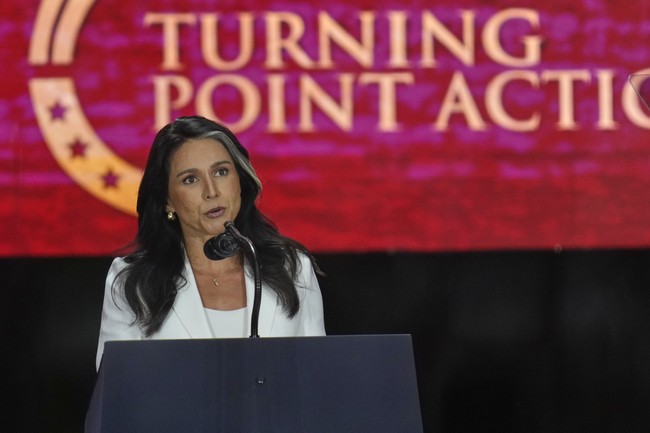
Tulsi Gabbard, now serving as Director of National Intelligence, used a high-profile speech to warn Americans that radical Islamist ideology is the foremost threat to liberty and Western civilization, urging renewed focus on defending free speech, the Constitution, and the values that underpin the nation.
At a conference with a heavily engaged audience, Gabbard framed Islamist ideology as a political force, not merely a collection of isolated attacks. She argued this ideology seeks to reshape laws and societies, which makes it fundamentally at odds with individual liberty and the principles in the Constitution.
“There is a threat to our freedom that is not often talked about enough, and it is the greatest near and long-term threat to both our freedom and our security, and that is the threat of Islamist ideology,” she said, and the crowd responded loudly. Her words were delivered in a tone meant to wake Americans up to an internal and external challenge that too many leaders have downplayed.
Gabbard contrasted her approach with her predecessor’s focus on domestic threats at home, suggesting a shift back to confronting ideologies that directly target Western freedoms. From a Republican vantage point, this is a welcome change: national security demands clarity and naming the threat plainly so policy can follow.
She described Islamist ideology as propagated by people whose goals are incompatible with the Bill of Rights and whose doctrine rejects the idea of inalienable rights. That framing keeps the problem squarely political and ideological rather than merely criminal, forcing policymakers to consider legal and cultural responses as well as law enforcement ones.
Gabbard gave concrete examples to show this is not theoretical. She pointed to municipalities and communities where officials have signaled preference for implementing Islamic principles in local governance and mentioned regions overseas where traditional public celebrations have been curtailed for security reasons.
“It is propagated by people who not only do not believe in freedom, their fundamental ideology is antithetical to the foundation that we find in our Constitution and Bill of Rights, which is that our Creator endowed upon us inalienable rights, the right to life, liberty, and the pursuit of happiness,” she warned, repeating the constitutional language that anchors the American argument against coercive ideologies. That invocation of founding texts is purposeful: it reminds citizens that this is a defense of the basic American bargain.
She also pointed to organizations and events that, in her view, are attempting to use legal and political channels to advance Sharia principles in the United States. Those comments sparked audible disapproval from some in the crowd, but they were meant to emphasize the point that this is an active political movement, not a distant threat.
Later in the speech she labeled specific places where she sees Islamist clerics and recruiters working to influence young people, and warned that some Western countries are adjusting public life in response to security threats tied to this ideology. The Republican argument here is pragmatic: if a culture or ideology undermines individual liberty, leaders must respond decisively to protect citizens and institutions.
Gabbard laid out a three-part approach to counter the threat: defend free speech, protect the Constitution, and elect leaders who actively uphold American values. That strategy is straightforward and actionable, and it fits a conservative posture that prioritizes civic cohesion, legal fidelity, and firm national defense.
She reminded listeners that liberty requires active defense: a free society that refuses to defend itself invites the erosion of freedoms it claims to protect. That message appealed to the conservative instinct to preserve institutions rather than relativize or dilute them in the name of accommodation.
The Director argued that the danger comes from both violent extremism and from political movements aiming to normalize incompatible legal systems. This dual character—terrorism plus political influence—means responses must be layered: intelligence and law enforcement, cultural clarity, and electoral choices all matter.
Gabbard’s speech was blunt and unapologetic, and it landed as a challenge to elected officials who have been reluctant to confront ideological threats directly. From a Republican perspective, leadership means naming threats and mobilizing civic resources to defend the Constitution and individual liberty without equivocation.


Add comment