
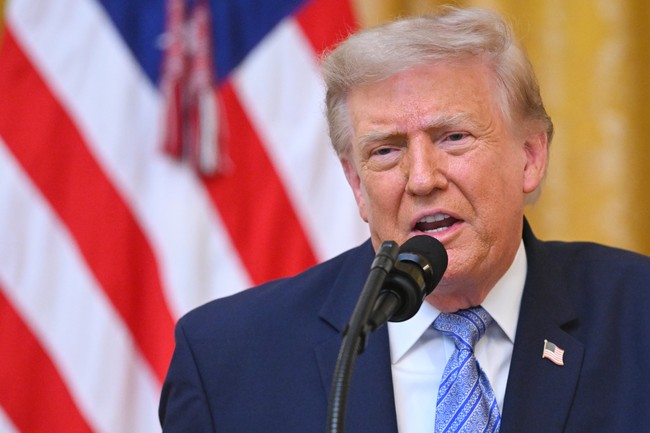
President Donald Trump hosted Lebanon’s president at the White House and faced pointed questions about Iran, Hezbollah, and America’s posture in the Middle East. His answers were blunt, stressing military readiness, long-term damage already inflicted, and a willingness to talk to adversaries if it served American interests.
The visit put the spotlight on Iran’s regional behavior and its proxy networks, particularly in Lebanon. Trump made clear that any Iranian nuclear activity would be met with forceful U.S. response, framing past actions as decisive blows that set Iran back for decades. That message carried a confident, take-no-nonsense tone: the United States has tools and the will to use them, and those options remain on the table.
When pressed about specific targets, the president did not soften his stance. He warned explicitly about striking any facility tied to nuclear efforts and described long-term damage already done, saying, “Now, nobody knows except the Iranians, about the damage that we’ve done to them. We have done damage that will take them 20-25 years for them to recover from. So, if we left tomorrow, we had a big success. But we’re not leaving tomorrow.” Those are not just rhetoric lines; they communicate a strategic posture meant to deter further escalation.
https://x.com/RapidResponse47/status/2079594136139673842
He doubled down with a follow-up claim meant to underline both capability and restraint. “If we left today, it would take them decades to rebuild. And I don’t believe they could ever rebuild, and honestly, they haven’t seen anything yet. We’ve been nice. We’ve been nice.” That phrasing blends warning with swagger, signaling that restraint so far has been deliberate rather than a lack of means.
Trump also opened the door to unusual diplomacy by saying he would speak with Hezbollah if it served U.S. interests and if Lebanon’s president requested it. He framed outreach as pragmatic: dialogue with unsavory actors can sometimes reduce violence and clarify intentions, but it does not mean trust. That practical, transactional approach is consistent with a strategy that prefers clarity and leverage over moralizing isolation.
The president explained his willingness to talk plainly: “I would speak to Hezbollah, yeah. I speak to everybody. I’ll speak to people that a lot of people think I shouldn’t speak to, and things work out. (inaudible questions) I will say this; if the president (of Lebanon) wanted me to speak to Hezbollah, you know, he’s lived with Hezbollah for a long time. And if the president wanted me to speak to Hezbollah, I would.” Those words underline an appetite for direct lines that can de-escalate or extract concessions.
At the same time, the message to Hezbollah and Iran was unmistakable: talking comes with consequences if hostile actions continue. The president and his Pentagon team made clear that attacks on commercial shipping or other provocations will be met with heavy force. That mix of diplomacy and credible military threat is designed to make adversaries calculate the cost of escalation before they act.
The defense secretary reiterated the tough stance, describing a sustained campaign of pressure against Iran’s capabilities. “Iran’s been given every opportunity to negotiate. To show that they’re reasonable on the Strait of Hormuz. But, if they’re going to shoot at commercial shipping, the we’re going to hit them, as the president said, ten times harder. Which every night, we’ve been degrading them further, and further. And the president has all the options necessary. If they want to talk, they can talk. Otherwise, they can deal with the War Department, and we’re ready.” That quote emphasizes enforcement backed by operational action.
The administration’s narrative is straightforward and unapologetic: deterrence backed by demonstrated damage is preferable to open-ended, ambiguous engagement. By highlighting both the scale of actions already taken and the continued readiness to strike, the president seeks to reassure domestic audiences and to signal adversaries that patience has limits. This posture aims to protect American interests with muscle and to keep diplomatic avenues available when they yield results.
Throughout the exchange, the president repeatedly framed policy in transactional terms, placing American security and leverage first. Talking with adversaries is an option, not a concession, and strength underwrites any negotiation. That combination of blunt language and operational preparation defines the administration’s approach as portrayed during the White House session.

Add comment