
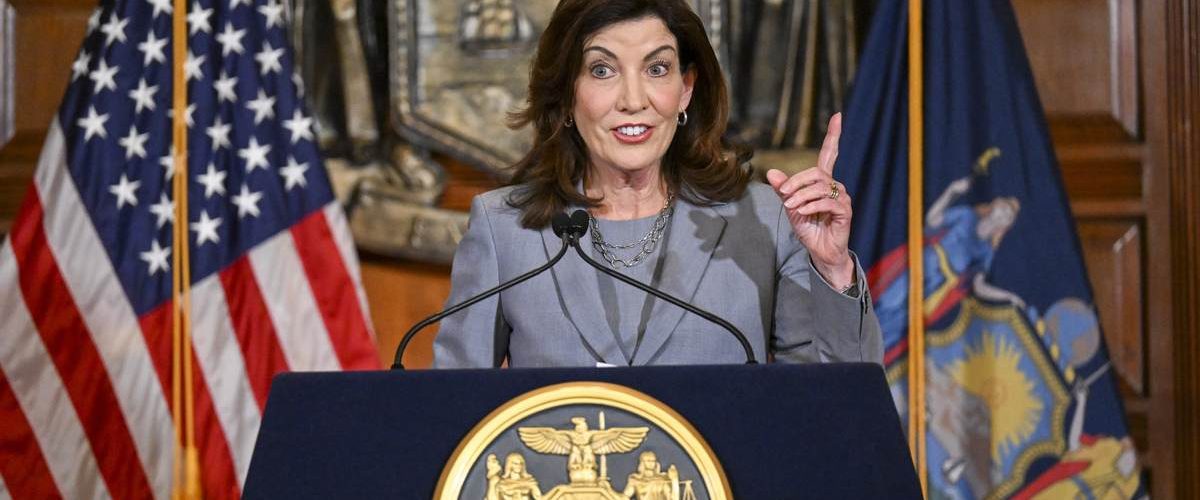
New York Governor Kathy Hochul donned a headscarf at the Islamic Cultural Center of New York, prompting sharp conservative criticism and mocking reactions from public figures who see the move as political pandering ahead of a competitive governor’s race.
Hochul visited the Islamic Cultural Center in Upper Manhattan and was filmed removing her shoes and covering her hair with a scarf, an act some called a hijab and others described more cautiously as a headscarf. The decision drew immediate attention because it came close to the 25th anniversary of 9/11 and in the city where that anniversary still carries heavy symbolism. Observers on the right argued the gesture looked less like outreach and more like calculated pandering to win votes.
Conservative commentators pointed out a tension: the same cultural appropriation the Left condemns from others seems acceptable when done by Democrats for votes. That critique framed Hochul’s scarf as a performative act rather than a sincere sign of solidarity. It fed into a broader narrative that Democrats shift positions and appearances based on which voters they are trying to impress.
Kyle Becker’s take suggested a pattern among Democratic officeholders who alter their public persona to appeal to specific constituencies. Becker wrote that Hochul “readily jettisoned her feminist garb and adopted the Muslim one to impress an audience of New York City Zohran Mamdani’s friends.” That language captured the view among critics that the move was transactional. The exchange inspired quick, punchy responses online from cultural figures and reality-TV personalities.
Former Los Angeles mayoral candidate Spencer Pratt summed up a lot of sentiment with a short, sharp social-media reaction that circulated widely after the incident. The clip and commentary amplified the perception that Hochul’s actions were theatrical and aimed at a particular voting bloc rather than reflecting a long-held commitment to the community. Conservatives argue that voters can spot when a politician is acting for applause rather than out of principle.
President Trump weighed in, calling attention to the optics and the political stakes while labeling Hochul “the Worst Governor in the Country.” He used the episode to underscore his broader criticism of her governance, especially on local policy matters. Trump’s message stressed that such public stunts do not meaningfully change how neighborhoods feel about a leader who supports unpopular measures.
Trump’s public statement read exactly: “Kathy Hochul, considered the Worst Governor in the Country, in a recent picture working hard to get the Arab Vote, even though they can’t stand her! Congestion Pricing in Manhattan is hurting her with everybody, but especially the people for whom she wears the hijab. The whole thing is CRAZY! President DONALD J. TRUMP”
One of the big policy fights tied to this incident is Manhattan’s congestion pricing, a toll system that began on January 5, 2025, charging $9 to drivers entering below 60th Street. Conservatives highlight congestion pricing as an example of Democratic policies that disproportionately burden working drivers. Taxi drivers, rideshare workers, and delivery drivers, many of whom are Muslim, face the financial squeeze of tolls that rise again to $12 in 2028 and $15 in 2031.
https://x.com/spencerpratt/status/2094100475092021468
The demographic reality in New York’s taxi and for-hire workforce was noted by critics pointing to longstanding patterns: drivers come from a wide range of countries and communities, with sizable shares from Bangladesh and Pakistan. That background underlines why congestion pricing is not an abstract policy fight but one that hits specific communities in the wallet. The argument from the right is straightforward: gestures at cultural centers do not offset economic pain caused by policy choices.
Republican nominee for governor Bruce Blakeman called the episode tone-deaf and emblematic of a politician willing to change messaging to chase votes. Blakeman’s comments emphasized consistency and principle as qualities New Yorkers deserve in a governor, framing Hochul’s scarf moment as a failure in both. His remarks were quick, pointed, and designed to connect with voters who feel policies like congestion pricing and public-safety issues are being ignored.
Blakeman said: “Kathy Hochul will say whatever she needs to say and become whoever she needs to become when there are votes on the line. Less than two weeks before the 25th anniversary of 9/11, this kind of political pandering is especially tone-deaf.” New Yorkers deserve a Governor with principles that don’t change depending on the audience.
The episode illustrates how symbolic acts can backfire when they are perceived as opportunistic, especially in a closely watched state contest. For conservatives, Hochul’s scarf provides a vivid example of why consistent policy and tangible action matter more than photo ops. The conversation now centers less on the gesture itself than on how voters interpret authenticity versus spectacle in the run-up to the election.
Add comment