
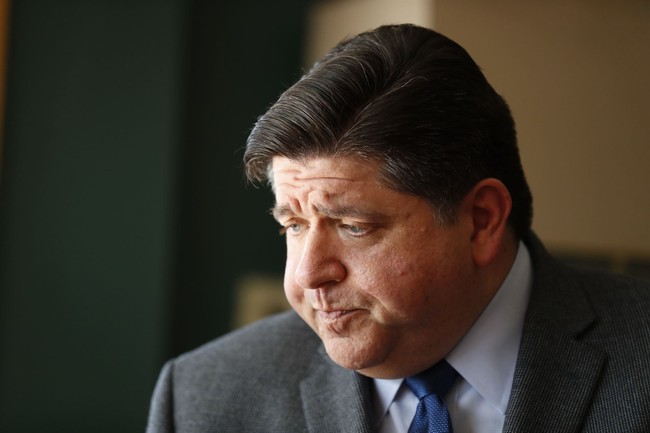
Illinois Governor J.B. Pritzker has pitched a $56 billion budget to show steady stewardship, but the numbers — slow job growth, huge pension liabilities, tiny surpluses, and fragile federal funding — tell a different story about fiscal health and political priorities.
Pritzker has spent the past year raising his national profile and presenting himself as a capable executive ready for higher office. The new budget is meant to bolster that image, yet beneath the headlines the fiscal picture raises serious questions about whether Illinois is headed toward stability or prolonged strain.
The state’s economic forecast offers little to brag about, with projections showing Illinois trailing the national growth rate. Moody’s Analytics warns that “Illinois’ economy will underperform the Midwest and the United States in the coming year… employment will be essentially unchanged.” Stagnant job numbers in a state losing residents is not a selling point for someone touting executive competence.
Illinois is burdened by a massive pension shortfall that drives policy choices and constrains flexibility. The unfunded liabilities hover around $145 billion, the largest in the nation, and required contributions next year are eye-popping. Those pension obligations are not optional line items; they structurally consume revenue that could otherwise be directed to infrastructure, public safety, or tax relief.
“The proposed fiscal year 2027 budget includes more than $10.7 billion in contributions to the state’s underfunded retirement systems.”
That mandatory payment is baked into the budget and squeezes out discretionary priorities. Outside key mandatory categories like pensions and education, discretionary spending barely moves, leaving little room to respond to economic shocks or invest in growth. Supporters call this fiscal discipline; critics see it as survival math under the weight of prior commitments.
The proposal increases overall spending by about 1.6 percent, and discretionary growth is roughly 0.5 percent, which is effectively flat when inflation and demographic pressures are considered. A general fund surplus of $24 million on a $56 billion budget hardly qualifies as a safety net. On a budget that size, $24 million reads as a rounding error rather than a meaningful buffer.
“The administration projects a general fund surplus of just $24 million on a $56 billion budget.”
Federal funding assumptions add another layer of risk: roughly $1.7 billion in federal dollars are treated as reliable even as legal disputes and shifting federal policy place them in doubt. The budget also leans on new, narrow taxes, such as a levy on large social platforms expected to raise about $200 million. That kind of targeted revenue is volatile and unlikely to mask deeper structural issues.
Despite credit upgrades while Pritzker has been governor, Illinois still holds the lowest bond rating among states, a signal that borrowing remains costly and investor confidence fragile. A low rating isn’t just an abstract score; it affects future borrowing costs for roads, schools, and other long-term investments. For a governor pitching national leadership, persistent weak credit is a conspicuous liability.
Transparency and timely reporting are central to accountability, yet the state’s financial disclosures have been repeatedly delayed. “During the Pritzker administration, Illinois has accumulated more than 1,800 days of delayed statutory financial reporting.” Delays on that scale undermine oversight and make it harder for lawmakers and citizens to assess fiscal trade-offs in real time.
Political opponents frame the budget as evidence of misplaced priorities. House Republican leadership argues the governor focuses more on national ambitions than on fixing the state’s fiscal problems, pointing to rhetoric about affordability while the plan contains higher taxes and expanded government spending. Those criticisms are partisan, but the underlying fiscal facts stand on their own.
“For Governor Pritzker, this budget is about blame. It is clear the Governor is more focused on his presidential ambitions than delivering for Illinois families. He emphasized that everything is ‘too d*mn expensive,’ while proposing higher taxes, more spending, and expanded government. There’s nothing affordable about this budget proposal.”
Illinois taxpayers already carry one of the highest combined state and local tax burdens in the country, and this budget does little to change that reality. With job growth projected to stall, pension liabilities unmatched nationally, and borrowing costs elevated, the state faces constrained options for meaningful tax relief or investment. This pattern is not a one-year glitch but the eighth budget under the same administration.
A governor seeking national office should present tangible reform, credible improvement in creditworthiness, and momentum in the economy. Instead, Illinois still carries the nation’s worst bond rating, triple-digit billions in pension debt, and a near-term outlook of flat employment. If voters are evaluating readiness for national leadership, the state’s balance sheet matters as much as any speech.
Before embracing political messaging, careful scrutiny of the underlying fiscal data is required. The proposed budget shows how headline-level ambition can be undercut by persistent structural challenges that deserve straight talk and real solutions rather than slogans.

Add comment