
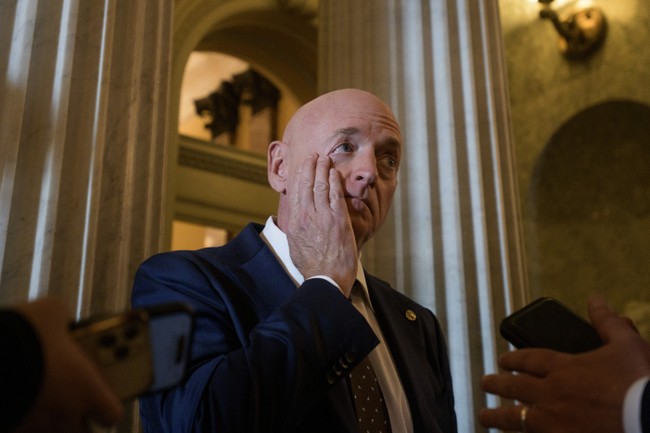
The Pentagon has escalated a preliminary review into “serious allegations of misconduct” against Sen. Mark Kelly after his role in a video urging troops to disobey orders they deem unlawful, and that move has prompted sharp pushback from defense officials who say political interference risks military cohesion and safety.
A Pentagon spokesperson confirmed Monday that the Office of General Counsel began the review and that it has now been elevated to an official Command Investigation into retired Navy Captain Mark Kelly. The escalation follows a widely criticized video in which Kelly and several Democratic lawmakers encouraged service members to consider refusing orders they believe are illegal.
The Department of War statement made clear the matter is now formal: “Retired Captain Kelly is currently under investigation for serious allegations of misconduct. Further official comments will be limited to preserve the integrity of the proceedings.” That line signals the investigation could lead to significant administrative or disciplinary remedies.
Defense officials argue there is a stark difference between manifestly illegal orders and those that are merely debatable, and they warn that injecting political rhetoric into the chain of command creates dangerous confusion. “The problem is that there is a vast difference between manifestly illegal orders and those whose illegality is debatable. The latter of which, refusing to obey an order one feels personally questionable, is itself illegal, under the Uniform Code of Military Justice (UCMJ).” That exact passage has been cited repeatedly by critics worried about precedent.
A Department of War notice explained the range of possible consequences being considered, from administrative measures to a court-martial, depending on what the Command Investigation uncovers. An “official Command Investigation” carries broader authority, including the ability to take sworn testimony and subpoena evidence, which suggests the department expects to probe facts more deeply than during a preliminary review.
Officials emphasize that orders clouded by personal judgment calls can cause hesitation, mission failure, and even casualties, making the chain of command sacrosanct in operational settings. “In the military, vague rhetoric and ambiguity undermines trust, creates hesitation in the chain of command, and erodes cohesion,” Secretary of War Pete Hegseth wrote on X, arguing that there are already established procedures for handling unlawful orders without political actors stirring doubt.
Kelly has pushed back publicly, framing the investigation as a political weapon. “It should send a shiver down the spine of every patriotic American that the president and secretary of defense would abuse their power to come after me or anyone this way,” he wrote on social media, condemning what he called an overreach by the current administration.
The group that participated in the video has been labeled harshly by some defense figures, with Hegseth calling them the “seditious six” for their role in urging service members to consider defiance of orders. That label and the ensuing rhetoric have only intensified partisan angles around the investigation and raised questions about how political messaging intersects with military discipline.
Legal authorities point to the Uniform Code of Military Justice as the guiding framework for assessing conduct, noting that refusal to follow lawful orders is itself punishable and that only clear, manifestly illegal commands justify disobedience. Command Investigations are meant to sort those gray zones by collecting testimony and material evidence to determine whether misconduct occurred and what penalties might follow.
Critics on the right argue that elected officials who involve themselves in military affairs with partisan messaging risk weaponizing troops for political ends and weakening national defense. They insist that preserving a single, accountable chain of command is essential for combat effectiveness and troop safety, and that political interventions that blur legal lines deserve scrutiny.
Supporters of Kelly counter that encouraging service members to understand their legal obligations is a form of oversight and conscience protection, but that distinction has not quieted concerns among military leaders. The investigation will test where the line is drawn between legitimate civic guidance and conduct that crosses into improper influence on the armed forces.
The escalation to an official Command Investigation means this matter will be handled with greater formality, and investigators will have tools to compel testimony and documents. For now, both sides are digging in: defense leaders stress discipline and order, while Kelly and his allies frame the probe as politically motivated and an attack on free expression.
A command-level review of this kind rarely produces quick answers, and the process will likely play out steadily as evidence is collected and legal standards are applied. Observers on both sides are watching closely because the outcome could set a precedent on how elected officials may or may not engage with uniformed personnel in politically charged contexts.
A Department of War explained that Kelly’s potential “serious” misconduct was under consideration for punishment, including a court-martial or other “administrative measures.”
An “official Command Investigation” is an upgrade that analyzes more serious or substantiated allegations, granting it broader powers, such as the ability to take sworn testimony.

Add comment