
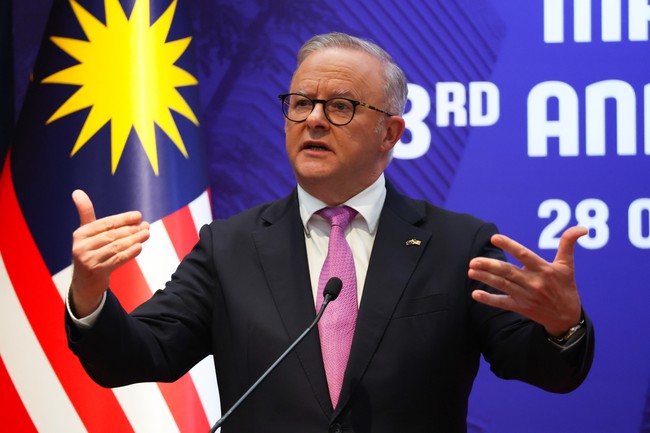
The Australian prime minister publicly acknowledged that the Bondi Beach attackers were “inspired by a terrorist organization, by ISIS,” after a deadly strike on a Hanukkah gathering, and that admission exposes deep disagreements about motive, policy and national security strategy. This piece reviews the key statements from the press conference, the visible evidence recovered, and the political argument over how Australia and similar Western nations handle Islamist radicalization and border policy.
Prime Minister Anthony Albanese told reporters that investigators had found evidence pointing to ISIS influence, including flags discovered in the attackers’ vehicle, and he linked that evidence to motive. For someone who initially avoided naming the victims’ faith in his earliest comment, this was a notable shift in tone and an acknowledgement that extremist ideology played a role. The press conference made clear authorities are treating inspiration by ISIS as a line of inquiry, even as debates continue about how settled the motive is. Public reaction has ranged from relief that leaders finally said the words to anger that it took so long for them to connect ideology to action.
Physical symbols matter in these cases, and the presence of an ISIS flag in the windshield is not a subtle clue; it is a direct signal from perpetrators about whom they claim to represent. Citizens expect investigators and leaders to name such signals and to tie them to existing patterns of Islamist-directed violence. When leaders hesitate or use cautious language, it feeds a narrative that governments are unwilling to confront ideological threats head-on. That hesitation has political consequences, including calls for tougher border measures and clearer de-radicalization strategies.
Below is what Albanese said at the press conference, quoted verbatim:
What we know already is, as part of the investigation, is it goes to motive and what is being investigated, as the commissioner has said, is that it would appear, there’s evidence that this was inspired by a terrorist organization, by ISIS.
Now, some of the evidence which has been procured, including the presence of Islamic State flags in the vehicle that has been seized, are a part of that.
Radical perversion of Islam is absolutely a problem. It is something that has been identified globally as a problem as well. ISIS was created by an evil ideology that has been called out not just by the Australian government but globally as well.
That language acknowledges ISIS as an ideological motivator, but critics argue it does not go far enough to address the broader problem of Islamist violence. From a conservative perspective, describing such attacks as a “radical perversion” makes the threat sound like an aberration rather than an enduring ideological struggle. There is frustration with leaders who suggest integration and understanding as a cure, when history and recent attacks point to persistent risks. Concrete measures, critics say, should follow admission of ideological influence.
The attackers had reportedly come to the attention of Australian authorities years earlier, and were interviewed in 2019 before being judged not a threat. That history raises hard questions about the thresholds and priorities used by security services. If ties to known extremists drew scrutiny then, why did subsequent monitoring not prevent escalation or further radicalization? These gaps fuel calls for reforms to intelligence sharing, risk assessment, and preventative action that prioritize public safety.
ISIS messaging continues to call for attacks on Jews and Christians in civilian settings, and that guidance matters to those studying the threat. The article preserves this direct quotation from an ISIS spokesman, included here exactly as originally stated:
“Lions of Islam: Chase your preys whether Jewish, Christian or their allies, on the streets and roads of America, Europe, and the world. Break into their homes, kill them and steal their peace of mind by any means you can lay hands on. Understand that you are the arm of the Islamic State hitting in the kuffar’s homelands, and are avenging the Muslims in Palestine, Iraq, Sham, and other Muslim countries…
“Intentionally seek easy targets before hard ones, civilian targets before military one, religious targets like synagogues and churches before others, for this will satisfy the soul and will demonstrate the characteristics of the battle, as our battle with them is a religious one and we kill them wherever we come upon them in response to Allah Almighty’s command.”
Policymakers who insist on symmetrical concern for supposed threats from both “right-wing” and Islamist extremism risk misallocating resources that should focus on the immediate danger. When authorities treat all ideologies as equally probable culprits, it obscures patterns that intelligence and law enforcement must track. A clear-eyed approach means naming the enemy when evidence points to it and directing preventive work where it will do the most good.
Public confidence depends on consistent, candid leadership that calls out ideological drivers, tightens surveillance on credible leads, and enforces measures that protect vulnerable communities. Observers and commentators are watching whether this moment prompts policy changes or becomes another occasion for cautious language without follow-through. The stakes are high: people expect governments to learn from prior warnings and to act decisively to prevent future attacks.
The press conference video includes Albanese’s remarks roughly 25 minutes in and remains a central piece of record for investigators and the public.
Media coverage has highlighted the timeline of prior interviews with the suspects and suggested ties to past extremist figures in the region, generating debate about accountability and system failures.
Those who want stronger border controls, tougher monitoring, and clearer categorizations of ideological threats see this admission as confirmation of long-standing concerns about Islamist terrorism in Western countries. The conversation over appropriate policy responses will continue, especially as investigators work to confirm motive and track any networks or influences tied to the attackers.



Add comment