
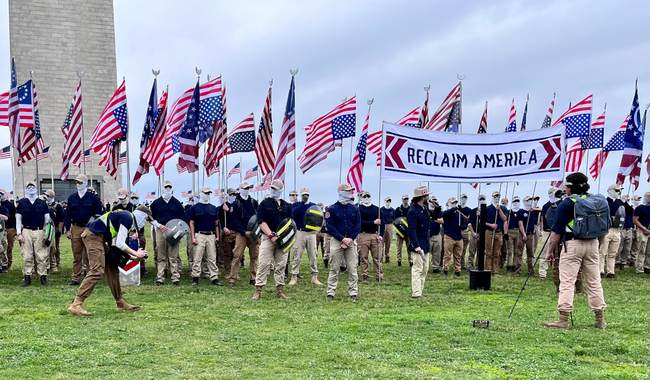
On the 250th anniversary weekend, a coordinated appearance by hundreds of masked members identifying as Patriot Front drew outsized media attention in Washington, D.C., prompting heated reactions from politicians, pundits, and social feeds while the actual on-the-ground events remained peaceful and uneventful.
Hundreds of Patriot Front Demonstrators Hit DC’s July 4 Celebration and Minds Are Blown
On Independence Day, a group traveling in matching blue shirts, khaki pants, tan caps, and face coverings moved through Metro stations and into the city, drawing cameras and column inches. Reporters and politicians framed the action as a major public safety and political story, linking the presence of these demonstrators to broader debates about extremism. The scene was visually striking, which fed a media narrative built more on optics than on immediate incidents. Despite the spectacle, no violent clashes or riots took place during their movement through public transit and downtown areas.
https://x.com/Reuters/status/2073519720955777431
The organization at the center of the coverage, Patriot Front, traces its roots back to the aftermath of the 2017 Charlottesville events and to a rebranding of a prior group. Its uniformed look and choreographed presence give the impression of a campaign staged for attention rather than a spontaneous protest. Observers pointed out how coordinated logistics—rentals, transport, and deliberate anonymity—made the appearance feel engineered. That choreography raised questions about who is behind the operations and what the goals truly are.
Media outlets and politicians quickly demanded denunciations and clarifications, setting off a predictable cascade of statements and counterstatements. One voice captured that wave of condemnation in stark terms: “We cannot be silent in the face of white nationalists marching in our nation’s capitol,” followed by, “From Massachusetts to Washington D.C. hatred and bigotry have no place here.” Those lines encapsulated a common political posture: publicly rebuke and make distance from such groups. Yet the calls for repudiation also revealed how political theater can overshadow practical inquiry.
The footage and photos from the day show a group that appears organized but not inherently combative. Close inspection suggested many participants lacked the tattoos, scars, or mannerisms often associated with street-fighting subcultures. Instead, they looked like young adults in coordinated outfits whose public role seemed focused on being seen. That contrast prompted analyses comparing them to other, more visibly confrontational outfits that have a track record of street clashes and property damage. The lack of altercations, arrests, or dramatic encounters complicated the narrative that this was an imminent threat to public order.
Critics asked why investigators and reporters did not dig deeper into membership, funding, and affiliations when similar organizations on the other side of the spectrum are routinely scrutinized. Questions surfaced about how such a sizable presence moved through a major metro area without drawing more immediate law enforcement intervention or community pushback. The apparent absence of doxxing, exposés, or follow-up profiles stood out to those tracking the story. That absence fed speculation about the group’s real capabilities and intentions.
Officials and pundits sought to force a clear political posture from national figures, suggesting silence equals tacit support. That logic was pushed hard across cable and social platforms, pressuring a range of actors to denounce the group publicly. Yet some public officials pushed back against the demand for automatic repudiations of people or groups not affiliated with mainstream political movements. The debate exposed a tension between symbolic responses and the need for measured, evidence-based actions by authorities.
Video clips and subway photos became the core artifacts of this episode, shared and re-shared as shorthand for a broader cultural fight. Viewers debated what the images actually proved: coordinated intimidation, peaceful demonstration, or staged theater. One short video circulated widely and sparked fresh commentary about the demographics and apparent social backgrounds of participants. That clip became a central piece of evidence for those arguing the group was not what the initial headlines claimed.
Observers also compared this episode to episodes of unrest tied to other movements, noting differences in behavior, outcomes, and official responses. While some protest movements have resulted in arrests, property damage, and sustained clashes, this July 4th appearance did not follow that pattern. That discrepancy led analysts to question the consistency of enforcement and the priorities of those who decide which events receive intensive scrutiny. The result was a conversation as much about media framing and political incentives as it was about the group itself.
Social media amplified personal reactions, and a few images drew strong emotional responses from users worried about fellow passengers on the subway. One widely shared post focused on a lone Black woman aboard the train, and commenters debated whether the scene constituted intimidation or simply an uncomfortable optics moment. Many viewers noted that, despite the uneasy visuals, the woman was neither harmed nor confronted. These nuances got lost in the rush to assign meaning.
As the day closed, the most concrete takeaway was that a large, uniformed group had managed to stage a silent, visually striking presence in the capital without triggering the kinds of violent clashes that make headlines. That outcome left space for discussion about motive, management, and the power of visual spectacle in modern politics. It also highlighted how quickly political narratives crystallize around images before the facts are fully examined. The episode will likely be cited in future debates about protest policing, media coverage, and how political actors handle fringe groups.
For now, the July 4 appearance remains a provocative example of how coordinated public displays can dominate national conversation even when the immediate public safety concerns are limited. The images and the reactions they generated will stick in public memory, regardless of the unanswered questions about organization and intent. Where this goes next depends on whether journalists and investigators follow up on logistics, funding, and networks or allow the moment to fade as another viral media event.


Add comment