
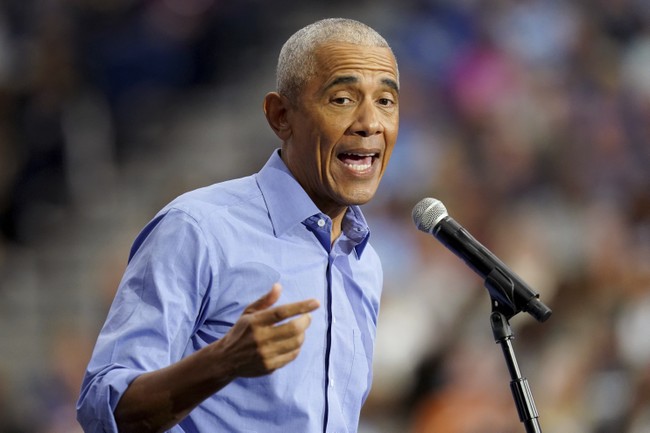
Barack Obama campaigned for Abigail Spanberger in Virginia while sharing a stage with a controversial figure, and this piece takes a skeptical, Republican viewpoint on what that says about the Democrats’ judgment and priorities. It covers Obama’s pitch to voters, the presence of Attorney General candidate Jay Jones, claims about policy failures, comparisons to Trump projects, and how these appearances fit into broader campaign dynamics in Virginia and New Jersey. The article keeps the key quotes intact and places the original embed tokens where they appeared.
Barack Obama showed up to a Spanberger rally and tried to sell a message of civility and constructive debate. He told the crowd that “she knows that if we want to make progress on the things that we care about, we have to be able to disagree without calling each other nasty names or demonizing each other.” That phrasing sounds good until you notice who else he shared the stage with that day.
Also speaking at the rally was Jay Jones, the Democratic attorney general candidate whose text scandal has drawn serious attention. Seeing Obama praise civility while standing beside Jones raises questions about consistency and priorities within the party. Supporters might shrug, but voters paying attention see a mismatch between message and company.
That kind of mismatch is more than cosmetic; it speaks to how Democrats pick their champions even when controversy follows them. The problem is not simply one rogue speaker but a pattern where questionable choices are tolerated if they serve electoral aims. From a Republican perspective, this underscores a lack of principles when party loyalty outweighs accountability.
Obama then shifted to critiquing Republican governance, accusing opponents of weaponizing institutions and failing to act where needed. He declared, “We’ve got a president who thinks it’s okay to use the Justice Department…to go after his political opponents,” and recycled familiar lines about congressional dysfunction and rising healthcare costs. Those lines land differently when you factor in real policy histories and who actually drove major reforms.
Consider the Obamacare legacy: premiums and subsidies became central problems under Democratic leadership, yet the talking points often redirect blame. The article notes that “Healthcare premiums for millions of people are about to double or even triple next year. Meanwhile, the government is shut down, and the Republicans who currently are in charge of Congress, they’re not even pretending to solve the problem. They have not even been showing up to work. Not in session. Where are you? What are you doing?” That criticism of Republicans rings hollow when Democrats themselves authored the structures that created the current market distortions.
Obama’s swipe at Trump for allegedly focusing on cosmetic projects also drew fire. He accused the former president of “paving over the Rose Garden” and “gold-plating the Oval Office, and building a $300 million ballroom.” Critics respond by pointing out the Rose Garden work used practical solutions like limestone tiles to prevent soggy event spaces and that private funding played a role in adding event facilities. From this side of the aisle, that kind of pragmatic improvement is something to praise, not to weaponize for political theater.
The larger pattern is familiar: Democrats deploy moralizing rhetoric while defending or minimizing the missteps of their own. Seeing high-profile figures share platforms with controversial associates only amplifies that perception. Voters who expect accountable leadership will notice when words about unity and decency sit side-by-side with choices that suggest otherwise.
Beyond Virginia, Obama’s campaign schedule took him to New Jersey to back another Democrat, signaling national investment in close state-level contests. Those races are tight, and Republicans see openings where Democratic messaging and candidate choices leave questions. The presence of national figures in local fights is less persuasive if the local choices undermine the national message.
The broader political landscape also reflects shifts in voter behavior that worry Democrats, at least according to Republican analysts. Gains among groups like black and Hispanic voters in certain contests suggest the political map is not locked into old assumptions. From a conservative viewpoint, that trend is a sign that practical, results-oriented messaging can resonate even in places long considered off-limits.
Campaign events are theater, but they also reveal priorities. Bringing a former president to rally for a candidate is normal, yet inviting him to stand alongside someone enmeshed in scandal invites scrutiny. For voters who care about consistency and responsibility, actions matter as much as slogans, and appearances like this one make an argument about where the party’s true loyalties lie.
At the end of the day, the choices made by Democratic leaders and their candidates will be judged at the ballot box. If voters prioritize accountability and coherent messaging, the contrast between stated values and actual alliances could influence outcomes in Virginia, New Jersey, and beyond. The campaign trail is where those contradictions get noticed, and this rally offered a clear example.


Add comment