
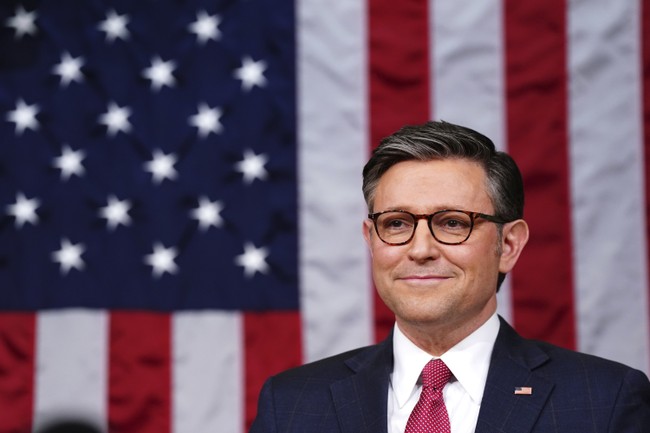
Mike Johnson pushed back hard when a House Democrat staged a theatrical protest outside his office, turning a predictable stunt into a political own-goal and exposing how easily Democrats fall back on drama instead of policy. This piece walks through the confrontation, earlier similar incidents, Johnson’s clever rebuttal using looping clips, and how the optics favored the speaker while the Democrat organizer came off as performative and unprepared.
House Speaker Mike Johnson has become the face of Republican resistance during what his office and allies call the Schumer Shutdown, and he’s leaned into that role with blunt, unapologetic messaging. Democrats have tried to stage protests outside his office to score headlines, but those stunts keep backfiring when Republicans respond with facts and a sense of humor. The latest incident made that dynamic plain: a manufactured confrontation that collapsed under its own theatrics.
Earlier this fall, Democrats staged stunts that were heavy on symbolism and light on substance, including an episode where Rep. Nanette Barragán accused a Capitol Police officer of “forcibly grabbing” her while she tore down signs outside the speaker’s door. Those moments play well for cameras but rarely change public opinion, especially when Republicans point to real policy concerns like border security and spending priorities. The conservative argument is simple: voters want results, not performance art.
The most recent stunt came from Rep. Yassamin Ansari, who set up a “change my mind” table just feet from Johnson’s office and accused the speaker of “starving” millions and “gutting healthcare.” She also floated an implication tying the speaker to a conspiracy about Rep.-Elect Adelita Grijalva and the so-called Epstein Files. The setup was designed to pressure Johnson into a confrontation, but the speaker’s team anticipated the event and turned it into a counter-message.
Johnson’s office used material they’ve displayed outside his door for weeks to respond instantly. A TV in front of the office played a loop that included Minority Whip Katherine Clark’s “leverage” quote and other Democratic statements, letting those words speak for themselves against Ansari’s claims. When Ansari’s unpaid aides had to move the table, she was left holding a sign and a narrative that now looked staged and hollow rather than urgent and credible.
The response didn’t stop at a looping clip. Johnson’s team also played Sen. Minority Leader Chuck Schumer’s line, “every day gets better for us,” to turn Democratic optimism into an admission of priorities that, from a Republican vantage, explain why Democrats pushed the nation toward a shutdown. The tactic was straightforward: use Democrats’ own words to expose the mismatch between their rhetoric and the consequences of their agenda.
Video and images from the scene amplified the contrast. Staffers moved protesters when they blocked access, and the visual of a lawmaker standing alone behind a sign didn’t match the narrative of grassroots outrage Democrats attempted to sell. Republicans saw the moment as another example of how performative protests substitute for governance — loud on camera but weak on delivery when the spotlight shifts.
Republicans framing the episode emphasize responsibility and priorities. From that perspective, Johnson isn’t just defending an office; he’s defending a broader policy position that argues Congress should focus on American citizens and secure borders before expanding federal benefits. The stunts only underscore the difference between spectacle and substance, and in this case the spectacle served to reinforce the Republican critique.
The language used by Democrats in these protests matters, because it can be repurposed in a way that undercuts their intentions. When Democratic leaders boast about political leverage or celebrate tactical wins, Republicans use those admissions to point out trade-offs and unintended outcomes. That rhetorical sleight of hand played out in real time outside Johnson’s door, to his advantage.
For voters watching, the takeaway was plain: Democratic theatricality did not move policy forward and instead highlighted the theater of modern politics. House Republicans, led by Johnson, answered with clear messaging and a willingness to make Democrats own their narratives. The end result was a political moment that strengthened Johnson’s argument and left the protest looking choreographed rather than consequential.
Editor’s Note: The Schumer Shutdown is here. Rather than put the American people first, Chuck Schumer and the radical Democrats forced a government shutdown for healthcare for illegals. They own this.
Deep fakes that’s what the Radical far left democrats have become in this Schumer shut down! None of the Democrat should be in the White house they should be trying to audition for Woke Hollywood. We don’t need theatrical shows we need the Government open! Instead of siting there doing nothing GET TO WORK!! Now those are real fighting words to the once upon a time the Democrat party!