
Sean Dunn, a former Department of Justice employee acquitted after throwing a sandwich at a federal officer in Washington, D.C., was found not guilty by a jury that deliberated roughly seven hours; his case raised sharp questions about protest, law enforcement boundaries, and the consequences for federal employees involved in political demonstrations.
The case landed in the headlines because the act itself was petty and theatrical, yet it triggered federal charges for assaulting a federal officer. On the surface, a sandwich tossed across a chaotic scene feels symbolic of protest more than a serious threat, but the government treated it seriously and pressed charges that carried significant consequences.
A former Department of Justice worker on trial for throwing a sandwich at a federal officer in Washington, D.C., earlier this year was found not guilty on Thursday.
Sean Dunn struck a U.S. Customs and Border Protection agent (CBP) in the chest with a sandwich in August. He was facing charges of assaulting, resisting, opposing, impeding, intimidating and interfering with a federal officer.
Jurors deliberated for about seven hours before reaching a verdict. After it was read, Dunn hugged his lawyers in the courtroom.
Juries exist to weigh context, intent, and justice, and in this instance the jury decided the act did not warrant criminal punishment. That outcome will rile people on every side: some will say the law was applied too lightly, others will argue the charges were politically motivated from the start. The reality sits somewhere between a silly headline and a consequential legal test.
Dunn made his own case outside the courtroom, saying, “I believe that I was protecting the rights of immigrants. And let us not forget that the Great Seal of the United States says, E Pluribus Unum,” Dunn said after the verdict was read. “That means, from many, one, every life matters, no matter where you came from, no matter how you got here, no matter how you identify, you have the right to live a life that is free.”
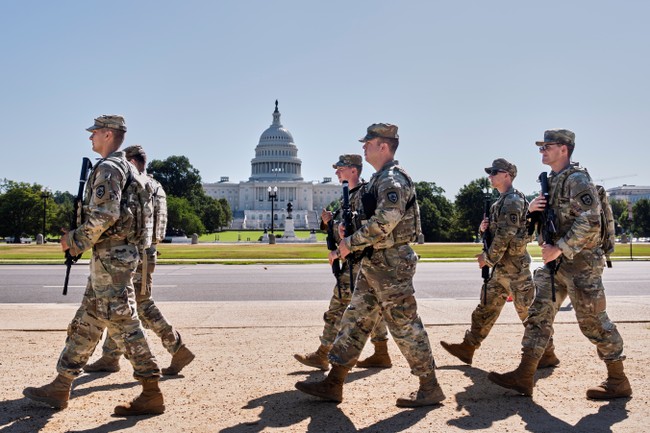
His legal team argued the throw was a political protest against the deployment of the National Guard in Washington, D.C., and not a violent assault. That defense framed the incident as expressive conduct protected by public discourse rather than as aggressive wrongdoing intended to harm, a distinction that resonated with the jury.
Conservative readers will note two significant outcomes from this episode. First, while the jury cleared him criminally, Dunn still faces the real-world fallout of losing federal employment and likely forfeiting benefits. Second, the case reflects a broader tension about how government institutions handle political dissent when the actor once served inside those institutions.
There is a bigger question for leaders and managers inside the federal workforce: how do you treat employees who cross the line into public protest while still bound by the responsibilities of their office? The balance between free expression and the appearance of government neutrality is not trivial, and agencies must weigh disciplinary and administrative responses carefully.
The episode also exposes a cultural divide about the optics of enforcement. For some, prosecuting someone for a tossed sandwich feels like overreach and an example of selective justice. For others, treating assaults on federal officers as serious sends a clear message about respect for authority and the rule of law, even when the weapon is oddly deli-themed.
Whatever one thinks of the verdict, the personal costs for Dunn are concrete and immediate: unemployment and the erosion of a federal career that once provided stability. The jury’s decision does not erase those losses, and it does not soften the public debate about protests that cross into confrontational acts against officers on the job.
I sub-pose that Mr. Dunn can now get on with his life, knowing that this legal case ended up, in the end, to be no big dill.
Public incidents like this tend to become shorthand in political disputes: a single moment gets framed as either courageous dissent or unacceptable behavior. That shorthand shortcuts the harder work of deciding how law, public safety, and political expression should interact in a free society.

Add comment