
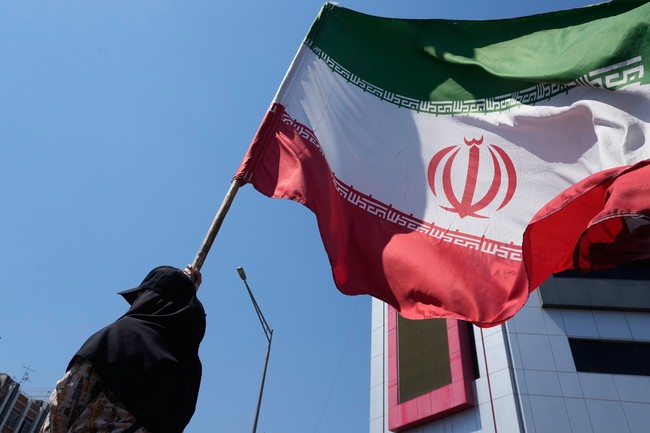
The funeral for Iran’s Supreme Leader became a noisy display of rage and threats directed at American figures, with crowd signs naming U.S. leaders and public figures as targets; what happened there raises real national security questions, concerns about Iranian influence inside the United States, and the need to take hostile rhetoric seriously.
The late Ayatollah Ali Khamenei’s funeral drew huge crowds in Iran, and footage shows demonstrators holding posters that place American leaders in their crosshairs. Some of the signs were pointed and specific, naming individuals by full name and placing them on an imagined target list. The spectacle looked less like mourning and more like a public declaration of hostility toward identifiable Americans.
On camera, the list of people singled out included President Donald Trump, conservative commentator Ben Shapiro, activist and independent journalist Laura Loomer, Miriam Adelson, Peter Thiel, Mark Dubowitz, and Senator Lindsey Graham. Observers later reported similar posters identifying Vice President JD Vance and Secretary of War Pete Hegseth at other points during the event. :
https://x.com/libsoftiktok/status/2074142637674631203
There’s an instinct to laugh these displays off as bluster or propaganda theater, but public threats matter. Nation-states with intelligence arms and proxy networks do not rely on social media bravado alone; state-directed or state-inspired violence, especially when it includes professional operatives, has a very different footprint than isolated amateur attacks. The imagery at a funeral functions as signaling, and signaling like that should be treated as intelligence, not theater.
I previously documented the risk to senior American officials, noting multiple assassination attempts against President Trump in recent years and what a professionally planned operation might look like. The distinction between amateur attempts and an operation mounted by trained, well-equipped teams is critical, and it is why public calls for violence from any quarter must be investigated and countered. The capability gap between a random attacker and a state-backed cell is large and dangerous.
Remember, we have seen three assassination attempts against President Trump: Two during the campaign and one during his second term. These were attempts by amateurs, and yet one of them almost succeeded; the president escaped a fatal shot by a literal hair’s breadth.
Any such attempt by a nation-state, with the resources of even a failed nation-state like Iran, would be very different; the attempt would be made by trained people, well-equipped, well-prepared, almost certainly working in a team of 2-3, possibly – likely – with more than one shooter. Iran has people like that, just as we do, just as any nation-state would.
There are, right now, between 20,000 and 30,000 Iranian nationals in the country illegally, having entered, mostly, across the southern border and again, mostly, during the four years of the Biden administration’s non-enforcement of the border. If one percent of those are some kind of operative, infiltrated into the United States while the border was wide open, then that makes up 200-300 possible hostile operators.
Those numbers are not idle speculation; they’re a way to frame risks. Even a small number of trained hostile actors embedded in a population can create outsized danger to leaders, to high-value targets, and to Americans abroad. We should not assume every angry sign-waver is a credible assassin, but neither should we ignore the potential pathways violence could take when hostile intent is publicly declared.
There are broader enforcement questions tied to immigration and border policy that bear on this issue. The presence of Iranian nationals in the United States—both legally and illegally—combined with porous enforcement windows creates uncertainty about who might be present and what intentions they might carry. Those conditions complicate domestic security planning and increase the workload for intelligence and homeland security agencies.
Public reaction to the funeral footage mixed derision with alarm, and both responses miss part of the point. Mockery alone does not deter motivated adversaries, and alarm without action is wasted noise. The right response is sober: collect intelligence, analyze intent, and take protective measures where warranted, while preserving civil liberties and due process for those within the United States.
At the same time, officials and agencies need to communicate clearly with the public about observed threats and the measures being taken to mitigate them. Transparency about risks, without spreading panic, helps citizens understand why security actions happen and why certain protective steps are justified. That clarity also forces policy discussions about border enforcement, vetting, and counterintelligence resources that are essential in a dangerous world.
These are not questions for theater or partisan sound bites; they are national security problems with real stakes. The images from Khamenei’s funeral were a stark reminder that hostile regimes still use public events to project threats, and those threats deserve a rational, forceful response from American institutions tasked with protecting the country.
Add comment