
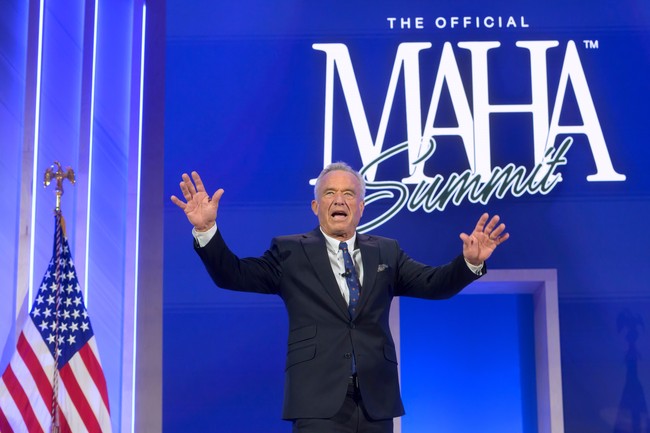
At CPAC 2026, HHS Secretary Robert F. Kennedy Jr. closed the conference with a candid review of his first year running Health and Human Services under President Donald Trump, outlining major policy shifts on nutrition, military food, baby formula, price transparency, addiction recovery, and medical training — and offering personal takes on the president’s approach to power and empathy.
Robert F. Kennedy Jr. was met with sustained applause as he addressed the CPAC crowd, framing his tenure as a year of concrete changes aimed at restoring common-sense health policy. He positioned those changes as practical corrections to decades of misguided priorities in nutrition, military feeding, and regulatory opacity. The tone was one of results over rhetoric, with Kennedy emphasizing measurable outcomes.
“Well, let me just say this: President Trump is exactly the opposite of everything that I believed him to be. And, you know, I meant, you know, I basically drank the Kool-Aid that he was this, you know, malignant narcissist, who didn’t read books, and was ill-informed. And then, you know, now I know exactly the opposite. He’s the opposite of a narcissist. He’s an empath.”
Kennedy used that surprise to underline how his time in the Cabinet reshaped his view of presidential leadership. He illustrated Trump’s command of details, describing an image of the president sketching troop deployments on an airplane placemat to make a point about policy knowledge and decision-making instincts. Kennedy argued that such hands-on engagement translates into better choices across agencies, including HHS.
“You will see that every time he talks about the Ukraine war, he talks about the casualties on both sides. You will not hear any Democrat ever talk about that. And he talks about the Russian kids who are dying. He gets the reports every week, and they make a huge impression on him about the death rate of 1,000 kids a day who are dying. But my son, my son fought in Ukraine. He’s the only member of his military unit who survived.
“And [Trump] understands that these are people’s children. And he talks about that. And then also, he has an encyclopedic, molecular knowledge on these, very, very eclectic interests: Music, Broadway shows, pro wrestling, golf, and business. Wall Street knows how everybody made their money and what deals they made. And he tells stories all the time about it, and just one after the other. And one time I was, during the campaign, I was on the airplane with him, and we were sitting across the table from each other eating McDonald’s. We started talking about Syria. And he got a placemat, and he turned it on its back, and then he took a Sharpie, and he drew a perfect map of the Middle East. And then he put the troop strength of every country on every border on that map.
“And it just, it challenged a lot of the assumptions that I had been told about. He has, you know, he has this extraordinary depth of knowledge about what’s happening in each one of the agencies. My agency and others and that he has an instinct for making good choices.”
He went further, placing Trump in the company of consequential presidents by comparing his understanding of power to historical figures. That compliment came from the mouth of someone raised in a family long associated with Democratic politics, and it carried weight in the room. Kennedy’s praise functioned as a signal: the administration’s policies are not accidental, they are strategic.
“I think my uncle John Kennedy understood the use of power better than any president who’s seen it. I think Donald Trump understands the use of power better than probably any president that we’ve had since Roosevelt, and maybe in American history.”
Kennedy then laid out specific policy wins. He described overhauling the dietary guidelines and “flipping the food pyramid” after finding industry influence had skewed federal advice for decades. He said a new, science-based approach would reshape federal subsidies and programs that touch millions, changing what’s served in schools and assistance programs.
“I think the food pyramid was really important because for 50 years the government has been lying to us about food, what food we should be eating. When I got into office, a week after I got into office, and Brooke Rollins and I were sworn in on the same day. And it’s our responsibility for our agencies to sign off on that. The dietary guidelines we got from the Biden administration that they’d been working on for four years, were 453 pages long.
“And they were written by industry lobbyists. And they reflected the mercantile impulses that had put Froot Loops at the top of the food pyramid. Which is not even a food. And so we flipped the food pyramid. We brought in the best nutritionists in the country from a dozen universities, medical schools. And we gave a science-based food pyramid for the first time. We restored protein.”
Military dining rooms were another focus. Kennedy described a plan to replace low-quality, processed offerings with fresh, high-quality meals after partnering with outside chefs and leaders, boosting both morale and nutrition for troops. He presented figures showing the military now feeds soldiers better at a lower daily cost, and he emphasized the practical benefits of that shift.
“The food is changing in our military. Pete Hegseth has brought in this extraordinary Chef called Robert Irvine, and he’s already changed the food. I’ll tell you something. He’s changed the food on five of the biggest bases. By the end of this month, it’ll be in 20. So it’s all fresh. Really high quality food.”
He touched on baby formula safety and nutrition updates, saying tests were underway to remove harmful chemicals and to revise standards for the first time in decades. Kennedy also announced moves to inject meaningful nutrition education into medical training, citing dozens of medical schools agreeing to add coursework and states adopting continuing education requirements. Each initiative was framed as practical, measurable reform.
“We’ve done a first test in Operation Stork Speed on the baby formula. So we’re gonna have the best information now about baby formula by the end of this month. For the first time in 30 years, we’re revising the nutrition standards so that we’re going to have good nutrition in baby formula, as close to breast milk as we can get.”
Price transparency, prior authorization reform, and an overhaul of addiction recovery rounded out the list. Kennedy argued the administration is restoring consumer power in healthcare and returning faith-based recovery to federal support, while creating incentives for long-term success instead of perpetuating short-term cycles. Throughout, his remarks emphasized accountability, family, and community as central to health policy.


Add comment