
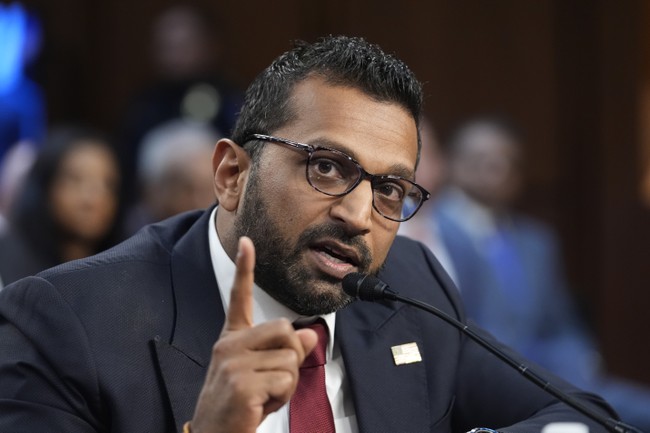
Kash Patel, now leading the FBI, told Megyn Kelly on Sirius XM that the agency firmly rejects the conspiracy theories circling Charlie Kirk’s death. He said investigators have no evidence tying Turning Point USA or foreign governments to the killing, and he emphasized that the probe is ongoing and methodical despite intense public speculation.
On the Megyn Kelly Show, Kelly asked a direct question: do they believe they have the “proper suspect in custody” — specifically, is Tyler Robinson “in fact, the man who killed Kirk.” Patel did not hedge and replied plainly, “Yes.” That answer was meant to put to rest, at least officially, the basic question of who the FBI believes carried out the crime.
Kelly then raised one of the more outlandish claims being spread online: that people inside Turning Point USA or Kirk’s circle somehow knew about or approved of his murder. That allegation has circulated in some corners and generated a lot of anger and confusion. Kelly asked whether there was any credible reason to believe someone connected with the organization had anything to do with Charlie’s death.
Patel answered that question succinctly with a single word: “Zero.” His point was straightforward — there is no admissible evidence linking the organization or Kirk’s friends to the killing. He made clear the FBI is not entertaining unfounded narratives as a substitute for forensic work and witness interviews.
Other claims went even further, alleging involvement by foreign military forces and clandestine operatives. Names and scenarios ranged from French paratroopers to Egyptian Air Force movements and shadowy tunnel-based assassins. Kelly referenced those theories when pressing Patel on whether any foreign government links had surfaced in the investigation.
Patel was again blunt: “At this time, the FBI doesn’t have credible information to connect any foreign governments to it.” That answer aims to stop the wild speculation people have been repeating without evidence. He stressed that the bureau will follow any credible lead, but there is a difference between a tip and verified intelligence.
Patel reiterated that the arrest of a suspect is not an endpoint but a milestone in a larger investigative process. He compared the approach to prior high-profile probes where charges were only one piece of a broader effort to identify accomplices or related criminal activity. The FBI continues to coordinate with Utah authorities and to pursue additional lines of inquiry as they arise.
“We are not done just because we arrest someone, just like in the pipe bomber case,” Patel said, pointing out that cases can expand as new evidence appears. “We don’t just say, Okay, we’re done, on to the next. The investigative team continues to work with the Utah authorities, and they’re deriving their own leads and coming back to us saying, ‘Hey, can you look at this piece of information? Can we get a search warrant on this account? What about this individual who is located in X, Y, or Z?'” Those words underline the iterative nature of complex investigations.
Patel added, “We’re tracking all that down,” a line that signals ongoing activity even after public arrests. The bureau’s focus remains on corroboration and legal standards so evidence can hold up in court. He pushed back implicitly on pundit-driven narratives that try to substitute conjecture for documented proof.
Kelly also raised questions about a strange text thread between Tyler Robinson and his roommate that some observers found suspicious or oddly staged. People online suggested that the exchange sounded contrived, which fed alternative theories about whether Robinson acted alone or at all. Kelly asked if the FBI had reason to believe the messages were fabricated or orchestrated by the two men.
Patel acknowledged the emotional intensity around the case but defended the integrity of prosecutorial vetting. He said he did not “believe the prosecutors in the state of Utah would be using any piece of information or evidence that was not credible.” That is a clear signal that the FBI expects state prosecutors to vet evidence thoroughly before relying on it in court.
Outside the interview, voices close to Turning Point USA criticized those spreading false claims and labeled some statements about Kirk’s death as reckless. Accusations of “evil” falsehoods have circulated, and those reactions have deepened the divisiveness around a grieving family and a charged political moment. Patel’s public statements are meant to calm the conversation by returning it to verifiable facts and procedural progress rather than rumor.
The bottom line from the FBI director was consistent and plainspoken: investigators have no credible evidence tying Turning Point USA or any foreign government to Charlie Kirk’s death, the person arrested is believed to be the suspect, and the investigation will continue to follow leads and maintain prosecutorial standards. That stance signals the bureau’s effort to move debate from speculation back to evidentiary work and legal process.
Add comment