
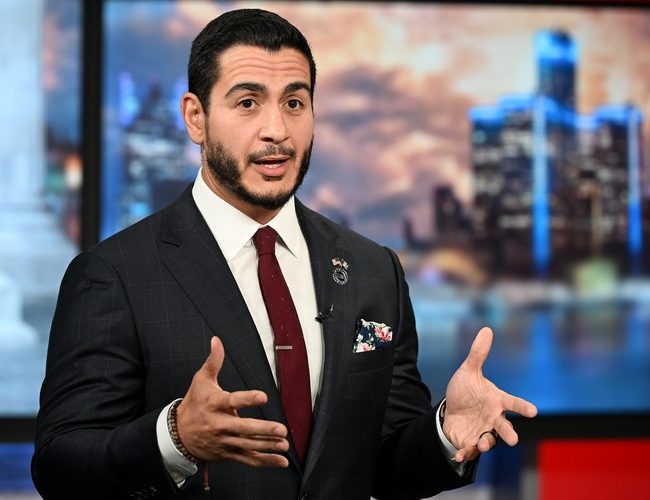
The Michigan Democratic Senate primary has turned into a high-stakes clash between party insiders and the far-left insurgency, and the outcome could hand Republicans a much easier general election matchup depending on who wins the nomination.
The primary once looked like a slam dunk for the establishment candidate, Rep. Haley Stevens, but Abdul El‑Sayed’s insurgent campaign has surged and rewritten the script. Mallory McMorrow’s brief candidacy and subsequent withdrawal injected drama without changing the core dynamic: voters are choosing between a centrist surrounded by party infrastructure and a progressive who excites the activist base. That split matters in a purple state where turnout, independent voters, and national narratives will decide the fall.
El‑Sayed’s rise was predictable to anyone watching national trends: progressive candidates who tie themselves to grassroots energy and bold messaging can vault past better-funded, buttoned-up opponents. Stevens was cast early as the establishment favorite and the more conventional, pro-Israel choice, while El‑Sayed positioned himself as the anti-war, populist option. McMorrow’s exit consolidated some of the center-left vote briefly, but polling quickly showed momentum swinging back to the insurgent camp.
Polls released days before the primary painted a stark picture. One Emerson College survey found El‑Sayed leading Stevens by a wide margin, with the progressive at 54 percent and Stevens at 39 percent, and undecided voters leaning further toward El‑Sayed. The numbers suggested the progressive coalition’s turnout model was working in Michigan just as it has in other recent Democratic primaries.
Progressive Abdul El-Sayed is leading Rep. Haley Stevens (D-Mich.) by 15 points ahead of next week’s Democratic primary for Michigan’s open Senate seat, according to a new poll.
An Emerson College Polling/WLNS/WOODTV survey released Thursday showed El-Sayed handily defeating Stevens in the primary with 54 percent support to Stevens’s 39 percent. A separate 6 percent of respondents said they were undecided while about 2 percent backed state Sen. Mallory McMorrow (D), who dropped out of the race earlier this summer.
When factoring in undecided Democratic voters who were asked who they lean toward, El-Sayed rose to 57 percent support while Stevens sat at 41 percent. A separate 2 percent of respondents supported McMorrow.
From a Republican point of view, this primary is something of a political gift if El‑Sayed becomes the nominee. Early general election polling suggested former Rep. Mike Rogers would perform better against El‑Sayed than against Stevens. That’s the predictable outcome when an opponent comes out of a Democratic primary with sharp progressive stances that alienate swing and independent voters in a battleground state.
Former Rep. Mike Rogers, the presumptive Republican nominee for Senate in Michigan, comfortably leads progressive Abdul El-Sayed and is neck and neck with Rep. Haley Stevens (D-Mich.) in new polling just one week out from the Michigan Senate primary.
A Michigan Education survey, which was conducted by the Glengariff Group and commissioned by the Michigan Education Association and Business Leaders for Michigan, shows Rogers beating El-Sayed by 10 points in a hypothetical match-up. Eleven percent of respondents were undecided.
https://x.com/sistertoldjah/status/2082952810878898660
Another poll detail worth noting: independents are the swing voters who will decide Michigan. The Glengariff survey noted Stevens and Rogers drew almost identical independent support, but El‑Sayed trailed badly among that crucial group. That gap is the reason Republicans are breathing easier if the progressive wins the nomination, and it explains why party strategists view the primary outcome as more consequential than it might appear at face value.
The policy mix El‑Sayed offers—antiwar rhetoric, calls to cut foreign aid, and a platform aligned with the activist left—plays well at primary‑season rallies but not as well in general election battlegrounds. Democrats who dismiss the risk of nominating a far-left candidate in a split state may be underestimating how voters react when campaign rhetoric meets constituency realities. Michigan isn’t New York City, and statewide voters include many who prefer steady, pragmatic approaches over bold ideological experiments.
Rogers and Republican operatives are surely watching this primary closely, but they shouldn’t assume the seat is theirs yet. A progressive nominee creates opportunity, not a guarantee. The GOP must still run a disciplined, focused campaign that ties the Democratic nominee to extreme positions and convinces independents that the choice matters. If Republicans manage that, Michigan could flip; if they don’t, Democrats still have paths to hold the seat even from a weaker starting point.
For Democrats, the lesson is obvious: primary choices have downstream effects. Picking candidates who motivate the base matters, but so does nominating people who can attract the independent and moderate voters necessary to win statewide. This Michigan primary will be a test of which strategy the party values more as the fall election rushes into view.


Add comment