
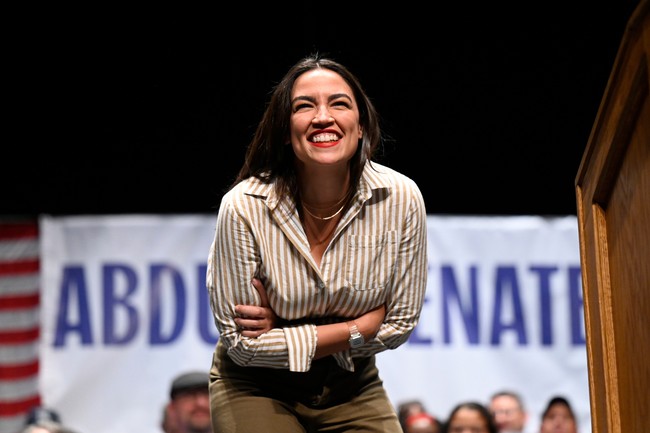
I’ll explain how Alexandria Ocasio-Cortez is trying to soften her image, lay out the public record of her past statements, show examples preserved online, explore why that matters for higher office, and note how political opponents could use that record against her.
Alexandria Ocasio-Cortez, better known as AOC, has become the face of the far left for a lot of voters. She rose fast from an unlikely upset to a national figure with a clear ideological brand tied to the Democratic Socialists of America. Lately she’s been trying to take a more measured tone, apparently with bigger ambitions in mind. That shift raises questions about whether voters can trust a sudden moderation that conflicts with her earlier record.
Her past rhetoric and positions are easy to find and hard to erase, because the internet preserves old posts and interviews. Public posts and recorded comments show she embraced hard-left ideas that many mainstream voters find extreme. That mismatch between past and present creates political vulnerability if she seeks statewide or national office. The playing field outside NY-14 is different and far less forgiving than her safe district.
Rep. Alexandria Ocasio-Cortez has been at the center of a minor uproar over comments she made in an interview last week putting distance between herself and the aggressive “woke” politics that brought her and other Squad members to power, and seemingly acknowledging those views may not be as popular as they once were – or as sane as she pretended at the time.
The record shows the “Woke 1” early adopter doesn’t have a lot of room with which to add such distance.
She can talk about moderation now, but her earlier words don’t vanish. Those earlier statements are the kind of material political opponents and skeptical voters will replay. AOC’s critics argue that her trajectory isn’t genuine evolution so much as political rebranding aimed at higher office. For skeptics, policy gaffes and radical-sounding lines from the past are the strongest evidence against a sudden pivot.
Some of her public posts focus on issues that remain polarizing, including racial politics and gender ideology. Her public social posts and interviews often used blunt language that energized the base but alienated many swing and moderate voters. Those posts are still accessible and can be presented out of context during a tough campaign. That’s the reality of modern politics: old posts become campaign fodder.
https://x.com/AOC/status/1159254426097467394?ref_src=twsrc%5Etfw
Her stance on criminal justice and policing is a key example. In the past she called for significant changes to policing budgets and embraced ideas that many Americans found alarming. That positioning drove support among activists but also sparked a backlash among voters who prioritize law and order. The debate over defunding and abolition remains a flashpoint that can be exploited in tight races.
She also has a record of sharp critiques aimed at traditional institutions and systems, including the justice system and economic structures. Those critiques were popular inside activist circles but are often framed by opponents as radical or unserious when moved into a general election environment. When running statewide or nationwide, a politician’s activist-era rhetoric tends to be judged more harshly than it is within a friendly district.
Moving from a safe House seat into statewide or national bids requires persuading a broader electorate, and that means reconciling past rhetoric with present messaging. Opponents will assemble clips, posts, and quotes to create a narrative of inconsistency or extremism. Campaigns are brutal about packaging a rival’s history into a single, repeatable line voters can remember.
Flashback: In the early 2020s, Ocasio-Cortez was one of the most aggressive and advocates for “defunding” the police — an idea that polls have long shown is not popular.
- In the summer of 2020, she New York City’s government for proposing to cut its police department by only $1 billion.
- “Defunding police means defunding police,” she said then. “It does not mean budget tricks or funny math.” She added: “The fight to defund policing continues.”
In 2019, AOC posted on that “we need to have a real conversation about decarceration & prison abolition in this country.”
- She said that year that some marginalized groups “have no choice but to riot.”
- And she at an event in 2021: “I want to abolish our carceral system that’s designed to trap Black and brown men.”
If she truly wants voters to accept a new posture, actions will have to match words for months or years — not just a few soundbites. For many voters, a single strong denunciation of extreme voices aligned with her past circles would be an early test. That hasn’t consistently happened in public. Without repeated, concrete distancing, skepticism will persist.
Finally, the tactical reality for Republicans is straightforward: when a political figure has a long trail of radical-sounding remarks, those clips are a reliable campaign tool. Whether AOC can credibly change how she’s seen depends on time, consistent behavior, and willingness to confront problematic allies and past statements. Until then, any rapid moderation will read to many as political calculation rather than conviction.



Add comment