
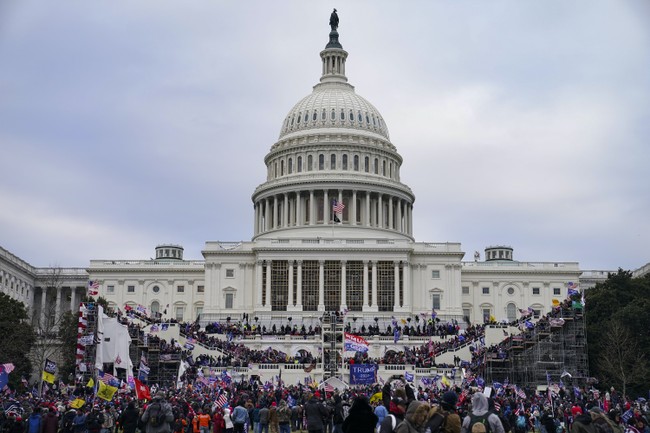
White House Shreds Democrats’ Jan. 6 Narrative With New 5th Anniversary Website
The White House launched a new website on the fifth anniversary of January 6 that directly challenges the dominant Democratic narrative, questions the decisions of then-House leadership, and defends the recent blanket pardons issued for those prosecuted in the aftermath. This article reviews the site’s central claims, the language used to describe pardons and security failures, and how the administration frames responsibility for the events and subsequent prosecutions.
The past five years have seen Democrats repeatedly return to January 6 as a central political theme, framing it as an insurrection while offering few policy alternatives to voters. The new White House site rejects that framing and argues many prosecutions were politically motivated, describing defendants as “unfairly targeted” and “overcharged.” The administration paints the congressional probe as a one-sided spectacle featuring high-profile grandstanders. The site also accuses Democratic leaders of using prosecutions to distract from their own failures.
The website explicitly defends the mass pardons that were issued upon the new administration’s return to power, framing them as corrective action for a politicized Department of Justice. That section emphasizes that many defendants were “mere trespassers or peaceful protesters” who faced harsh treatment. It stresses prompt relief for those still imprisoned and labels prior sentences and detention conditions as excessive. The tone is unapologetically assertive about presidential authority to remedy perceived injustices.
The site includes a prominent passage that lays out the administration’s position on clemency in blunt terms, and the quoted language is presented as a central justification for the pardons. That quoted passage portrays the pardons as necessary to counteract what the site calls a weaponized DOJ and to restore due process. It also highlights the scale of relief granted and the administration’s priority of ending punitive treatment. The passage is framed to show decisive, immediate action taken on January 20, 2025.
President Trump took decisive action to pardon January 6 defendants who were unfairly targeted, overcharged, and used as political examples. They were not protected by the leaders who failed them. They were punished to cover incompetence.
On his first day back in office, January 20, 2025, President Trump issued sweeping blanket pardons and commutations for nearly 1,600 patriotic Americans prosecuted for their presence at the Capitol—many mere trespassers or peaceful protesters treated as insurrectionists by a weaponized Biden DOJ. He fully pardoned most, commuted sentences, and ordered immediate release of those still imprisoned, ending years of harsh solitary confinement, denied due process, and family separation for exercising their First Amendment rights.
Beyond pardons, the site offers its own timeline of January 6 that challenges mainstream accounts and assigns blame for security lapses to leadership choices. The timeline highlights what it calls “critical security failures” and criticizes the decision-making that led to inadequate pre-deployment of security resources. It also emphasizes motives and messaging from that day, describing a sequence from a presidential speech to subsequent unrest and law enforcement responses. The narrative is constructed to contrast the site’s interpretation with the official investigatory storyline.
The White House site calls out Nancy Pelosi and other Democratic leaders for what it describes as clear admissions of responsibility for the security breakdown. It points to video and audio materials where Pelosi is quoted as acknowledging failures to secure the Capitol and failing to pre-deploy the National Guard despite warnings. That material is presented as direct evidence that leadership decisions, not only crowd actions, determined the degree of chaos. The administration uses those admissions to shift focus toward institutional accountability.
Video and audio recordings, including unaired HBO footage from her own daughter, show Nancy Pelosi repeatedly acknowledging responsibility for the catastrophic security failures—admitting “We have totally failed” and “I take full responsibility” for not having the National Guard pre-deployed, despite intelligence warnings and President Trump’s offers of troops that were ignored under her leadership as Speaker.
“We have totally failed. We need to take some responsibility for not moving to secure…[unintelligible]”
The site also argues that media outlets and political opponents amplified selective details to keep the story alive for political gain, long after most voters stopped treating it as decisive. It claims that the continued fixation on January 6 serves as a political tool rather than a national healing exercise. The White House frames its website as a corrective, offering alternative documents, timelines, and clips to challenge the established narrative. Readers are presented with an interpretation that prioritizes institutional failure and prosecutorial excess over a singular characterisation of the day.
The White House release is strategically timed and unapologetic in tone, aiming to reshape public discussion on the fifth anniversary. It combines legal arguments about pardons, pointed criticism of leadership decisions, and curated media clips to support its version of events. Whether this framing will change long-term public perception remains to be seen, but the administration has clearly set out its counter-narrative in forceful language.



Add comment