
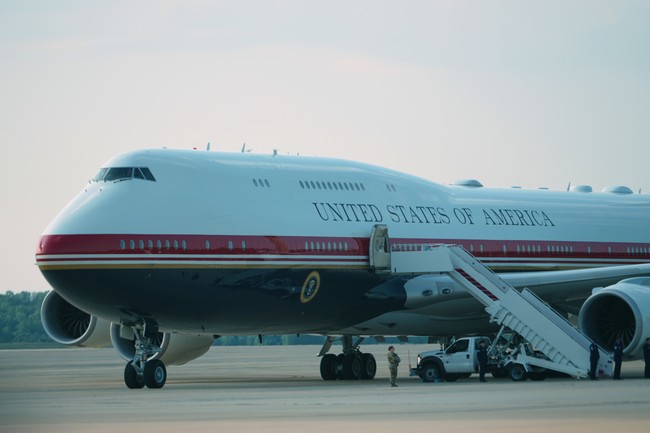
President Donald Trump’s decision to switch from the brand-new gifted Air Force One to the older, battle-tested jet for part of his return from the NATO summit drew attention because it mixed straightforward security thinking with a visible show of support for U.S. troops. The move came during renewed friction with Iran and was framed by officials as a prudent, safety-first choice. The newer Boeing 747-8 continued ahead to a U.K. base where service members toured it, giving the stop a morale angle as well as an operational one. What followed was a blend of practical risk management and a gesture toward the forces who protect American interests overseas.
Trump chose to transfer mid-journey from the older presidential plane to the new one while abroad, a decision informed by cautions from the protective detail. Reports indicate the Secret Service favored the older aircraft because it has well-established missile detection and countermeasures systems that the newer jet lacks in full, proven form. In a moment when regional tensions with Iran were rising, officials saw little upside in testing a different configuration for the president’s safety. That calculation reflects a conservative approach to safeguarding the commander in chief in a risky environment.
The Iranian regime’s record of proxy actions and direct threats factored into the administration’s thinking, with planners mindful of assassination plots and attacks against American targets. Tehran’s actions across the region, including strikes and support for militant groups, have repeatedly tested U.S. red lines and prompted hard decisions on force protection. Choosing a plane with known defensive capabilities was presented as common-sense prudence rather than alarmism. When national security is on the line, minimizing variables in transportation and security systems is a plain operational priority.
Once the decision was made to use the older jet for a leg of the trip, the newer presidential aircraft did not sit idle. The administration sent the gifted 747-8 on to RAF Mildenhall, where President Trump later boarded it after an event, creating an opportunity for service members to see the aircraft up close. Troops stationed far from home were allowed to tour the plane, a move presented as a thoughtful use of the jet’s transit to boost morale. That visit offered personnel on the forward base a moment of connection to high-end national assets and a rare firsthand experience.
https://x.com/RapidResponse47/status/2075012375242063999
Making the new aircraft available for tours fit within a pattern of direct engagement with the military that the president has emphasized. Sending the plane ahead rather than leaving it unused turned a logistical transit into a tangible gesture for troops at a key forward installation. For many service members, seeing advanced equipment operated by their country can be a meaningful morale lift and a reminder of national capability. The episode was described by supporters as practical support for those who wear the uniform.
Critics, especially from outlets predisposed to question the administration, will frame the swap as inconsistency or an awkward consequence of accepting a foreign gift. But within the administration’s view, accepting the aircraft from an ally saved taxpayers hundreds of millions during Boeing’s production bottlenecks and was a pragmatic move. Layering extra caution on top of that acceptance when threats are active is straightforward risk management, not political theater. The choice illustrates a willingness to adjust operational plans in response to credible threat assessments.
The episode highlights two distinct priorities: protecting the presidency from external threats and showing practical regard for the troops who support America’s global posture. Trump did not use the moment for grandstanding but instead made decisions that balanced immediate security needs with an opportunity to engage service members. Those quiet operational calls often define effective leadership in volatile times, focusing on what preserves lives and enhances the morale of the force. The trip combined sensible protection measures with a small but meaningful recognition of the men and women who serve abroad.
Operationally, sticking with proven defense systems aboard the older jet during a risky leg of transit reduced uncertainty for the protective detail and for those tasked with executing the mission. At the same time, sending the new aircraft ahead and allowing troops to tour it made practical use of a transatlantic movement, turning logistics into goodwill. Both elements underscored a simple priority list: keep the president safe and respect the service members who make U.S. power possible. Those aims guided the choices made on the trip and explain how the administration framed the swap.


Add comment