
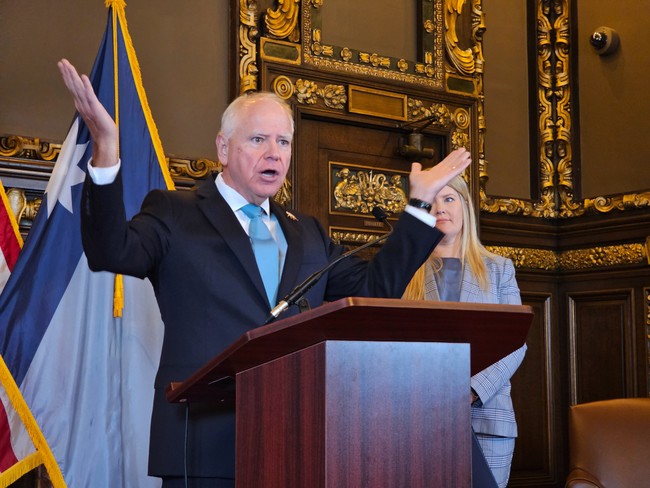
This piece examines Minnesota Gov. Tim Walz’s conspicuous silence after anti-ICE activists entered a Minneapolis church, contrasts his recent fiery rhetoric with his lack of response, and argues that his inaction signals a political double standard from Democrats toward law enforcement and public safety.
The Cowardice of Tim Walz Is on Full Display After Anti-ICE Agitators Invade Minnesota Church
For months Gov. Tim Walz has made headlines with aggressive language aimed at federal actors and political opponents, even calling his state “at war with the federal government” in high-decibel commentary meant to rally supporters. That talk set expectations that he would be fast to condemn lawless behavior when it involves public safety or the sanctity of worship spaces. Instead, when a Minneapolis church was overrun by anti-ICE protesters, Walz was notable for what he did not say. The contrast between his earlier bravado and his current quiet is hard to miss.
The church incident was shocking to many observers because it involved activists interrupting services and sending children and congregants fleeing in fear. Local leaders and the broader public expected a governor who had spent months denouncing federal action to speak out about this kind of blatant disorder. Yet neither Walz nor Minneapolis Mayor Jacob Frey offered the rapid public rebuke people anticipated. That silence raises questions about priorities and consistency from Democratic leaders when protests target law enforcement versus when authorities take action.
Earlier, Walz warned that ICE might disrupt “midnight mass services” during the holidays — a claim that never materialized — and he used other dramatic comparisons to criticize federal immigration enforcement. Those statements were widely covered and amplified, establishing a narrative that he would defend those he perceived as under siege. When the roles flipped and anti-ICE demonstrators became the aggressors, that same energy was absent. To many on the right, the discrepancy looks less like prudence and more like selective outrage.
Observers also point out that this incident echoes earlier episodes where left-aligned activists targeted religious institutions, such as the protests around the abortion debate. In those moments, progressives often framed their actions as moral urgency that justified disrupting services. But when a similar disruption happens in the context of immigration and enforcement, Democratic leaders’ silence suggests a tolerance for disorder depending on whether the actors fit their political aims. For critics, that’s not a principled stance; it’s political calculation.
The phrase “silence is violence” has been repeated in progressive circles to pressure opponents into taking stances that align with their goals. When that slogan is deployed, it demands vocal condemnation of perceived injustices. So when leaders who embraced that rhetoric then go quiet after a church invasion, it reads as hypocrisy to many voters. Walz’s lack of comment, in this view, amounts to tacit complicity rather than careful statesmanship.
Beyond rhetoric, the public wants leaders who enforce laws impartially and defend the safety of citizens in houses of worship. Law-abiding residents expect equal protection regardless of the political identity of protesters or the agencies involved. When enforcement actions by ICE or DHS are criticized loudly by the same officials who ignore activist incursions, it erodes trust in leadership and suggests a two-tiered standard. That dynamic drives the perception that Democratic officials place political optics over public safety.
There are real consequences when political leaders fail to call out behavior that threatens community safety and religious freedom. Congregants traumatized by the church takeover deserve attention and protection, not silence from those sworn to serve them. If officials are selective about what lawless acts merit condemnation, they send a message that allegiance to a cause matters more than upholding order. For many voters, that signal is intolerable and fuels broader political backlash.
Minnesotans watching this play out are left to decide whether Walz’s earlier theatrics were sincere warnings or mere campaign theater. The governor’s previous comparisons and provocative comments set a high bar for moral clarity and leadership. When he fails to meet those expectations during a crisis affecting ordinary worshipers, critics see cowardice rather than courage. That judgment will matter at the ballot box and in public debate going forward.
At a minimum, a consistent standard for protecting peaceful assembly and worship would restore some faith in political leaders’ commitments to public safety. Citizens expect their governors to speak up when communities are threatened, not only when the headlines serve a narrative. Walz’s silence after the Minneapolis church incident will be interpreted by many as a political choice with tangible implications for public trust and civic order.
Add comment