
The Smithsonian is showcasing items tied to Dr. Anthony Fauci just as his Senate performance left him embattled, and that contrast—between museum reverence and public humiliation—raises real questions about judgment and the use of taxpayer-funded platforms.
Smithsonian’s Fauci display clashes with his worst public moments
The Smithsonian Institution has long billed itself as a neutral, educational steward of American history, but its recent presentation of items linked to Dr. Anthony Fauci reads more like hagiography than history. In 2021 the institution awarded him the Great Americans Medal, and today it features museum labels that describe his advice during the pandemic in heroic tones. That choice matters because museums shape public memory, and honoring a figure so recently at the center of fierce controversy will not land neutrally with many taxpayers.
Critics point out a stark disconnect between the museum’s tone and Fauci’s record as seen by opponents: the doctor promoted broad lockdowns and other sweeping public-health directives that some argue caused enormous social and economic damage. Those same critics say Fauci’s guidance often changed and, in their view, sometimes contradicted earlier claims, which fed public distrust. For a taxpayer-supported museum to present him without addressing those disputes looks like an editorial decision, not a straightforward curatorial one.
https://x.com/EricBauman/status/1367858755489079296
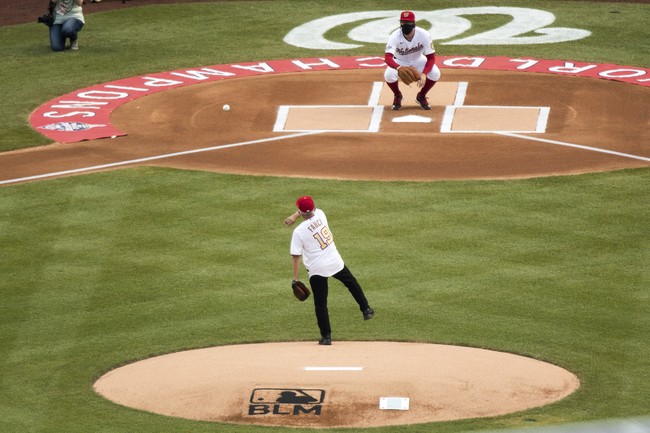
The Smithsonian’s exhibit copy praises his guidance to sports leagues, noting his role in the decisions around reopening and even a ceremonial appearance at a baseball game. The placard quoted in the exhibit reads exactly: “As a deadly pandemic ravaged the nation, major sports leagues found themselves at the center of a debate over ‘reopening’ the country,” a placard dedicated to Fauci says.
“Amidst a cacophony of misinformation and denial, advice from Dr. Anthony Fauci, the nation’s leading epidemiologist, urged leagues to make decisions about resuming play ‘based on scientific evidence and public health judgment,'” it continues. “When baseball became the first league to retake the field, Fauci threw the ceremonial opening pitch—wearing a facemask in a stadium empty of fans.”
That celebratory language ignores how many viewed the moment: a ceremonial pitch in a near-empty ballpark that some now regard as emblematic of the era’s contradictions. He wore a mask outdoors while standing alone in an empty stadium, a visual that opponents say proved the messaging about risk and masking often lacked common-sense nuance. The pitch itself was widely mocked at the time and has been replayed as a symbol of missteps rather than triumphs.
Opponents also take aim at the museum’s decision to enshrine the cap and jersey from that day, pointing out the irony that the mask itself was excluded from display over concerns of contamination. That omission fuels ridicule: critics argue that if the mask was so important in the story, why not preserve it like any other artifact? That decision invites questions about authenticity, risk assessment, and consistency in exhibit choices.
The tension here is broader than one man or one museum item. It touches on how public institutions, funded by taxpayers, decide what to elevate and how to frame controversial figures. When museums lean into celebratory language for living, political figures, they risk appearing partisan and alienating large portions of the public who saw different outcomes from those leaders’ policies.
Beyond the Fauci display, critics cite other recent Smithsonian controversies as evidence of politicized curation, arguing that certain exhibits advance current social narratives without sufficient historical balance. Whether it’s the interpretation of historical figures or the selection of contemporary objects, those decisions shape how future generations will understand our recent past. Citizens expecting neutral stewardship of national heritage see a problem when museums adopt a tone that reads as approval rather than analysis.
The spectacle of a revered institution celebrating a figure who hours later or days later faces intense scrutiny and political rebuke creates sharp optics. For conservatives and many taxpayers, the juxtaposition of museum reverence with Senate trouble feels like tone-deafness at best and ideological capture at worst. That perception reduces trust in cultural institutions meant to serve everyone, regardless of politics.
Museums should be arenas of inquiry, not platforms for polishing reputations. If an institution wants to include contemporary figures, it can do so while acknowledging controversy and competing perspectives instead of offering uncritical praise. The Smithsonian’s choices here have turned what could have been historical context into what many see as cultural endorsement.



Add comment