
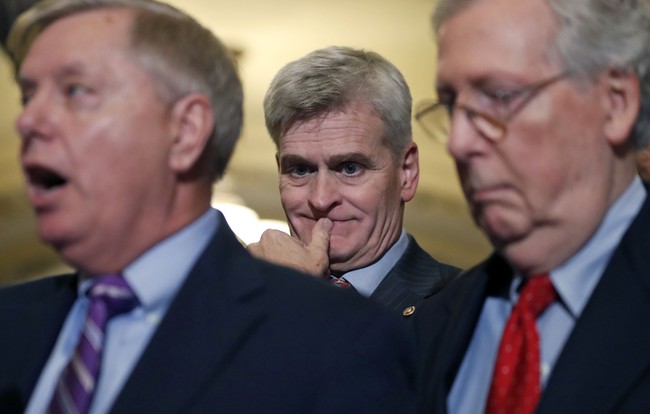
Bill Cassidy’s decision to vote to convict Donald Trump in February 2021 reshaped his political fate in Louisiana, and Saturday’s primary cleared the path: Cassidy failed to reach the top two, ending his Senate career and setting up a June 27 runoff between Trump-endorsed Rep. Julia Letlow and State Treasurer John Fleming to determine the GOP nominee for the fall.
Bill Cassidy voted to convict Donald Trump in February 2021. That single vote became the defining issue of his second-term tenure, drawing formal censure from the Republican Party of Louisiana and painting him as a target for challengers who offered a clearer alignment with the party’s base. Over five years the political arithmetic in Louisiana shifted around that moment, and Saturday’s primary was the political reckoning.
Cassidy, in the Senate since 2015, failed to finish among the top two in the Republican primary and will not advance to the June 27 runoff. For a senator who built a profile on a mix of establishment and conservative credentials, the loss underscores how potent intra-party dynamics have become when national loyalty questions are at stake. In Louisiana, where the Republican primary essentially decides the general contest, this result signals the end of a two-term Senate run.
Two candidates moved forward: Rep. Julia Letlow and State Treasurer John Fleming. Letlow carries a Trump endorsement that came on January 18, 2026, and she declared her campaign two days after that public support, an alignment that sent a clear message about where the national party’s priorities sit in the state. Fleming, by contrast, entered early and carved out a lane with a base in rural Louisiana and a record of conservative House service dating back to 2009.
There were early warning signs for Cassidy that his 2021 vote would remain politically toxic. “THERE WERE SIGNS: ” There’s a Really Good Chance Bill Cassidy Doesn’t Even Make His Own Run-Off on Saturday was a refrain echoed in political coverage and local sentiment. The accumulation of endorsements, polling, and primary challengers all tracked back to that moment in the impeachment aftermath, and the GOP electorate in Louisiana made its choice with that history in mind.
The impeachment vote that marked the end of Cassidy’s Senate career is also a study in consequence. He was one of seven Senate Republicans to vote to convict Trump following the January 6, 2021, Capitol riot, a decision that drew public rebuke and a formal party censure. For years that vote defined how donors, activists, and influential allies calculated their support, and it made him the rare Republican senator that Trump’s team actively targeted in this cycle.
Trump’s intervention in the race sharpened the contrast between candidates who align visibly with him and those who prefer to rely on their local networks. Letlow represents Louisiana’s 5th Congressional District in the northeast, and arriving with the Trump-Landry coalition behind her gave her immediate statewide visibility. Fleming, meanwhile, served in the House from 2009 to 2017, helped found the House Freedom Caucus, and held a role in the early Trump administration, positioning himself as a conservative with credentials independent of a presidential endorsement.
The runoff now turns on which brand of conservatism carries the day: the candidate chosen by the president or the candidate who built a base without that explicit endorsement. This contest will test whether endorsements from the top are decisive in Louisiana, where voters have shown both loyalty to Trump and appetite for locally rooted leaders. On June 27, Republican voters will decide whether presidential favor or preexisting conservative credentials best answer the party’s priorities heading into the midterms.
For Cassidy, the result is a clear political judgment from the electorate. His two-term Senate tenure included legislative accomplishments and moments of bipartisanship, but in today’s Republican politics, that record could not outweigh a single, high-profile vote against the party’s leading figure. The primary outcome carries lessons for other GOP incumbents who weigh institutional judgment against the expectations of an activist base.
Letlow and Fleming now move into a compressed runoff season where messaging, turnout, and coalition-building will determine who becomes the Republican standard-bearer in a state where the GOP winner in June is heavily favored in November. The dynamics that produced this primary result — a national figure weighing in, a punished incumbent, and two conservatives vying for different paths to victory — are likely to echo in other GOP contests. The Louisiana electorate has chosen to make its priorities plain, and the runoff will be the next chapter in how that choice translates into a general election nominee.


You screw the pooch the American people are screwing you now. We keep telling you if you don’t stand with Trump your careers are finished. We will not forget all the RINOS who don’t stand with the American people who voted for Trump. Start looking for new careers because you’re next to be removed. Start counting the days because we are eliminating all RINOS. POS.. FAFO
The American people have spoken.