
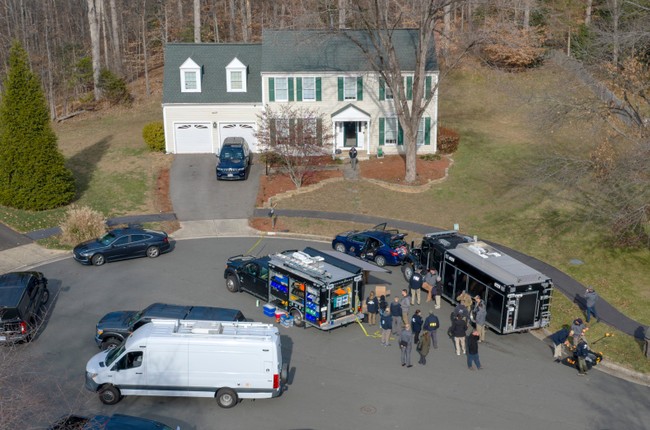
The court has ordered that Brian Cole Jr., accused of planting pipe bombs outside party headquarters on January 5, 2021, remain jailed pending trial based on a judge’s finding that he poses a danger to the public; the ruling leans on the severity of the charged offenses, alleged statements made during an interview, and purchases of bomb components after the incident.
Federal prosecutors asked the court to keep Cole detained, laying out evidence and alleged admissions they say tie him to the pipe bombs found near the DNC and RNC headquarters in early January 2021. A detention hearing followed, and Magistrate Judge Matthew Sharbaugh issued a detailed 19-page opinion explaining why Cole will stay in custody until trial. The opinion focuses less on flight risk and more on danger to the community, invoking the Bail Reform Act’s presumption favoring detention for the charged offenses.
The judge emphasized the seriousness of the offenses, including the potential consequences had the devices detonated in Washington, D.C., on the eve of an important Congressional proceeding. The court rejected the defense argument that no one was hurt and no property was damaged as a reason to minimize the charges, calling that notion unpersuasive and noting it would have been “luck, not lack of effort” if the devices failed to explode. That assessment weighed heavily toward pretrial detention.
Court excerpts included the government’s description of a recorded interview, and the opinion notes the defense did not contest that characterization during the detention proceedings. The judge found the timing and context of the alleged acts amplified their severity and that the statutory penalties for the offenses are significant. All of these considerations collectively supported the conclusion that no set of conditions could reasonably guarantee community safety.
According to the government’s characterization of the video-recorded interview—a characterization the defense did not contest as part of the detention proceedings, whether in its written submissions or during the detention hearing—the following transpired.
…
Applying these principles here, the Court concludes that this case implicates a rebuttable presumption of detention. And even assuming Mr. Cole rebutted that presumption, the government has shown by clear and convincing evidence that there are no conditions of release that can reasonably assure the safety of the community.
…
The charged offenses are undeniably serious as a general matter. To simply describe them is to demonstrate as much. More, the U.S. Code prescribes significant penalties for these specific criminal offenses.
….
Further, the specific circumstances by which the offenses are alleged to have been carried out—including the timing and broader context—further amplify their severity.
…
Even still, the defense strives to minimize the offenses because the IEDs never detonated, such that nobody was injured and no property was damaged. The Court finds that point decidedly unpersuasive. As the government appropriately observes (see ECF No. 17 at 20), “it was luck, not lack of effort,” that caused the devices not to detonate.
…
After all, Mr. Cole reportedly stated that he planted the devices—one of them underneath a public bench, no less—hoping they would detonate and that there would be news about it. Mercifully, that did not happen. But if the plan had succeeded, the results could have been devasting: creating a greater sense of terror on the eve of a high-security Congressional proceeding, causing serious property damage in the heart of Washington, D.C., grievously injuring DNC or RNC staff and other innocent bystanders, or worse.
Simply put, the nature and circumstances of the charged offenses here are gravely serious, so this factor points strongly toward pretrial detention.
The opinion also stressed evidence suggesting Cole continued to acquire bomb-making materials well after January 2021, which undercuts any claim that the alleged conduct was a one-time lapse long ago. According to the court’s recap, purchases of pipes, end caps, wire, steel wool, a timer, and other components were made across multiple transactions between January 21, 2021, and August 13, 2022. That pattern, the court found, raises significant concerns about an ongoing danger to the community.
But there is more. Because as the government’s proffer shows, after January 5, 2021, Mr. Cole reportedly purchased many of the same parts used in the explosive devices—including metal pipes, end caps, wire, steel wool, a timer, and more. (ECF No. 17 at 11 (chart).) These purchases spanned at least a dozen different transactions between January 21, 2021, and August 13, 2022. This evidence undercuts the suggestion that Mr. Cole’s alleged conduct was some anomalous event that occurred only once many years ago. Instead, for at least the better part of two years afterward, Mr. Cole reportedly engaged in the same activity leading up to the offense conduct, amassing the same sorts of parts he used to construct the two explosive devices giving rise to these charges.
…
His ongoing retention of and access to the same components used to construct the explosive devices recovered outside the DNC and RNC headquarters in January 2021 raise substantial red flags in the Court’s mind about a prospective risk to public and community safety.
….
Although home incarceration and a GPS monitor would provide some check against Mr. Cole’s ability to carry out any menacing or dangerous conduct in the community, the Court is simply not satisfied these conditions rise to the necessary level for the reasons explained. This is particularly true based on the severity of the potential danger Mr. Cole is alleged to pose, given his alleged persistent acquisition and retention of so-called “bombmaking parts,” and given his reported penchant and capacity to create explosive devices and deploy them in public settings.
As it stands, Brian Cole Jr. remains in federal custody and has not entered a plea in the case; the judge’s ruling leaves open the possibility of a later plea agreement but prioritizes public safety for now. The legal process will proceed, and the detention order will hold until further action from the court. For Republicans who prioritize law and order, the ruling underscores a straightforward point: when allegations involve devices and intent to harm, the justice system must act to protect the public.

Add comment