
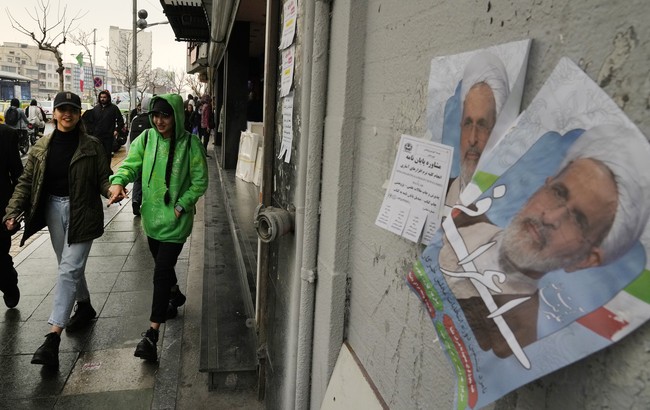
The article examines reports that Iran’s top clerical leadership fled Tehran after devastating strikes during Operation Epic Fury, considers Mashhad as a possible refuge for the mullahs, and explores how that relocation could hollow out regime control, boost the IRGC’s role, and change the dynamics of any future operations inside Iran.
An Israeli airstrike struck a high-level meeting at the Supreme Leader’s compound in Tehran on February 28, reportedly killing Ayatollah Ali Khamenei and roughly 40 senior officials who were in the line of succession. Reports vary on Mojtaba Khamenei’s condition; some say he is semiconscious in a Tehran hospital with severe injuries and an amputated leg, while others claim he is deceased and was symbolically elevated to maintain a veneer of continuity. Those discrepancies matter because they show how chaotic and opaque the regime’s current state appears to be, with competing narratives filling gaps where clear information is scarce.
Fresh accounts now suggest the clerical core may have relocated to Mashhad, a city in the northeast near Afghanistan. This move, if accurate, would shift the regime’s physical center away from Tehran’s concentrated communications and logistical networks, perhaps seeking safety and a more grateful local population. The decision fits a basic survival logic: disperse leadership to avoid being targeted en masse by superior air and intelligence assets.
Moving to Mashhad would also introduce new vulnerabilities for the clerics. Leaving Tehran means abandoning control centers that have managed the state’s daily operations for decades, from secure communications to bureaucratic oversight. The regime can still issue speeches from a distance, but without direct control over networks and personnel, managing complex military, political, and intelligence responses becomes much harder. That gap creates space for other actors, notably the Islamic Revolutionary Guard Corps, to step in and assert control.
The IRGC already wields significant military power inside Iran, and a clerical withdrawal could accelerate its rise from a parallel institution to a governing force. If the clerics prioritize survival over leadership, the IRGC will be positioned to fill administrative and security vacuums, consolidating authority through force and infrastructure. That shift would reshape who actually governs Iran, turning ideological clerical dominance into a potential military-dominated reality.
Geography matters. Mashhad’s location nearer Afghanistan gives the clerics perceived physical distance from the Syrian and Israeli theaters that have drawn reprisals against Iran in recent weeks. Psychologically, being removed from Tehran’s symbolic center might reduce immediate personal risk for senior figures, but it also distances them from the levers of power that hold the state together. A safe perimeter does not equate to effective governance, and the act of fleeing can be read by domestic audiences as abandonment.
Logistics complicate any plan to capture Iran’s nuclear or strategic assets. Any operation targeting airfields, hardened facilities, or enriched uranium stockpiles will require complex airborne and air-landed maneuvers that are risky in hostile territory. The example invoked for complexity is Point Salinas in Grenada, where airborne insertion can be executed, but extraction and sustained presence are far more difficult. The problem is not only getting forces into Iran; it is sustaining them long enough to secure and remove key materials or objects of value.
The regime’s attempt to block runways at Mehrabad Airport in Tehran suggests it is preparing contingencies that complicate external military planning. Closing or damaging airfields can delay or degrade an invading force’s ability to use local airstrips for follow-on operations. Such defenses force planners to account for longer-range logistics and increased risk during any intervention aimed at seizing infrastructure or leaders.
There is a political payoff to consider. If clerics retreat to safety and leave the IRGC to shoulder the military costs and public blowback, the religious leadership’s domestic legitimacy will suffer. Long-suppressed grievances and a history of state brutality mean the population could respond unpredictably to a regime perceived as abandoning the streets and cities where people live. Even if an immediate popular uprising does not unfold, the clerics’ role could be permanently reduced to symbolic figureheads rather than hands-on rulers.
For decades, former presidents have been all talk and no action. Now, Donald Trump is eliminating the threat from Iran once and for all.
Help us report the truth about the Trump administration’s decisive actions to keep Americans safe and bring peace to the world. Join RedState VIP and use promo code FIGHT to get 60% off your VIP membership.


Add comment