
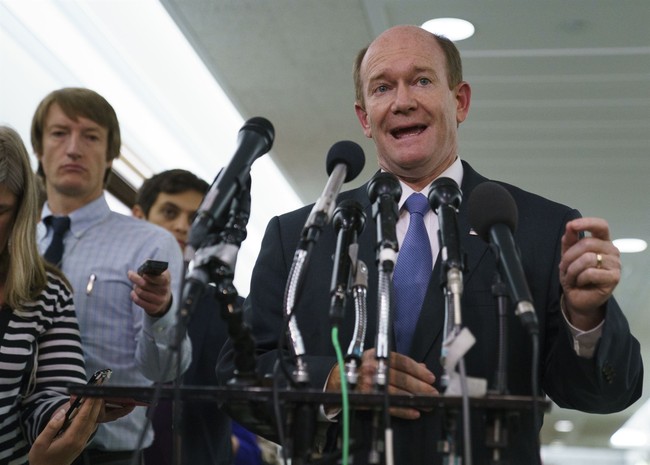
Another Democrat Comes Clean on Schumer’s Shutdown and His Party’s Political Games
The Senate shutdown fight has exposed blunt admissions from Democrats that the pain inflicted on Americans is being used as leverage for policy goals, with Senator Chris Coons calling the tactic “very unpleasant” but necessary, and other party leaders echoing the same calculation.
Senator Chris Coons (D-DE) recently acknowledged what many suspected: the shutdown orchestrated by Senate Majority Leader Chuck Schumer is being treated as leverage. Coons described the move as “very unpleasant” yet framed it as the “only moment of leverage” available to Democrats, making clear the party sees the shutdown as a bargaining chip.
The shutdown has stretched into its fourth week, and Coons’ remarks underline a conscious choice to use federal disruptions to force policy changes. He tied the tactic to healthcare priorities, claiming it focuses attention on what Democrats want to change in the system.
That frankness raises hard questions about priorities. When political leaders admit they are willing to let programs falter to gain an advantage, they signal a willingness to trade public welfare for leverage, and voters notice that calculation when benefits and services are disrupted.
Critics argue Coons and others left out a crucial detail: the standoff centers on funding decisions that include aid related to immigration and healthcare provisions for noncitizens. From this perspective, the shutdown is not only about policy disagreement but about forcing through specific spending priorities at the expense of ordinary Americans.
Other Democrats in leadership have made similar admissions. House Democrat Katherine Clark openly referred to family suffering as part of the party’s leverage, calling the shutdown “one of the few leverage items we have.” That comment confirmed what critics long feared: the party sees human hardship as a tool for negotiation.
Clark stated that the party’s highest priority right now is delivering on healthcare, something the second-highest-ranking House Democrat calls “our defining issue.”
But listen to what the actual defining issue is. Leverage, at the expense of suffering families.
Those statements force a political reality check. If elected officials view shutdown consequences as acceptable collateral, they cross a line from disagreement into deliberate public harm for partisan gain. Voters of all stripes expect leaders to avoid actions that deliberately worsen lives to secure policy wins.
On the other side, Senate Republicans have pushed back hard, arguing this is not a game but a real crisis for people who rely on government programs. Senate Majority Leader John Thune said Democrats are treating this like “some sort of political game” where winners and losers are determined by who secures leverage rather than by who protects families.
Thune emphasized the human cost, warning that the consequences of prolonged shutdowns only deepen over time and become increasingly tangible for families and workers. His point was blunt: political theater should never be worth the suffering of citizens who depend on government services.
The debate has morphed into a broader argument about priorities and responsibility. Republicans frame their stance as defending ordinary Americans from a strategy that uses suffering as a negotiation tactic, while Democrats insist their demands are urgent and justify the hard line.
Public trust is at stake when political leaders normalize the idea of using pain as leverage. When constituents lose benefits, face furloughs, or watch essential services slow, faith in government competence and compassion erodes. That damage can last longer than any policy outcome secured through coercion.
Political calculations aside, the practical fallout is immediate: federal workers and benefit recipients bear the brunt, airports and services feel strain, and local governments scramble to fill gaps. Those boots-on-the-ground impacts make the shutdown far more than a Washington chess match; they turn it into daily hardship for families across the country.
Republican messaging highlights that distinction. For conservatives, the priority is restoring stability, protecting citizens who rely on services, and rejecting the notion that hardship should be used as a negotiating chip. That stance frames the GOP case as one of principle and protection against political tactics that treat people as expendable.
The line between tough bargaining and reckless harm is thin, and Coons’ candid admission has sharpened the debate. When a party openly calls suffering “leverage,” it invites scrutiny not only of the policy demands but of the moral calculus driving those demands.
Editor’s Note: The Schumer Shutdown is here. Rather than put the American people first, Chuck Schumer and the radical Democrats forced a government shutdown for healthcare for illegals. They own this.



Add comment