
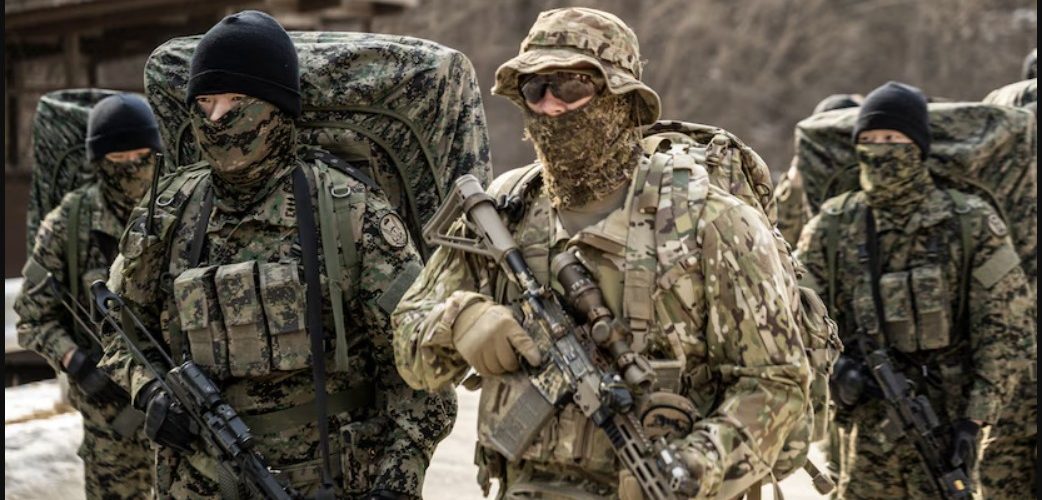
President Trump has taken a bold step in addressing threats to the United States by identifying the influx of illegal immigrants as an invasion and the rise of fentanyl as an act of war. In response, he has directed the U.S. military to act against these dangers, deploying forces to the Caribbean to tackle drug cartels. This move is part of a larger strategy to enhance border and national security.
The deployment is one of the largest military operations in the Caribbean in recent history, focusing on Latin American drug cartels labeled as global terrorist organizations. President Trump sees dismantling these groups as essential to his security agenda, tasking the Pentagon with crafting military responses. The mission involves over 4,000 Marines and sailors, supported by advanced naval and aerial assets.
Key military units involved include the Iwo Jima Amphibious Ready Group and the 22nd Marine Expeditionary Unit, along with P-8 surveillance planes, a warship, and a submarine. These forces operate in international waters, providing intelligence and potentially launching targeted strikes against cartel networks. This action follows earlier deployments for border security and increased surveillance of Mexican cartels.
In February, the administration officially designated several cartels and gangs as global terrorist organizations, marking a shift from a law enforcement approach to a national security strategy. This deployment is an unprecedented concentration of U.S. military might in the Caribbean, combining advanced naval platforms and thousands of personnel. The naval force includes destroyers and a guided-missile cruiser, underscoring the seriousness of the mission.
The USS Gravely, a destroyer capable of intercepting ballistic missiles, is part of this force, highlighting President Trump’s commitment to combating cartels. Aerial surveillance is provided by the P-8A Poseidons, the Navy’s top maritime patrol aircraft. These planes can conduct long-range patrols over vast waters, equipped with systems to detect and track vessels.
The mission targets the Southern Caribbean, a major transit zone for drugs like cocaine and heroin headed to the U.S. and Europe. Traffickers use various methods to evade detection, including high-speed boats and corrupt port officials. Naval forces will support law enforcement missions against maritime terrorism and other transnational crimes.
In March, the U.S. military deployed destroyers to the U.S.–Mexico border, reinforcing the broader militarization of counter-drug operations. President Trump authorized military action against Latin American cartels after their designation as foreign terrorist organizations. This move expands the FTO framework, traditionally used for terrorist groups, to include criminal cartels.
Secretary of State Marco Rubio designated eight organizations, including MS-13 and several Mexican cartels, as FTOs. The crackdown extends to Venezuela, with the Treasury Department sanctioning the Cartel de los Soles. Led by President Nicolas Maduro, this cartel has trafficked drugs into the U.S. while supporting other criminal groups.
On May 2, the list expanded to include Haitian gangs, reflecting the administration’s comprehensive approach. Critics, primarily from liberal circles, question the operation’s legality and its alignment with international law. However, the Trump administration maintains that U.S. sovereignty allows such actions.
Legal experts clarify that FTO designation does not inherently authorize force, yet historical precedents exist for using executive power in similar contexts. The 2001 AUMF enabled President Bush to target 9/11 planners, while the 2002 AUMF justified the Iraq invasion. Currently, drug cartels lack direct links to these terrorist groups.
President Trump’s stance on illegal immigration and narcotrafficking highlights his commitment to U.S. national security. He perceives the cartel-controlled governments of Latin America as unable or unwilling to address these issues. Thus, deploying the U.S. military becomes a necessary measure.
Critics of President Trump have failed to propose viable alternatives to dismantling drug cartels. His decisive action aims to protect American citizens from the dangers posed by these criminal organizations. The military’s involvement underscores the gravity of the threat and the administration’s resolve.
As the operation unfolds, the focus remains on disrupting drug trafficking routes and weakening cartel influence. The U.S. military’s presence in the Caribbean is a testament to President Trump’s dedication to securing the homeland. The mission continues as part of a broader strategy to combat threats to national security.
The deployment is a clear message to cartels that their activities will not be tolerated. By treating these groups as terrorist organizations, the administration seeks to dismantle their networks. The military’s role is pivotal in executing this strategy, showcasing American strength and determination.
While debates around the operation persist, the administration’s focus remains unwavering. The military’s capabilities are leveraged to safeguard the nation from external threats. President Trump’s actions reflect a commitment to preserving U.S. sovereignty and security.
The operation in the Caribbean is a significant step in the fight against organized crime. By treating cartels as terrorist entities, the administration adopts a tougher stance. The military deployment signals a shift in strategy, emphasizing national defense.
As the mission progresses, its success will depend on sustained efforts and strategic planning. The U.S. military’s involvement is crucial in achieving the administration’s objectives. This operation represents a decisive move in the ongoing battle against drug cartels and their influence.
I get paid more than $120 to $130 per hour for working online. I heard about this job 3 months ago and after joining this i have earned easily $15k from this without having online working skills.
This is what I do———⊃⫸ Www.EarnApp1.Com