
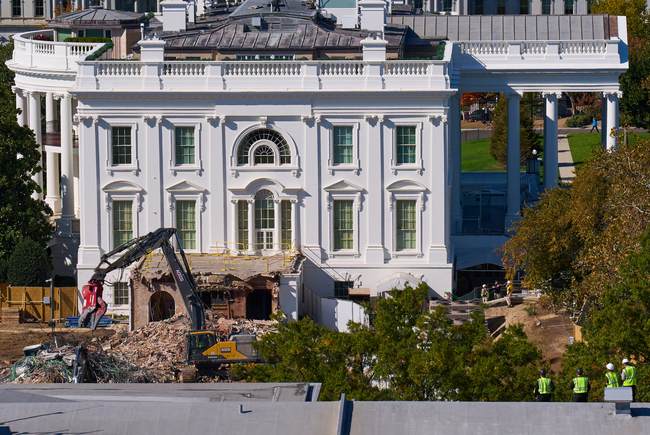
White House Ballroom Plans Win Key Approval From Planning Commissioners
The National Capital Planning Commission has approved plans for a proposed White House ballroom, clearing a procedural hurdle even as legal fights continue; commissioners appointed by President Trump oversaw the vote, and public comment was mixed and sometimes harsh, but the commission concluded many objections fell outside its mandate.
The commission meeting focused on design, scale, and process rather than funding or political arguments, and the approval signals momentum for a project meant to create a formal state event space. Opponents described the design in vivid terms, while supporters argued the grounds need a modern venue for hosting heads of state and important diplomatic dinners. The approval does not end litigation, but it does remove one official bar the project faced.
The commission, which is led by Trump appointees, met last month to evaluate the plans and public comments, many of which were negative. Critics have blasted the project as “appalling,” a “monstrosity” and “vulgar” in the public comments.
Will Scharf, the Trump-appointed commission chair, said he personally read every comment submitted to the commission and many of the negative ones were “unresponsive” and “dealt with issues beyond the scope of this commission,” such as the ballroom’s funding, the demolition process and Trump.
“Considering issues of this sort is not within our mandate,” he said. “We are not some sort of free-ranging ballroom justice commission.”
Chair Will Scharf made clear the commission’s role is narrow, emphasizing procedure over politics, and he insisted public submissions that addressed funding or demolition process were not germane to the commission’s responsibilities. The chair also noted he read every public comment, a detail meant to reassure the public that the process was thorough and not perfunctory. For conservatives who favor orderly governance, that kind of attention to administrative procedure matters.
Not everyone on the commission agreed on the design specifics, however, and questions about scale dominated parts of the discussion. Phil Mendelson, a commission member and chairman of the D.C. Council, objected to the ballroom’s proposed size and urged a design that would not compete in height with the main White House structure. Those concerns reflect a broader tension between creating an impressive venue and preserving the historic proportions of the Executive Residence.
Another commission member, Phil Mendelson, who is the chairman of the D.C. Council, expressed his opposition to the ballroom plans based on the structure’s proposed size.
“It’s just — I’m trying to be nice here — it’s just too large,” he said. “It’s just too large. And if we can get the same program but not as tall, not competing in height with the main structure, and a condensed footprint, we are better for that.”
Those pushing for a grander space argue that statecraft sometimes requires scale, and they point to international precedents where nations maintain formal venues to host sovereigns and heads of state. A commissioner noted the practical awkwardness of hosting dignitaries outdoors in tents when formal dining would be expected, especially for a visiting monarch. For conservatives who see prestige and strength in American institutions, a well-appointed state room that reflects the country’s standing is sensible.
Another commission member appointed by the president, Michael Blair, said during the meeting that Trump was blending “great architecture with great hospitality,” in his plans for the ballroom, pointing to the need for a space to welcome visitors like King Charles, who plans to visit the U.S. later this month.
“The King of England will be here at the end of the month, and we will likely dine in tents. When the president was recently in the United Kingdom, they dined in Windsor Castle. It’s a little bit different,” Blair said. “And you know, we would say that it is not fitting of the presidency or the White House to have to invite the king of our oldest ally, and, you know, perhaps most loyal ally, to come and eat in tents on the White House lawn.”
Commissioner Michael Blair framed the project as restoring dignity to state hospitality and avoiding makeshift solutions like tented dinners for visiting leaders. The example of dining arrangements during foreign visits underlines the practical diplomatic reasons for an indoor, formal venue on the White House grounds. For those who prize respect for allies and grand ceremonial occasions, the argument has persuasive force.
Critics will keep fighting in the courts, and recent rulings have temporarily halted work in some areas, but the commission’s signoff removes one regulatory barrier. Meanwhile, demolition work on the East Wing has already occurred, a fact that complicates any attempts to restore the site to a prior condition. That physical reality matters when opponents seek injunctions or piecemeal reversals in litigation.
The debate touches on taste, history, and the role of government architecture in American life, and it will continue to play out in public hearings and courtrooms. For many conservatives, the takeaway is simple: America should host the world with confidence and appropriate facilities that match its status, while ensuring process and law are followed at every step.

Go for it!! build that ballroom just like we built the wall!!! Each one being needed!! About time!! Let’s see if the democrats have any class besides low class!!