
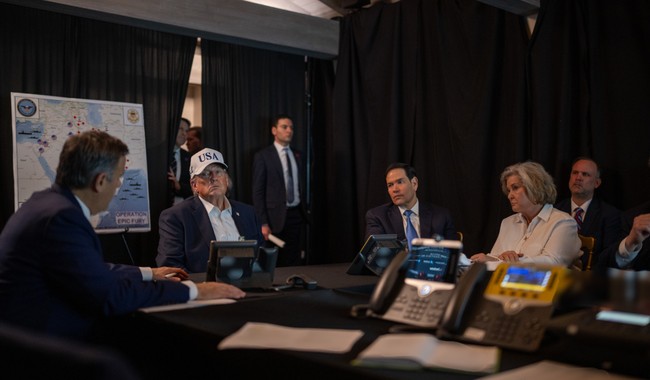
I’ll walk through the big claim: President Trump says a cease-fire and a pathway to long-term peace with Iran are underway, with specific conditions for reopening the Strait of Hormuz and a two-week suspension of strikes while negotiators finalize terms.
<p”Winston Churchill, during World War 2 – if memory serves, it was just after the Battle of Britain – said:
Now this is not the end. It is not even the beginning of the end. But it is, perhaps, the end of the beginning.
President Donald Trump has announced what he calls a potential cease-fire deal in which Iran would agree to allow shipping to pass unimpeded through the Strait of Hormuz, and both sides would apparently observe a . The claim is dramatic and fits a straightforward Republican argument: use overwhelming strength to force a better diplomatic hand, then consolidate gains through negotiation.
The President writes (paragraph breaks added for clarity):
Based on conversations with Prime Minister Shehbaz Sharif and Field Marshal Asim Munir, of Pakistan, and wherein they requested that I hold off the destructive force being sent tonight to Iran, and subject to the Islamic Republic of Iran agreeing to the COMPLETE, IMMEDIATE, and SAFE OPENING of the Strait of Hormuz, I agree to suspend the bombing and attack of Iran for a period of two weeks.
This will be a double sided CEASEFIRE! The reason for doing so is that we have already met and exceeded all Military objectives, and are very far along with a definitive Agreement concerning Longterm PEACE with Iran, and PEACE in the Middle East.
We received a 10 point proposal from Iran, and believe it is a workable basis on which to negotiate. Almost all of the various points of past contention have been agreed to between the United States and Iran, but a two week period will allow the Agreement to be finalized and consummated. On behalf of the United States of America, as President, and also representing the Countries of the Middle East, it is an Honor to have this Longterm problem close to resolution. Thank you for your attention to this matter! President DONALD J. TRUMP
That is the administration’s public posture: pressure, then negotiation. From a conservative perspective, you apply decisive force to reset the balance, then convert that leverage into enforceable terms. The conditions Trump outlines — full reopening of the strait and a fixed, short pause in military action — are designed to produce immediate relief for global shipping while buying time to lock in concessions.
There are obvious reasons to be skeptical. Iran’s theocracy has spent decades developing workarounds to sanctions, proxies, and inspections. Trusting any Iranian promise without ironclad verification would be naive, and any deal that simply returns Tehran to robust oil revenues risks funding a rapid rebuild of military capacity. Republicans rightfully warn that temporary quiet means little if the fundamental regime remains intact and empowered.
Still, the claim that Iran submitted a 10-point proposal changes dynamics if true. It suggests Tehran is willing to bargain on key friction points after sustaining losses and facing international pressure. The task for the U.S. is to ensure any written commitments include immediate, verifiable steps and consequences for backsliding rather than vague goodwill language that Iran can exploit.
What’s acceptable from a Republican viewpoint is clear: no deal that props up the regime or lifts sanctions in a way that replenishes its war-making coffers without meaningful reforms. A credible outcome would include monitored elections, dismantling of proxy operations, and long-term restrictions on weapons procurement. Anything less hands the mullahs a second chance to rebuild and undermine Western interests.
Practically, a short cease-fire can buy time for diplomats to draft enforceable text, but the hard work is in the enforcement architecture: international inspectors with real teeth, rapid sanctions triggers, and military readiness behind any agreement. That mix of stick and credible verification is what converts battlefield success into lasting security gains.
Political opponents will claim patience and talks are the path to peace, while isolationists and some allies will worry about entanglement. Conservatives will watch for signs the administration tradeoffs military advantage for ephemeral headlines. If sanctions are eased or oil sales resumed too quickly, the risk of empowering Iran’s bad behavior rises sharply.
At the moment, the claim is a conditional breakthrough: leverage achieved, an offer on the table, and a two-week window to turn a proposal into a binding pact. How this plays out depends on negotiating discipline and the insistence on verifiable, permanent constraints on Iran’s ability to threaten the region. The stakes are high, and Republicans expect any agreement to be backed by consequences for cheating.
Editor’s Note: For decades, former presidents have been all talk and no action. Now, Donald Trump is eliminating the threat from Iran once and for all.
Follow developments closely; the promise of a negotiated settlement is only as good as the mechanisms that hold it together.

Add comment