
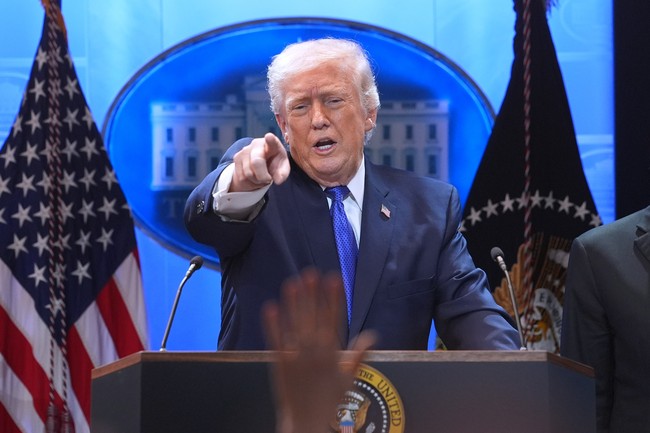
President Donald Trump faced a combative PBS reporter at the White House after the Easter Egg Roll, and the exchange—about bombing Iran and the feelings of Iranian citizens—drew sharp shots from both sides and sparked a national discussion about media bias, regime brutality, and the limits of questioning in a press briefing.
Trump spent Monday at the White House hosting the Easter Egg Roll and holding a briefing about recent strikes on Iran. During the briefing, a PBS reporter asked whether bombing could be considered caring for the Iranian people, a question that quickly turned tense. The president pushed back, questioning the reporter’s perspective and accusing mainstream outlets of being soft on the regime. What followed was a blunt exchange that captured how divided Americans are about military action and media framing.
When Trump asked, “Yeah, who are you with?” the reporter answered, “PBS.” He shot back, “Well, that’s a radical left group of lunatics if you will,” and then moved to explain why many Iranians welcome pressure on their government. His argument hinged on a simple point: Iranians have suffered under a violent, repressive regime, and some see military pressure as a path to relief. That view challenges the media narrative that Iran’s people uniformly oppose any strikes against their rulers.
Trump emphasized that many protesters inside Iran were silenced by fear of retaliation, pointing to executions and lethal crackdowns on dissent. He referenced specific victims, including a young wrestling champion whose execution stirred outrage. Those details, he argued, explain why some Iranians feel relief when regime infrastructure is targeted rather than civilians. The president framed the strikes as aimed at power centers, not ordinary people, and said that reality matters when judging public reaction in Iran.
“Let me just tell you, let me just tell you. The Iranian people, when they don’t hear bombs go off, they’re upset! They want to hear bombs because they want to be free. And the only reason they’re not out protesting, you know that, is because they were informed that if they protest, like the wrestler and his friends, if they protest, they will be shot immediately!”
That quotation captured the confrontation’s heat, and it resonated with people who have personal connections to Iran or who follow firsthand accounts on social media. Supporters of Trump pointed to messages from Iranians on X and other platforms, saying those voices show cheering, relief, and even hope when the regime is pressured. Critics called the president’s language inflammatory and argued that it risked downplaying civilian suffering or escalating conflict unnecessarily.
The exchange also spotlighted the role of legacy media in framing foreign policy questions. To many conservatives, the PBS reporter’s tone suggested a disconnect from the realities of life under Tehran’s rule. That perceived disconnect fuels a broader critique: that some U.S. outlets prioritize antiwar postures or moralizing over reporting the horrors of authoritarian regimes. Trump used the moment to underscore that difference, labeling certain outlets as ideologically driven and questioning their sensitivity to victims of repression.
Part of the pushback came from accounts of Iranians who cheered strikes as a potential break from a system that murders dissenters. The president stressed that public opinion inside Iran is not monolithic and that fear suppresses much of what people truly feel. He argued that targeted military actions can weaken the regime’s control mechanisms, creating space for protests and change, even if those operations remain controversial in the West. For Trump’s supporters, that approach reflects decisive leadership rather than empty talk.
Not everyone agreed with his assessment. Skeptics said the rhetoric oversimplified complex regional dynamics and risked conflating the regime with the population at large. They warned that military action can produce unintended consequences and that robust, on-the-ground intelligence should guide any decisions. Still, the president maintained that the strikes were surgical and aimed at oppressive institutions rather than civilians, a distinction he repeatedly stressed during the briefing.
Voices from the diaspora and from inside Iran were central to this debate, with some individuals recounting personal losses and others expressing cautious support for pressure on the regime. Stories circulated of public executions and brutal reprisals that, for many, explained why some Iranians appear to welcome outside intervention. Those accounts strengthened Trump’s argument that opposing the regime is not just a foreign policy stance but a humanitarian concern for people longing for freedom.
The confrontation at the lectern also highlights how press conferences can become theater for larger cultural fights. Questions about intent, civilian harm, and moral responsibility are necessary, but the way they are posed matters. This exchange will likely be replayed and dissected by both critics and supporters as evidence of media bias and presidential bluntness in the same breath. Either way, it made clear that foreign policy debates in the U.S. remain raw, personal, and politically charged.


Surprising! I’ve been making 100 Dollars an hour since I started freelance on the Internet six months ago. I work long hours a day from home and do the basic work that I get from the business I met online. share this work for you opportunity This is definitely the best job I have ever done…
just use the info on this page .====> PayAtHome1.Com