
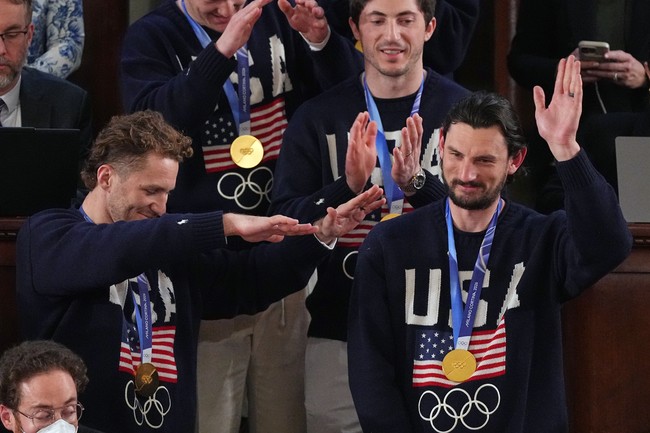
The U.S. men’s hockey team rode a feverish 72 hours from Olympic gold to a Washington celebration, turning a cinematic win into a high-profile visit that included a nightclub singalong, an Oval Office meeting, and seats as honored guests during the State of the Union; President Trump announced he will present goalie Connor Hellebuyck with the Presidential Medal of Freedom and praised the team’s performance in very direct terms.
The gold-medal game against Canada ended in overtime, sealing a moment the team and fans will talk about for years. Within days the players were in Miami celebrating with supporters, then flown to Washington on Air Force One to meet the president. That kind of full-throttle post-victory schedule underscored how national pride and athletic excellence can become a political moment.
President Trump singled out the team’s goalie, Connor Hellebuyck, for special recognition and said he will receive the Presidential Medal of Freedom. The announcement came during the Oval Office gathering and was delivered with the unmistakable flourish Trump uses for big moments. For many conservatives, awarding a top civilian honor to a championship-caliber athlete resonates as both recognition of achievement and a symbolic defense of civic values.
Trump said:
But I just want to tell you that the members of this great hockey squad will be very happy to hear, based on their vote and my vote — and in this case, my vote was more important — that I will soon be presenting Connor with our highest civilian honor, which has been given to many athletes over the years… but when I say many, not too many, like 12.
It’s called the highest civilian honor in our country, the Presidential Medal of Freedom.
That direct style is familiar to Trump’s supporters, who see this as a fitting, unapologetic celebration of American accomplishment. Hellebuyck’s season and Olympic performance offered a tangible reason to spotlight excellence. The award decision ties sports achievement to national recognition in a way conservatives often endorse: honor merit publicly and let the country celebrate together.
Media coverage naturally zoomed in on Jack Hughes, whose golden goal provided the headline moment. But supporters and observers who watched the full game know Hellebuyck’s saves and calm under pressure shaped the result. In the view of many fans, his contributions deserved the spotlight and, for some, even MVP recognition despite the game’s dramatic goal scorer getting the headlines.
The team’s itinerary — nightclub singalongs, Air Force One, Oval Office, and a State of the Union appearance — read like a modern American victory tour. It highlighted how sports heroes can be uplifted as symbols of national unity during politically charged events. For Republicans, moments like this create opportunities to emphasize patriotism and to present leaders as supporters of American achievement.
Players often talk about momentum, chemistry, and timing, and this group hit its peak at exactly the right moment. Their postgame passion and public appearances turned teammates into ambassadors of an American story many want to hear. That narrative—hard work rewarded, national pride affirmed—fits comfortably into conservative messaging around celebration of success.
Hellebuyck’s journey from the minors to the top level of international hockey is the kind of underdog-to-hero arc that resonates broadly. It gives the award more than symbolism; it ties a personal story to national recognition. Presenting the Medal of Freedom to an athlete with that background highlights how achievement outside of politics can still carry civic weight.
Some will criticize any partisan overtones attached to athletic honors, but a large portion of the public sees value in high-profile praise for excellence. When a president uses his platform to honor achievers, it can move beyond politics and into national celebration. Conservatives argue that public recognition for hard work and success is part of what binds a country together.
The team’s presence at the State of the Union brought energy into a formal setting and gave Republicans a visible, nonpolitical touchstone to emphasize American greatness. Sporting accomplishments offer a shorthand for national virtues—discipline, teamwork, resilience—and placing athletes center stage reinforces those themes. It also reminds voters that leadership can spotlight unifying achievements amid inevitable contention.
Within the locker room and in postgame interviews, the players spoke about sacrifice and focus, themes that translate well into public life. For audiences who prefer clear, patriotic messaging, those themes are powerful and straightforward. Recognizing the goalie with a top civilian honor sends a message: excellence in any field is worthy of the nation’s gratitude.
There will be debate about who should receive what honors, especially in high-profile political moments, but for those who back the president’s approach the decision feels right. It rewards a tangible, necessary contribution to a national triumph. And it demonstrates a willingness to celebrate symbols of American success beyond the arena of politics.
Editor’s Note: With President Trump back in the White House, the state of our Union is strong once again.
Hellebuyck’s rise to the NHL and Olympic stage reflects years of development, grit, and consistent performance at the highest levels. That background helps explain why the president and many fans want to honor him with a major civilian award. When sports and national recognition intersect, the result can be an unmistakable moment of pride for a lot of Americans.


Add comment