
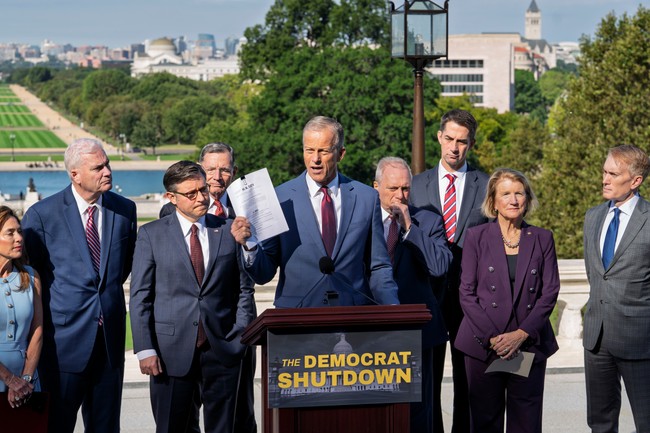
Senate Majority Leader John Thune has announced a shift back to the traditional appropriations process to fund the government, arguing that regular order will prevent future shutdowns and restore transparency and member input to federal spending decisions.
Thune told reporters the “path to a stronger, safer America” runs through passing funding bills the old-fashioned way, not via continuing resolutions that sidestep committee input and open debate. He noted that three of the 12 appropriations bills — MilCon-VA, Ag, and the Legislative Branch — are already law, a milestone he pointed out occurred for the first time since 2018.
“I think, at least here in the Senate, we have a lot of things, as you know, we have to get done,” Thune said. “And of course, we want to get the appropriations process moving again. It got slowed down during the shutdown, unfortunately, and as a consequence of that, we’ve got a lot of ground to make up. But as you all know, we did pass the three appropriations bills … MilCon-VA, Ag, and Leg Branch.”
Thune emphasized that restoring regular order is about more than procedure; it’s about accountability and public confidence in how taxpayer dollars are allocated. He argued that omnibus packages or year-long continuing resolutions concentrate power in leaders’ offices and remove the chance for rank-and-file senators to offer amendments and oversight.
“So three of the 12 are now law, and those three we got across the floor of the Senate before August, which is the first time that’s happened since 2018,” he added. “So, as you all know, we are very committed to regular order on appropriations. We think that’s the best way to fund the government – rather than having an omnibus bill written in the leader’s office or a year-long CR.”
The majority leader laid out plans to advance a defense appropriations bill and to clear additional measures to assemble a minibus package for Senate action. He made clear that getting through committee markups, allowing member input, and holding open floor processes should be the standard approach going forward.
“Going through a normal appropriations process where the committee marks up bills, has input from all the members on the committee, reports them to the floor, and there’s an open process, transparent process on the floor, we think is the best way to fund the government,” Thune continued. “And so, the challenge now is to get the next package ready to go – starting, we’ve got the defense appropriations bill ready…. we’re also trying to clear four other appropriations bills to put together a minibus that we could act on here in the Senate, so we’re working through those holds.”
Thune urged colleagues who want government funding achieved via the traditional route to work constructively to get bills to the floor. His appeal was practical: if members bring their concerns into committee and the amendment process rather than blowing up funding negotiations, the Senate can avoid chaotic stopgap measures that harm services and stability.
The leader warned that continuing resolutions, omnibus bills, and last-minute deals are poor solutions for the country and corrosive to both the Senate and the House. Those approaches, he said, strip transparency from the process and make long-term planning impossible for agencies that depend on predictable funding.
“To let us get on them and have an amendment process, and try and process them in a way that enables us to fund the government through the appropriations process, as opposed to, as I said, either a continuing resolution or an omnibus or something like that,” Thune said. “Those are not solutions that are good for the country, and they’re certainly not good for this institution or for the House of Representatives. We want to do it the old-fashioned way.”
Political reality complicates the plan, since the Democrat coalition has moved left and internal disagreements can stall or block normal order. Even so, returning to committee-driven appropriations reduces the leverage that shutdown threats and leadership-written packages give to any faction seeking to force concessions.
There are tangible benefits to the approach Thune advocates: clearer lines of responsibility, opportunities for bipartisan fixes, and public debate on spending priorities. With key bills already enacted, leadership wants to build momentum and demonstrate that funding can be delivered without repeating the disruption of recent weeks.
The thrust of Thune’s message is straightforward: institutional health matters and the best way to protect services, benefits, and national security is to pass appropriation bills through the open, committee-based process. If senators take the floor and use the amendment process, it will restore the checks and balances the appropriations system was designed to provide.



l Get paid over $110 per hour working from home. l never thought I’d be able to do it but my buddy makes over $22150 a month doing this and she convinced me to try. The possibility with this is endless….
Copy This ____________ EarnApp1.Com