
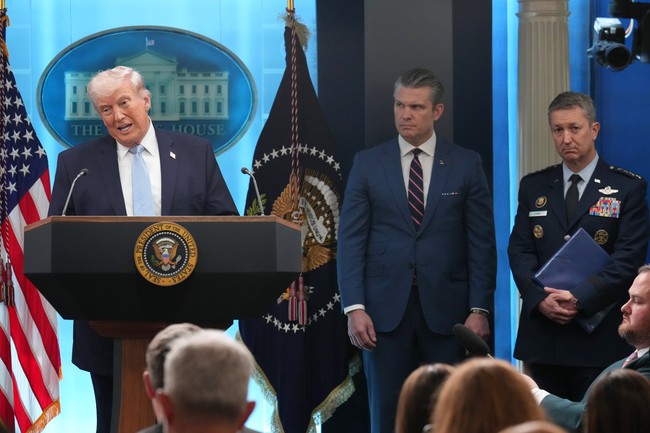
I’ll explain how Operation Epic Fury unfolded, highlight the teamwork and precision the Pentagon credited, present the exact remarks from Secretary Pete Hegseth and Joint Chiefs Chair Dan Caine, and preserve key timelines and quoted material from the briefing so readers can see how decisions and interagency planning brought two aviators home from hostile territory.
Monday’s briefing laid out a bold, no-nonsense account of two rescue operations executed deep inside Iranian territory. Senior officials described rapid decision making, close interagency work, and an unwavering commitment to recover American service members. The briefing made clear these were high-risk missions approved at the highest levels and carried out with lethal coordination and discipline.
Secretary Pete Hegseth stressed teamwork, firepower, and precision as central to success, and he credited the president’s decisive leadership. The rescue operations relied on special operators, elite aircrews, and intelligence professionals operating together under sustained pressure. Hegseth framed the missions as bold penetrations into enemy territory that synchronized air, ground, and special operations.
“In two extraordinary combat search and rescue operations deep inside enemy territory in Iran, our warriors executed missions of breathtaking skill, courage, and precision.
“Special operators supported by elite air crews and intelligence professionals moved swiftly and decisively into treacherous mountain terrain under the constant threat of Iranian forces closing in.
…
“Now, these are not routine operations. They were high-risk, high-stakes missions conducted in the heart of enemy territory.
“This was not just barely into Iran. This was deep into Iran, involving coordinated strikes to suppress threats, deception tactics to protect our teams, and full synchronization across air, ground, and special operations.
“The Iranians are still asking themselves right now, how did the Americans do this?”
Hegseth described the first mission as a rapid, audacious daylight recovery that moved quickly after the aircraft went down. It was authorized in less than two hours once the pilot’s location was confirmed, he said, and the tempo never let up. The account underscores how speed and clear authority matter when lives are at risk.
“The first mission, the first of two, was an audacious daylight thunder run right up the middle.
“It was authorized in less than two hours from that pilot going down, when we knew where he was, and it was authorized in the middle of the night because anybody that’s worked for this man knows he’s up in the middle of the night.”
Hegseth also credited the CIA for helping locate the second aviator and emphasized the nonstop coordination that supported both missions. He painted a picture of an around-the-clock operation with a virtual coordination cell that never dropped its call. That continuous focus was a central feature of the rescue effort.
“The second mission, as soon as we knew where that pilot was — and John was certainly helpful in that also — executed immediately.”
Hegseth noted the sheer persistence of the command structure: a secure facility held a coordination call open for 45 hours and 56 minutes. The call was described as unblinking from the moment the pilots went down, a detail that highlights the intensity and scale of the response. He used that timeline to underscore how single-minded the effort was to recover Americans.
“I looked up at my screen when the final mission was complete inside our SCIF, our secure facility.
“And we have a running VTC, a running coordination cell, and the top of it read 45 hours and 56 minutes.
“For 45 hours and 56 minutes, we held that call open for coordination.
“From the moment our pilots went down, our mission was unblinking.
“The call never dropped.
“The meeting never stopped.
“The planning never ceased.”
Hegseth left a blunt message for Tehran about U.S. capability and resolve, describing long flights flown in daylight and at night to get the pilots back. He said Iran did nothing to stop those flights. His comments were framed to show that the United States will go where needed to protect service members and complete the mission.
“The United States military will go anywhere at any time to protect our own and complete the mission.
“We execute with precision.
“We control the skies.
“You see, we flew for seven hours in daylight over Iran to get the first pilot.
“And we flew seven hours in the middle of the night to get the second.
“And Iran did nothing about it.”
General Dan Caine provided a granular timeline, naming the initial event at 10:10 p.m. Eastern on April 2 and detailing the assets used in the recovery effort. He described a combat search and rescue task force built around A-10s, HC-130s, HH-60s, and pararescue teams, operating under a fighter strike umbrella. The picture was one of heavy coordination under fire.
“On Thursday, 2 April, at 10:10 p.m. Eastern time — 4:40 in the morning local Iran time — the Joint Personnel Recovery Center, which handles the Central Command area of responsibility, declared an isolated personnel recovery event for a U.S. Air Force F-15E Strike Eagle, call sign Dude 44, which was down in hostile Iranian territory.
“The pilot and weapons system officer had both safely ejected and were isolated behind enemy lines.
“Following confirmation of active rescue beacons, and on the direction of the secretary and by order of the president, a rescue operation was launched with the stated purpose of bringing both Americans home safely.”
Caine recounted close-in engagements, one A-10 Sandy being hit, and helicopters taking small arms fire while extracting the front-seater. He emphasized the selflessness and training of the rescue force, invoking the Vietnam-era Sandy mission heritage. His words highlighted that people, not hardware, are the reason these missions succeed.
“As the secretary said, several hours later, on the morning after positively locating the front-seater, call sign Dude 44 Alpha, and aware of an aggressive ongoing search by the enemy, a U.S. Central Command plan was approved by the secretary and the president.
“Shortly thereafter, a U.S. Air Force combat search and rescue task force comprised of A-10 Warthogs in their Sandy role — and I’ll describe what that is in a minute — HC-130 Combat King IIs, HH-60 Jolly Green II helicopters, and Air Force special warfare airmen, a package comprised of combat rescue officers and pararescuemen operators, audaciously penetrated enemy territory in broad daylight to find, fix, and recover Dude 44 Alpha from behind enemy lines.”
Caine also detailed the recovery of the backseater and the central role of interagency cooperation in locating and extracting him. He described repeated strikes to keep enemy forces at bay and the complexity of fighting two simultaneous problems: the force looking for the backseater and contingencies that arise during such missions. The operations ended with both airmen returned to friendly territory after more than 50 hours of sustained effort.
“Meanwhile, the backseater, as the president and secretary have said, had continued to work and survive through the hours of daylight.
“Dude 44 Bravo, the backseater, evaded using every means available.
“The efforts of the United States military, the Central Intelligence Agency, and others were attempting to find and locate with precision Dude 44 Bravo, the backseater.
…
“On Saturday, 4 April, after establishing positive communications with the backseater, we learned, as the president said, that he was injured and actively evading enemy forces.
“And thanks to our interagency partners, we were able to get eyes on his location and positively ID him.
“Throughout this entire time, the enemy force continued to search for 44 Bravo, and the joint force continued to strike them over and over and over again, fighting off marginal weather in Iran and the enemy’s search.
“For a second time on Saturday, at the recommendation of the CENTCOM commander and at the approval of the secretary and the president, we launched a rescue task force to recover Dude 44 Bravo.
“Again, this came to the president and the secretary for approval.
“This time with a much larger force package based on the time that the enemy had to prepare to find 44 Bravo.
“Again, this force was protected by A-10 Warthogs using the Sandy call sign.
“And this force had one single mission: do everything they can to bring an American home.
“This meant having a plan, being prepared to execute that plan, and more importantly being prepared for multiple simultaneous contingencies.
“And because of this force’s professionalism, grit, and determination, they fought off two enemies at the same time: the enemy searching for 44 Bravo and contingencies, which anyone who has done these types of missions knows we run into every single time.
“The force fought off both of those enemies incredibly well.
“During the period of darkness on Saturday and, as the secretary said, into Easter Sunday and into the daylight, the force fought its way in and rescued Dude 44 Bravo.
“They were protected overhead by an air armada, including tactical drones, strike aircraft, and others.
“The force fought through multiple simultaneous contingencies, something no other nation, no other military can do, and safely returned Dude 44 Bravo, the backseater, home, and all other Americans home as well.
“At midnight local Eastern time, Easter Sunday, more than 50 hours after the start of this operation, the Joint Personnel Recovery Center declared Dude 44 Bravo, both the front- and backseater, returned to friendly territory.”
Hegseth concluded with a human moment: one of the rescued airmen, after the ordeal, sent a simple message: “God is good.” That line captured faith, relief, and the gravity of what had unfolded. For readers wanting the unvarnished account, the officials’ comments make plain that firm leadership, coordinated force, and relentless focus brought Americans home.

Surprising! I’ve been making 100 Dollars an hour since I started freelance on the Internet six months ago. I work long hours a day from home and do the basic work that I get from the business I met online. share this work for you opportunity This is definitely the best job I have ever done…
just use the info on this page .====> PayAtHome1.Com