
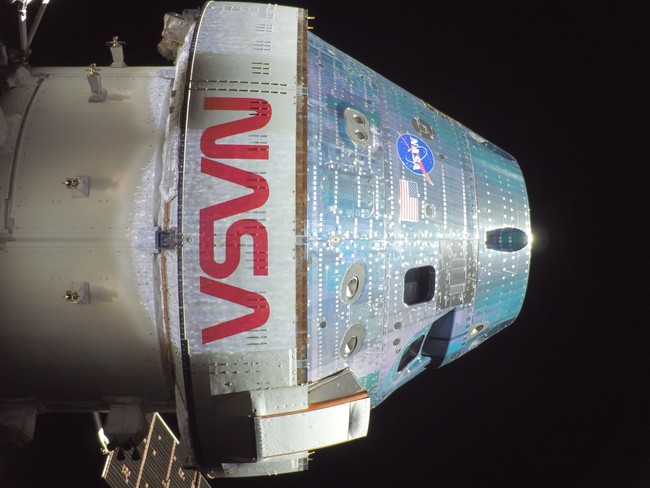
The Artemis II mission pushed human exploration farther than ever, carrying four astronauts on a historic lunar flyby, sharing heartfelt dedications, and sending back new views of the moon’s far side while setting distance records that challenge future generations to go even farther.
Most readers will recognize the Star Trek monologue that inspired the mood for this trip: “Space: the final frontier. These are the voyages of the starship Enterprise. Its five-year mission: to explore strange new worlds; to seek out new life and new civilizations; to boldly go where no man has gone before!” That spirit helps explain why the Artemis II flight feels both nostalgic and groundbreaking. The crew aboard Orion climbed to the furthest distance from Earth in human history during a seven-hour lunar flyby.
Deep-space means traveling beyond near-Earth orbit, and Artemis II is doing just that as the spacecraft swings around the moon and presents views of the hemisphere we never see from Earth. Observers often call that side the “dark side” even though, technically, it is the far side and is illuminated by the sun when conditions permit. The poetic label sticks because it captures the mystery of a hemisphere hidden from Earth’s view.
There were tender moments in the cabin as the crew chose names for two lunar craters while speaking with mission controllers. Canadian astronaut Jeremy Hansen suggested naming one crater “Integrity,” honoring the Orion spacecraft itself. He also proposed naming another crater “Carroll” in a tribute that connected the mission to the families and sacrifices behind the astronauts.
The Artemis II crew proposed new names for two lunar craters as they continued the flight that’s taking them around the far side of the moon.
Speaking to mission controllers, Canadian astronaut Jeremy Hansen suggested naming one crater “Integrity,” after the name of their Orion spacecraft.
And in an emotional tribute, he said they chose the name “Carroll” for another moon crater, after commander Reid Wiseman’s wife, who died in 2020.
“Some times of the moon’s transit around Earth we will be able to see this,” he said of the crater. “… And it’s a bright spot on the moon. And we would like to call it Carroll.”
As the spacecraft extended the human reach into space, Hansen offered a brief statement that acknowledged past explorers and challenged those who follow. He framed the moment as a continuation of previous efforts and a call to push limits even further before Earth’s gravity brings the crew home. The words connected the immediate achievement to a longer narrative of exploration and aspiration.
From the cabin of Integrity, as we surpass the furthest distance humans have ever traveled from planet Earth, we do so honoring the extraordinary efforts and feats of our predecessors in human space exploration.
We will continue our journey even further into space before Mother Earth pulls us back into everything that we hold dear.
Hansen added a challenge to future engineers and explorers, saying, “We challenge this generation and the next to make sure this record is not long-lived.” That line underscores a mindset common in space programs: records inspire follow-on efforts. The mission timing had the closest lunar approach predicted for around 7:02 p.m. ET on the day of the flyby.
The flight has been called a major success so far, and the mission even drew public congratulations from national leadership. Moments like that give the program broader political and public visibility, though the technical work remains the focus for the crews and teams back on Earth. The mission is designed to collect images and data during the far-side transit and to demonstrate systems needed for deeper missions.
Exploration to date has included lunar landings and numerous robotic missions to distant worlds, but humans have not yet found “new life and new civilizations.” That reality keeps missions like Artemis geared toward science, testing, and opening access to places we have only observed at a distance. The mission will return home with splashdown planned in the Pacific off San Diego, with arrival targeted for the evening of Friday, April 10, 2026.
Between now and splashdown, Artemis II is expected to produce more striking photographs and data from regions of the moon we’ve never observed directly from human eyes. The crew’s view of the far side and their personal dedications are already part of the story this flight will leave behind. Those images and the mission’s legacy will factor into designs and plans for future lunar and deep-space efforts.



Surprising! I’ve been making 100 Dollars an hour since I started freelance on the Internet six months ago. I work long hours a day from home and do the basic work that I get from the business I met online. share this work for you opportunity This is definitely the best job I have ever done…
just use the info on this page .====> PayAtHome1.Com