
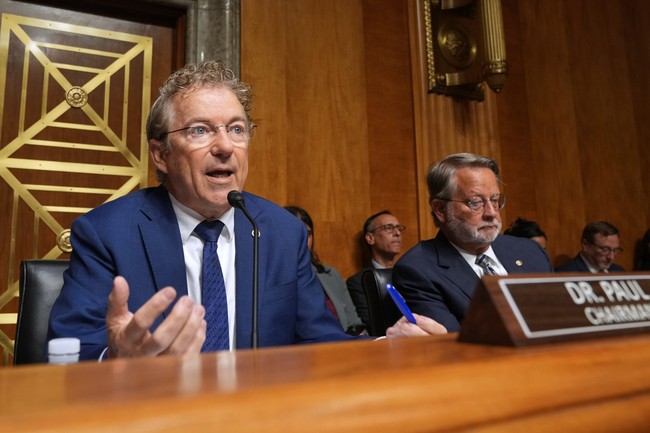
Sen. Rand Paul confronted Dr. Anthony Fauci at a recent hearing and exposed a detail that went largely unnoticed: Democrats on the oversight committee never even accessed the trove of evidence the GOP made publicly available, raising fresh questions about who wanted accountability and who preferred convenience over scrutiny.
At the hearing, Paul pressed the point that transparency was not the problem; engagement was. He noted the committee published documents and built a public portal, but Democrats never signed up to review the material, a fact that flips the usual narrative about access and obstruction.
That revelation came amid accusations from the committee’s ranking Democrat that the investigation was one-sided and withheld records. The counterargument from Paul was blunt and specific: the records were available and Democrats chose not to request the access code or visit the site.
The hearing focused on Fauci’s role in driving pandemic-era policies that some say overreached and inflicted lasting harm on Americans. As a physician and long-time critic of Fauci’s guidance, Paul framed his scrutiny as necessary to understand the origins of those policies and the decision-making that led to lockdowns, school closures, and restricted visitation at hospitals.
Paul’s approach combined medical expertise with procedural pressure, forcing answers about why certain recommendations were made and who advised them. He tied those decisions to real human costs, pointing to families forced to say goodbye over video and instances where patients’ deaths were conveyed in grotesque, impersonal ways.
https://x.com/JustTheNews/status/2082457393837858942?ref_src=twsrc%5Etfw
The exchange with Sen. Gary Peters highlighted a striking contrast: Democrats accused Republicans of playing politics, but Paul’s claim implies Democrats declined to engage with the actual evidence. That contrast matters because oversight only works if members on both sides participate in reviewing the facts, not only in denouncing the process from the sidelines.
During the hearing Paul stated publicly that the committee had done the opposite of secrecy, creating a transparent, searchable repository for all interested parties. His claim boiled down to this: the materials were put online, the access was offered, and the lack of Democrat sign-ups speaks to a lack of interest, not a lack of availability.
— Just the News (@JustTheNews)
“This is the most transparent investigation in the history of Congress. We actually created a website, and we put all of the information on the website. It continues to operate. The reason it hasn’t been accessed is no Democrat ever signed up for it. Not one Democrat. We told them the access. They never asked for the access code. They haven’t been on the website because they have not cared about the investigation.”
Those words landed hard because they shift the burden from access to accountability. If true, the claim suggests the political theater around Fauci has sometimes been louder than the actual work of digging through evidence. That’s a bad look for anyone who claims to want truth rather than talking points.
The broader implication goes beyond one hearing: accountability requires curiosity, not just outrage. When oversight is performed selectively or only when convenient, it weakens public confidence in institutions and lets crucial questions linger unanswered about public-health choices that reshaped daily life.
The stakes remain high because the pandemic era produced policy choices with deep social consequences. Examining the role of influential public-health figures must be more than symbolic. It should be a serious, bipartisan effort to understand what went right, what failed, and how to prevent avoidable errors in the future.
Rand Paul’s critique frames the debate as one about responsibility: were decisions made on solid science and open debate, or were they enforced by authority without sufficient challenge? His point forces a question Democrats often dodge—did they actively vet the evidence or simply accept the assurances and the institutional posture of Fauci’s office?
The hearing did more than revive old controversies; it put process back on the table. Whether people agree with Paul’s conclusions, his accusation that Democrats did not engage the available evidence demands an answer, and that answer will shape how the public judges the accountability of those who led the COVID response.


Add comment