
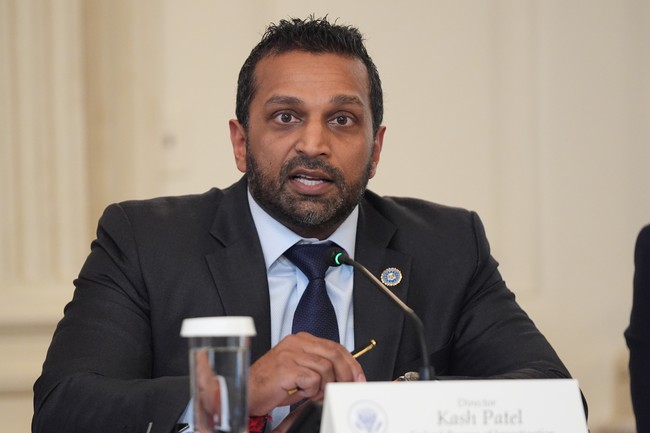
FBI Director Kash Patel told the House Intelligence Committee that the bureau has had to adapt its tactics to confront the Chinese Communist Party at home, describing both successes and limits imposed by existing law. He highlighted big wins in violent crime reduction and gang disruption while pointing to CFIUS restrictions that hamper efforts to address Chinese land purchases near U.S. military sites. Patel described two recent operations done with state and local partners to neutralize suspected CCP activity in Texas and off Louisiana. Lawmakers signaled interest in updating statutory authority so federal, state, and local partners can act more effectively.
Patel opened with a list of achievements he labeled historic for the FBI’s first year under the current administration, reporting major increases in arrests and significant seizures tied to public safety. Those numbers, he said, represent a renewed focus on violent crime, child exploitation, human trafficking, and drugs that are killing Americans. The bureau claims gains such as a 112% increase in violent offenders arrested and a 490% rise in arrests of online child predators. He also emphasized locating thousands of missing children and dismantling hundreds of criminal gangs.
At the same time, Patel warned that legal frameworks put in place by prior administrations limit how the FBI can address foreign influence on U.S. soil, particularly from the Chinese Communist Party. He singled out CFIUS as a restriction when it comes to property purchases near military installations, noting the existing statute only covers purchases within a one-mile radius. That gap, he said, forces investigators to look for alternative legal routes to act. Such workarounds underscore a mismatch between emerging national-security threats and out-of-date rules.
Where the statute falls short, the bureau has apparently become creative. Patel described operations where the FBI worked with state and local officials to target perceived CCP activity that fell outside CFIUS reach. In Texas, he said, a farm owned by a Chinese official was seized after an unlawful possession of firearms criminal complaint was executed. “But because he was outside the reach of the CFIUS law, the FBI executed an unlawful possession of firearms criminal complaint. We seized the land in its entirety, and that CCP official is back in mainland China. We are working to get him back here.”
Patel also discussed a counterintelligence operation near Louisiana that involved suspected cyberintelligence and data theft tied to foreign drilling operations. Working with the governor’s team, state authorities were given intelligence that led them to shut down a drilling center, which was believed to be used to “provide and steal data and intelligence” from Americans. That site lay beyond CFIUS jurisdiction, again illustrating how the bureau must rely on partners to fill legal blind spots. The director framed these moves as smart, coordinated responses to a sophisticated adversary.
He put the creativity plainly: “we’ve had to get ‘creative’ in several operations this past year.” Patel argued that close cooperation with state and local agencies allowed the FBI to act where federal rules limited direct intervention. He described seizing a 400-acre Texas farm tied to a CCP official and assisting in shutting down offshore activity in Louisiana. Those examples were presented as proof that, when federal authority is constrained, state-level cooperation can deliver results.
House Intelligence Chairman Rick Crawford pressed on the limits of CFIUS, calling the law “inadequate at this point” based on Patel’s testimony and urging Congress to examine legislative fixes. Patel welcomed the prospect of expanded tools for law enforcement, saying they would “love” broader authority to address these gaps. The exchange highlighted a bipartisan concern that policy must catch up with how adversaries operate inside the United States. For Republicans, the ask was straightforward: update the law to protect military sites, critical infrastructure, and Americans from foreign exploitation.
Patel framed the bureau’s broader work as restoring public safety and closing legal loopholes that foreign adversaries exploit. He pointed to dramatic increases in arrests for violent crime and child exploitation alongside aggressive work against trafficking and large-scale drug distribution. The message to lawmakers was clear: operational successes are possible, but sustainable, systemic results require legislative modernization. Without updated authorities, agencies will still need to improvise to keep communities and national security safe.
The director’s testimony places pressure on Congress to act where old rules leave dangerous gaps, especially around foreign purchases of land and covert intelligence collection near sensitive sites. Republican lawmakers emphasized that national defense includes securing domestic spaces from covert economic and intelligence operations. If Washington wants fewer surprises and more preventive action, the next step is a narrow, effective legal fix that expands the tools available to hold foreign threats accountable on U.S. soil.


Add comment