
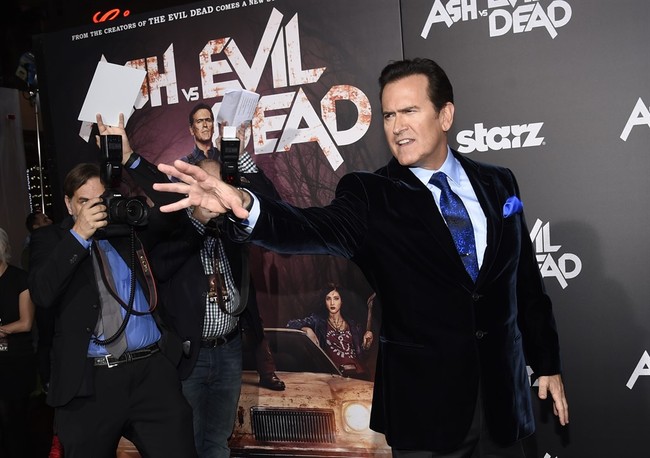
Bruce Campbell, best known for his work in the Evil Dead franchise and a string of cult TV shows and cameos, has revealed a treatable but incurable cancer diagnosis, and his message to fans mixes blunt honesty, a stubbornly optimistic spirit, and a refusal to be reduced to pity.
Some performers become icons not because they try to be different but because they are unmistakably themselves on screen. Bruce Campbell fits that mold: he brings a certain charisma and grin-ready bravado that lifts whatever project he touches, whether a big Sam Raimi set piece or a short-lived television series. Fans recognize that presence instantly and count on it to turn ordinary scenes into memorable moments.
Campbell announced his diagnosis directly, making clear that while the cancer can be treated it is not considered curable, and that he will need to pause public appearances and professional commitments to focus on therapy. He framed the news plainly, apologizing for any shock while signaling that he intends to tackle the work ahead without seeking sympathy. That straightforward tone is part of why his fans respond with loyalty and affection.
He has a long roster of credits beyond the Evil Dead films, including playful, underrated television work like Jack of All Trades and the western-tinged The Adventures of Brisco County, Jr., roles that showed a range beyond his cult horror status. He also turned up in multiple Sam Raimi projects and even made low-key appearances in Raimi’s Spider-Man films, always noticeable even in small parts. Those cameos and series work built a bond with viewers who appreciate his particular mix of self-aware bravado and physical comedy.
“The Evil Dead” star Bruce Campbell announced he’s been diagnosed with cancer and will be canceling upcoming appearances.
On Monday night, Campbell took to share that he has a “treatable” but not “curable” type of cancer. “I apologize if that was a shock — it was for me too,” he wrote.
“I’m posting this, because professionally, a few things will have to change — appearances and cons and work in general need to take [a] back seat to treatment,” Campbell continued.
Campbell did not dwell on gloom. He explicitly warned against false rumors, saying he wanted to get ahead of misinformation, and made it clear he was not soliciting advice or sympathy. That candid stance reflects a career spent in front of passionate, sometimes loud fandoms; he knows how narratives form and wanted to control this one from the start. Fans respond to that kind of directness—he speaks plainly and expects people to meet him on that level.
https://x.com/GroovyBruce/status/2028628509128876473?s=20
Campbell kept the rest of his message short and sweet, explaining that he’s “not trying to enlist sympathy — or advice.”
“I just want to get ahead of this information in case false information gets out (which it will). Fear not, I am a tough old son-of-a-b—- and I have great support, so I expect to be around a while. As always, you’re the greatest fans in the world and I hope to see you soon!” Campbell concluded.
That toughness is part of the persona, but so is gratitude. He thanked his fans and acknowledged the support around him while letting them know that treatment will change his schedule for the foreseeable future. For anyone who’s admired Campbell for decades, that combination of grit and gratitude is exactly what they hoped to hear—steady confidence, not melodrama.
Among his many highlights, Army of Darkness stands out as a signature moment where Campbell’s timing, physicality, and comic instincts aligned perfectly with Sam Raimi’s kinetic direction. That film contains scenes fans still quote and revisit, moments that made Campbell a cult hero and kept the Deadite mythology alive across generations. Even now, with difficult news, those films are the ledger of why so many are rooting for him.
Campbell’s career is the kind that built community: conventions, fan events, and late-night screenings where audiences cheered at familiar beats and lines. He acknowledged that some of those events will be postponed while he undergoes care, and he asked only for a little patience as he focuses on getting through treatment. That request is simple and reasonable, and his fans are already answering it with well-wishes and stories of how his work shaped their love of genre entertainment.
In place of speculation and rumor, Campbell offered a plain statement of fact and an attitude that smoothed the edges: he plans to fight this and expects to be around for a while. For a public figure whose identity is tied to resilience, theatrical bravado, and a genuine fondness for his audience, that approach feels true to form. Fans will keep watching, rewatching, and bringing their boomsticks when called.
Editor’s Note: Hollywood, academia, and liberal elites are out of touch with the average American.

Add comment