
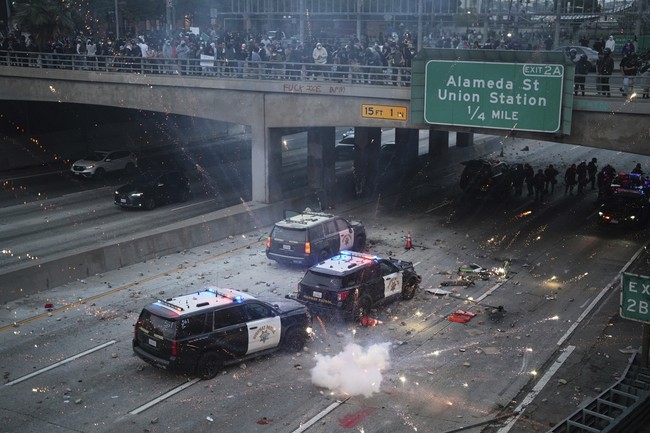
The recent convictions of anti-ICE agitators in Los Angeles and Portland show federal prosecutors moving from warnings to real consequences, with motorcycle and wooden-stake attacks now meeting felony pleas and scheduled sentencing dates. Court filings and public posts confirm guilty pleas under federal statutes, scheduled hearings, and potential multi-year prison terms, signaling a tougher posture toward violent protests that interfere with immigration enforcement. Local leaders’ responses, federal deployments, and the rule of law in action are all part of this developing story. The cases involve specific defendants, dates, and charges that underline how violent interference with law enforcement is being prosecuted.
In Los Angeles, protests against immigration enforcement escalated into actions that blocked traffic and clashed with officers, prompting federal and local responses. The unrest prompted criticism of local officials and led to National Guard involvement, while individual confrontations with police crossed into criminal conduct. One man who drove his motorcycle into a police skirmish line was later charged in both state and federal court, and his case moved forward to a guilty plea and a federal sentencing date. The progression from unrest to prosecution shows authorities are treating violent obstruction of federal operations as serious federal offenses.
For the second day in a row, people protesting without a permit have shut down Los Angeles roadways and assaulted police officers, and for the second day in a row Mayor Karen Bass has publicly ignored the situation and privately told officers to stand down and retreat.
The lawbreakers, many of them holding flags from Mexico and other Latin American countries, say they’re there to protest ICE raids, which they claim are picking up sweet little abuelas and whisking them off to concentration camps.
Randy Paul Ruiz, identified in public filings, pleaded guilty to obstructing, impeding, or interfering with law enforcement during civil disorder under 18 U.S.C. 111. The factual account describes him riding his motorcycle into a skirmish line outside a federal building on June 8, 2025, after protests had already shut federal offices and a nearby freeway. His case was highlighted publicly by prosecutors and will be resolved at a federal sentencing hearing scheduled for November 2. Those developments illustrate how acts that physically target officers are being escalated into federal offenses with substantial penalties.
Public statements and social posts from prosecutors emphasized the gravity of the conduct and framed the prosecutions as enforcement of laws passed by Congress. Officials noted that federal officers and Border Patrol personnel were protecting property and personnel threatened by violent agitators. The legal filings set out dates, alleged actions, and the statutory basis for felony charges, turning what some protesters viewed as civil disobedience into clear criminal conduct. This shift from crowd control to criminal accountability underlines a law-and-order approach favored by many who want public safety restored.
Portland produced a separate but equally serious prosecution after a June riot near an ICE office resulted in a brutal assault on a federal officer. Court documents describe a man striking an officer in the head with a wooden stake while that officer was making an arrest. A federal grand jury later returned a three-count indictment charging assault on a federal officer, assault with a dangerous weapon, and civil disorder. That indictment reflects the federal government’s intent to pursue stiff penalties in cases where officers are physically attacked.
A Gresham, Oregon, man pleaded guilty today after he was charged with assaulting a federal law enforcement officer during a declared riot near a U.S. Immigration and Customs Enforcement (ICE) office in South Portland.
Ginovanni Joseph Brumbelow, 22, pleaded guilty to assault on a federal officer with a dangerous weapon.
https://x.com/USAttyEssayli/status/2081882232931967273
According to court documents, on June 14, 2025, Brumbelow struck a federal officer in the back of the head with a wooden stake while the officer was arresting another individual during a riot at the ICE facility in South Portland.
On July 15, 2025, a federal grand jury in Portland returned a three-count indictment charging Brumbelow with assault on a federal officer, assault of a federal officer with a dangerous weapon and civil disorder.
Prosecutors reported that Ginovanni Joseph Brumbelow faces a maximum sentence of 20 years in prison, a $250,000 fine, and three years of supervised release under the plea agreement, and that he will pay restitution to the injured officer. The sentencing date is set for October 19, marking a clear timeline for federal consequences. These penalties reflect the statutory maximums tied to assaultive conduct against federal personnel, especially when a weapon is involved. The federal approach signals that violent interference with immigration operations will be met with severe punishment.
Both cases are being presented by federal prosecutors who stressed the importance of protecting officers and enforcing federal statutes. The prosecutions cite specific dates, charges, and procedural milestones such as indictments, guilty pleas, and sentencing schedules. Local political leaders who were criticized for their handling of protests remain part of the broader context, and federal action stepped in where local response was seen as insufficient. The net effect is a visible hardening in enforcement aimed at deterring violent obstruction of federal law enforcement.
Officials and observers watching these developments see a pattern: when protests turn violent and target officers, federal law offers straightforward tools to hold perpetrators accountable. The cases show concrete application of federal statutes to actions that cross the line from protest into felony assault and civil disorder. With sentencing dates set and plea deals filed, the judicial process is moving toward punishment rather than mere warnings. Those outcomes will likely influence the tactics of future demonstrations and the expectations of public officials and law enforcement.
The debate over the balance between protest rights and public order will continue, but recent convictions make it clear that violent attacks on federal officers are no longer treated as incidental. Prosecutors have spelled out charges, courts have accepted guilty pleas, and sentencing schedules are in place, underscoring a predictable follow-through. For communities and law enforcement alike, these cases set precedents about how similar incidents will be handled. The federal response aims to reinforce the rule of law and protect federal personnel carrying out immigration enforcement duties.



Add comment