
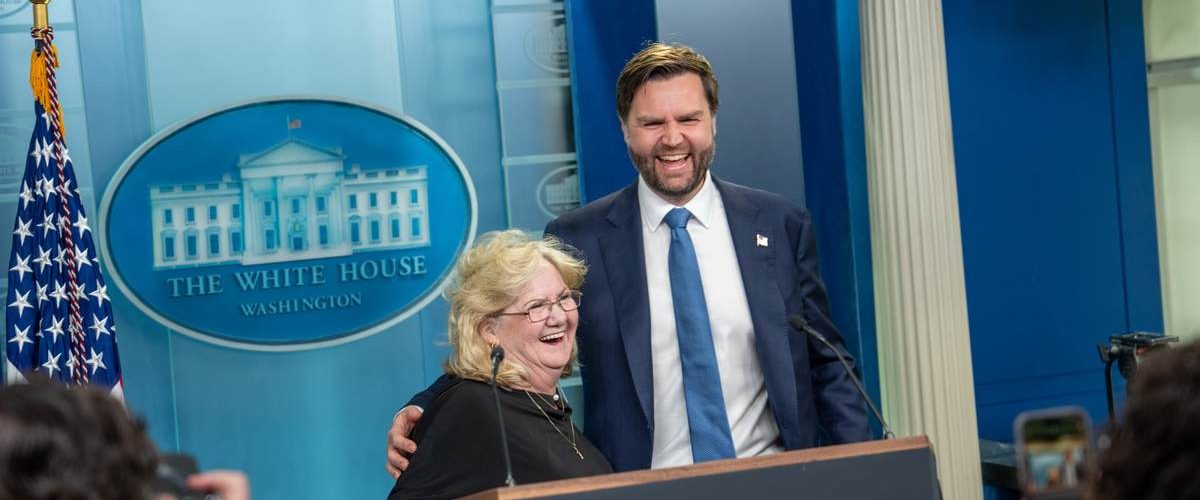
JD Vance’s mother has pushed back hard after Michigan Democrat Abdul El‑Sayed repeatedly attacked Vance’s family, and her blunt response exposes how personal political attacks cross a line. This piece walks through the exchange, the quotes from Beverly Vance Aikins, the context of El‑Sayed’s comments about the Vance family, and how the situation plays in the current political climate.
Abdul El‑Sayed has made a habit of targeting Vice President JD Vance’s family, and it hasn’t gone unnoticed. The comments have included references to Usha Vance and the couple’s children, which many view as out of bounds for a candidate seeking public office. Those attacks landed loudly with the Vance family and their supporters, who see this as a pattern of personal smears rather than substantive debate.
Beverly Vance Aikins stepped into the fray speaking plainly and without restraint, reflecting a common conservative view that family is off-limits in political contests. She said, “I think that man’s an idiot,” and added, “Those are my babies.” Her words were delivered on a televised program where she made it clear she feels protective and offended by the focus on her grandchildren.
Aikins made a point of expressing genuine affection for Usha Vance, noting, “I love Usha as if she were my own daughter,” and suggesting jealousy may explain El‑Sayed’s fixation on the family. She emphasized JD Vance’s accomplishments and stable family life, noting that he is 42, vice president of the United States, and has “a beautiful wife” and four children. That framing underlines a contrast conservatives often draw between family-focused leadership and candidates who trade in personal attacks.
The mother’s anger was straightforward and familiar: “It makes me mad, honestly,” she said, insisting El‑Sayed doesn’t know her son or the kind of person he is. She acknowledged the impulse that many relatives feel when a stranger criticizes their loved ones, and she voiced the kind of protective instinct voters respect. Then she added the line many listeners laughed at and understood: “I’m not gonna do anything about it,” Aikins said. “I mean, you know, I’d probably punch the guy if I’d ever seen him, and then that would get me in trouble.”
That mix of humor and menace landed well with an audience tired of personal attacks from the left, and it highlights a simple point conservatives often make: candidates should stick to issues, not families. Critics of El‑Sayed note that he has a wife and children of his own yet continues to reference the Vances’ family life in ways many find disrespectful. That inconsistency weakens his position when voters expect better judgment from those seeking higher office.
El‑Sayed has attempted to recast his behavior as restrained, telling a national outlet, “Look, I’d rather not talk about spouses at all.” He went on to say, “The truth of the matter is that Donald Trump, almost as soon as I was nominated, tweeted a picture of me and my wife relative to him and his wife, trying to highlight the fact that my wife wears a hijab, as if to make an argument that that’s somehow less American.” That defense rings hollow to those watching the tape of his own remarks about the Vance children.
If El‑Sayed genuinely wanted to move past family-focused attacks, the remedy is simple: stop directing attention to other people’s spouses and children. Until he does, voters will judge him by his words and the pattern they reveal. Aikins’ blunt defense of her family crystallizes the broader argument: political contests should be fought on principles, policies, and records, not on cheap shots aimed at loved ones.
https://x.com/TLisFearless/status/2095303845995790431
The exchange also plays into a larger 2026 midterm narrative about respect, norms, and political conduct. Republicans argue that dignity and boundaries matter in public life, and when opponents repeatedly cross those lines, it invites pushback that looks defensive but reasonable. Beverly Vance Aikins’ comments are part of that pushback: they resonate because they come from a place that voters recognize and sympathize with.
At the end of the day, the controversy is less about one television appearance and more about how candidates behave when the spotlight is on them. The Vance family response—direct, familial, and unapologetic—illustrates the political cost of personal attacks. For many voters, seeing a mother protect her family is not only familiar; it’s a reminder of the standards they want in public life.



Add comment