
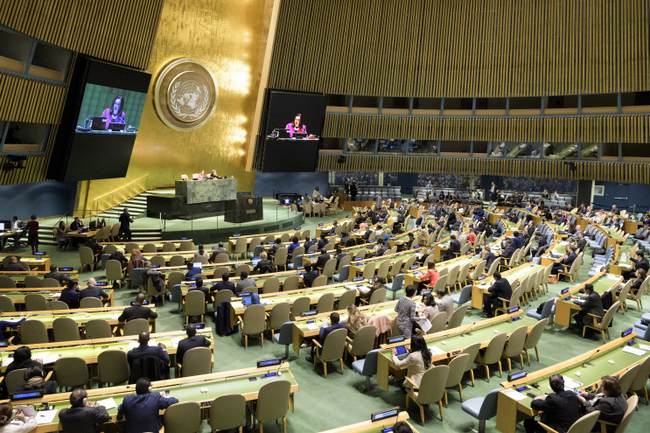
The U.N. Commission on the Status of Women released a yearly document this week that sparked an international dispute, with the United States casting the lone vote against a text criticized as heavy on DEI language and vague on basic definitions about sex and womanhood.
The Commission’s report is supposed to highlight injustices facing women around the world, but U.S. officials at the meeting said the draft was saturated with diversity, equity, and inclusion talking points and unclear language on reproductive issues. Delegation members described missing references to motherhood and what they called unique female experiences, and they objected to the document’s refusal to define the term “woman.”
Bethany Kozma, Director of Global Affairs at the Department of Health and Human Services, told the story of how the process unfolded and why the U.S. took a firm stand. She said the sequence of events looked off from the start, and that several proposed amendments intended to protect the clarity of the text were effectively ignored. Those amendments, she explained, would have allowed nations to support individual fixes rather than accepting or rejecting a bundled package.
“The UN Commission on Women is supposed to be for women, yet for years, it’s been co-opted to include men pretending to be women. Many countries claim to support and empower women, yet some of them cannot even answer the simple question: ‘What is a woman? Thanks to the moral leadership of President Trump, the tide is changing and we’re standing up for women and girls. And I really was hopeful that we could come to an agreement.”
According to the U.S. delegation, a final draft arrived late on a Sunday with no record that Washington’s proposed changes had been acknowledged or recorded. Instead of being voted on separately, the amendments were bundled into a single package, which made it impossible for countries to pick and choose reasonable adjustments. Presented this way, the package failed and the United States chose to vote against the whole text.
The voting pattern that followed was telling. The U.S. stood alone in opposition, while several nations known for mixed records on women’s rights abstained rather than supporting the document outright. That split raised concerns among U.S. officials who argued that the Commission had lost focus on defending biological women and girls and was prioritizing ideological language instead.
Kozma reiterated that the content of the text was not something the U.S. could endorse and that the delegation had offered what she called common-sense amendments. She framed the objection as a defense of clear language and of protections that should prioritize female-specific needs and experiences. The complaint was not merely procedural; it was substantive, centered on whether international instruments meant to protect women should refuse to define basic sex-based categories.
“The text was not something that the U.S. liked at all. It would not have been something that we would have ever put out on behalf of the United States government, but we had offered several amendments that were just very common sense.”
Critics of the U.S. stance argued the Commission was evolving to recognize diverse gender identities and that the U.S. position risked isolating itself. Supporters of the vote against the document argued the problem runs deeper: if a body meant to defend women cannot agree on what a woman is, it cannot reliably craft protections that address sex-specific harms.
The episode highlights a broader cultural clash at multilateral institutions where debates about gender identity, policy language, and national sovereignty collide. For the U.S. delegation, the dispute was framed as defending clarity and the tangible rights of women and girls; for others, the row reflected shifting international norms around inclusion and identity.
What matters for observers is the precedent this sets at the U.N. level. When drafting global policy, precise language determines who receives protections and who is left in legal and practical limbo. The U.S. position in this instance was to insist that, without clear definitions, a document cannot credibly claim to protect the group it purports to serve.

Add comment