
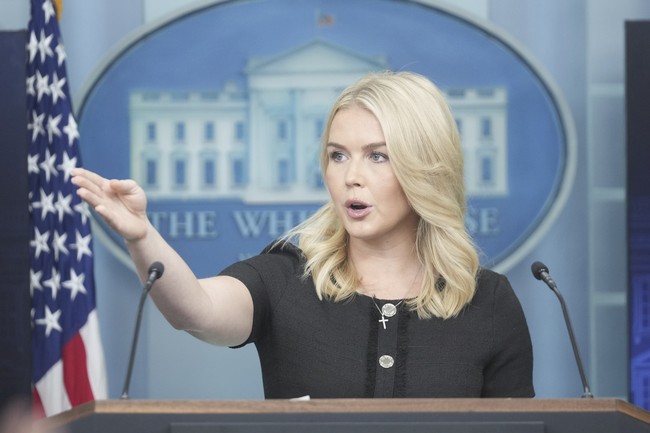
The White House press secretary pushed back on recent Iranian claims about the Strait of Hormuz after a ceasefire was announced, calling some reports false and highlighting inconsistencies between Tehran’s public statements and on-the-ground activity over shipping and regional attacks.
The ceasefire announced Tuesday night was meant to pause hostilities, but Iran immediately framed the deal in broader terms than officials say were agreed. U.S. officials and other observers dispute Tehran’s version, noting the accord did not concede to Iran’s reported 10-point demands. That discrepancy has already fueled confusion and competing narratives across the region.
Shortly after the ceasefire, various outlets reported that Iran and Oman had arranged for fees on ships transiting the Strait of Hormuz, a move that would change a longtime practice in one of the world’s most important shipping lanes. Oman’s defense and transport officials have denied those fee claims, stressing that existing agreements prevent such charges. That official denial undercuts the reports that suggested a new payment regime was part of any deal.
Omani Transport Minister on imposing fees on ships passing through the Strait of Hormuz: Oman has signed all agreements that stipulate no fees shall be imposed.
Even with those denials, Iranian state media released statements suggesting Tehran might block ships from passing in response to Israeli strikes in Lebanon, a claim that contradicts other eyewitness accounts. Fox correspondent Trey Yingst reported seeing two tankers transit the strait, evidence that at least some commercial traffic continued despite Tehran’s rhetoric. Those conflicting reports raise questions about whether Iran intends to follow through on threats or is trying to manipulate the narrative for political effect.
The United States has been clear that Lebanon was not part of the ceasefire framework tied to the Strait, so Iran’s linking of shipping access to events in Lebanon appears to stretch the scope of the original agreement. Analysts say such moves could be aimed at protecting Hezbollah by creating leverage over maritime traffic. Using the strait as a bargaining chip would be a worrying escalation, since the waterway handles a significant portion of global oil shipments.
At the same time, Iranian forces reportedly struck the Saudi East-West pipeline, a key alternative route that reduces reliance on the Strait of Hormuz. Hitting that infrastructure complicates assumptions that commercial traffic can simply divert around the strait if Tehran interferes. Such attacks suggest a pattern where Iran damages both primary and backup routes, limiting options for shippers and raising insurance and security costs for global trade.
White House Press Secretary Karoline Leavitt challenged claims that Iran had reclosed the strait or imposed fees, saying public reporting and U.S. assessments indicated vessels were transiting. Leavitt emphasized a gap between what Iran announces publicly and what independent observers are seeing, highlighting the difficulty of trusting Tehran’s statements. That skepticism reflects broader U.S. policy goals, including preventing Iran from expanding its nuclear capabilities and limiting its missile program.
President Donald Trump has said any deal must address Iran’s enriched uranium and other nuclear-related activities, reiterating that restricting Tehran’s path to a weapon is a central U.S. objective. Controlling nuclear enrichment and ballistic missile capacity were major points of concern long before the recent flare-up, and officials say they remain priorities in any diplomatic or security arrangement. Those demands help explain why American negotiators and allies insist on verification and enforcement mechanisms in any agreement with Iran.
The administration’s messaging stresses verification and monitoring to ensure Iran cannot covertly rebuild or expand dangerous capabilities while publicly claiming compliance. Critics note, however, that Tehran has a history of opaque behavior and strategic deception, making any deal fragile without robust inspection and consequences. That history informs why U.S. officials and partners are cautious about accepting Tehran’s public statements at face value.
Observers watching shipping and regional military moves over the next two weeks will be looking for consistency between Iran’s official pronouncements and actual behavior at sea and on the ground. If vessels continue to transit the Strait of Hormuz uninterrupted, that will undercut Tehran’s more aggressive claims. Conversely, any attacks on commercial shipping or alternative infrastructure will confirm fears that Iran seeks to use maritime pressure to influence developments in Lebanon and beyond.
What happens now will test whether a temporary pause in fighting can hold when one party has repeatedly shown it will pursue broader regional aims. The situation remains fluid and unpredictable, with many actors holding different expectations about the scope and intent of the ceasefire. For policymakers and commercial interests, the immediate issue is simple: ensuring safe passage through one of the planet’s most vital chokepoints while preventing Tehran from exploiting diplomatic ambiguities.



Add comment