
This piece explains why former President Trump is demanding no Department of Homeland Security funding deal until Democrats agree to the SAVE America Act, how that demand ties to voter ID and election integrity, and how the Senate fight and public sentiment shape the standoff.
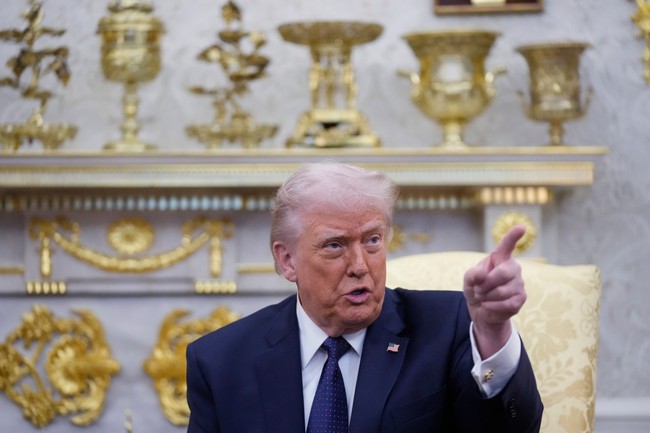
Donald Trump has made a hardline stance clear: no compromise on DHS funding without Democrats accepting the SAVE America Act. He frames the law as essential to election security, insisting proof of citizenship and photo ID are non-negotiable before any funding packages move forward.
On social media he threw down a challenge to Republicans who might consider a softer approach, calling out what he describes as weak-kneed colleagues and labeling Democratic opposition as destructive. He argues the stakes are national and immediate, and that leadership should force the issue rather than fold under pressure.
“I don’t think we should make any deal with the Crazy, Country Destroying, Radical Left Democrats unless, and until, they vote with Republicans to pass ‘THE SAVE AMERICA ACT,'” he wrote. He followed that by saying the measure is “far more important than anything else we are doing in the Senate …”
Trump also warned that any package that includes cuts to ICE, even in disguise, is unacceptable unless the SAVE America Act is attached. He has broadened the demand beyond voting rules to cultural-policy positions on sports and medical decisions for minors, framing a larger conservative agenda as tied to the funding fight.
That hardline posture is no accident; it’s a tactic to force Democrats to address what many conservatives view as rampant vulnerabilities in the electoral system. The strategy is to make DHS funding conditional on a bill that would tighten voter identification and registration rules nationwide, turning a routine appropriations fight into a referendum on election rules.
Senate dynamics have been tense. A handful of Republicans have resisted moving the SAVE America Act forward, and at least one GOP senator voted against it, creating the narrow margins that make a unified party position crucial. Trump has urged GOP senators to use every tool at their disposal, even suggesting breaking or altering Senate procedures if necessary to secure the bill’s passage.
Sen. Mike Lee publicly criticized Democrats’ arguments, stressing that constitutional protection of voting does not mean the system must be easy to abuse. His remarks called out what he sees as an indefensible willingness to make voting effortless at the expense of integrity, a point that resonates with many conservative voters concerned about fraud.
Opponents claim the SAVE America Act would restrict access, while supporters say it would merely enforce commonsense safeguards like photo ID and citizenship verification. That fundamental disagreement is the core reason the funding bill turned into leverage: each side views the other as willing to either undermine or weaponize the franchise.
Democrats in the Senate have repeatedly blocked a House-passed DHS funding bill, prolonging a shutdown that began on February 14. The blockade has left frontline workers unpaid and worsened chaos at transportation hubs, which Republican critics highlight as proof Democrats are prioritizing political demands over public safety.
Trump has announced an intention to use executive authority if Congress fails to act, promising to pursue an order enforcing strict voter ID requirements nationwide before the 2026 midterms. He acknowledges such a move would likely face legal challenges, but sees it as a necessary backstop if the legislative route continues to stall.
Pro-voter ID messaging leans on polling and public sentiment that consistently show broad support across party lines. That argument was reinforced by the quote from CNN data analyst Harry Enten: “Voter ID is NOT controversial in this country. A photo ID to vote is NOT controversial in this country. It is not controversial by party, and it is not controversial by race,” which conservatives use to underline the mainstream nature of these reforms.
From a Republican viewpoint, insisting on voter ID and citizenship verification is framed as protecting honest voters and maintaining trust in elections. The party sees the current fight as a rare moment where policy, public safety, and electoral legitimacy intersect, making the funding battle both tactical and symbolic.
Critics counter that tying homeland security to voting rules risks harming vulnerable communities and politicizing essential services, but the Trump camp argues the opposite: that safeguarding elections is precisely what preserves a functioning democracy. The rhetoric has ratcheted up as both sides mobilize their bases and the Senate counts votes.
Ultimately, the standoff has exposed fractures within Congress and highlighted how high-stakes policy priorities can be leveraged in appropriations battles. For conservatives pushing the SAVE America Act, the demand is simple: make election integrity a prerequisite for routine government funding, and let the political consequences fall where they may.

Add comment