
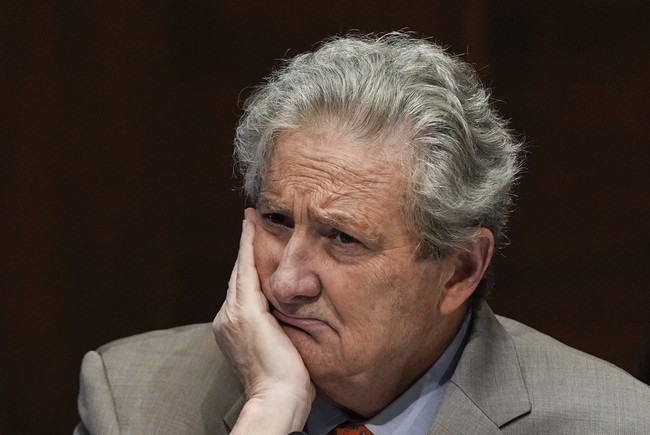
Senator John Kennedy took the Senate floor and forced a raw, public moment into focus: if colleagues block pay for frontline TSA workers, then lawmakers should face the same consequence. His motion to withhold Senate pay during the impasse turned into a dramatic exchange when an objection was raised and a Democratic senator abruptly left the chamber, prompting Kennedy to demand accountability in plain, furious language.
Senator John Kennedy (R-LA) has a reputation for sharp, folksy commentary, and he used it here with surgical effect. He proposed that if some senators block passage of legislation to restore pay for Transportation Security Administration employees, the Senate should also lose pay until the issue is fixed. The idea landed not as a quip but as a pointed ethical challenge aimed at colleagues who, in his view, are shirking responsibility.
On the floor, Kennedy formally moved to cut off senators’ pay until TSA employees were paid, pressing the chamber to match consequence with duty. At the critical moment an objection rang out, and the senator who raised it left the chamber rather than staying to defend his position. That abrupt exit converted a procedural skirmish into a raw test of courage and accountability.
Witnesses heard the objection, and then the scene turned strange as the objector departed, leaving Kennedy looking for an answer. The episode is captured near this moment: .
It may be cynical but it’s true: if I were king for a day…I would provide that members of Congress can’t be PAID during a shutdown, and I would provide that members of Congress can’t leave Washington DC during a shutdown!
I can’t pass the 2nd part of that. So I’m gonna try to pass the 1st part of that!
Kennedy’s shock at the sudden exit is plain in his remarks, and he made the point loudly that public servants ought to stand and argue their case. He asked whether the objector was ill and whether more time should be given, all while questioning the decency of blocking a measure meant to ensure TSA agents receive their wages. That line of questioning forced a spotlight on procedural games that leave federal workers in limbo.
After the initial exchange, the clip shows Kennedy incredulous: “He objected and LEFT THE CHAMBER. Is he COMING BACK?” The behavior struck many as unbefitting of a chamber meant for debate and confrontation of ideas. The moment underscored a deeper frustration over senators who block action yet avoid accountability when challenged.
Here’s the clip they were watching: .
KENNEDY, stunned: “He objected and LEFT THE CHAMBER. Is he COMING BACK?”
“Wait, I mean, is he ill?!” “What should I do, should I give him more time?”
He wants to BLOCK TSA pay and won’t face the American people. Shameful!
The procedural reality is simple: a single objection can stall a motion, and opponents sometimes rely on that to avoid debate. Kennedy called this out as cowardice, arguing that senators who oppose measures should at least explain themselves publicly to the American people. For a Republican concerned with accountability and the dignity of public institutions, that is the core of the complaint.
The scene continued to escalate as Kennedy urged colleagues to physically come to the floor and justify their votes to voters and to the workers affected by stalled pay. He framed the issue as basic fairness—if TSA agents are unpaid because of legislative delays, senators who block pay should answer directly to the public. That blunt appeal resonated with people tired of political theater replacing straightforward leadership.
The footage of the confrontation is embedded here for context:
His words after the disruption left no doubt about his intent to press the point. He demanded that opponents stand “in front of the United States Senate, and stand up in front of the American people, and stand up in front of God” and explain why they would block pay for federal workers.
If a member of this body disagrees with what I’m doing, they by God they ought to come down here and stand up in front of the United States Senate, and stand up in front of the American people, and stand up in front of God and stand up in front of (the) country, and stand up in front of all these people, these good people who aren’t being paid, and say ‘here’s why.’ Maybe we need to change the Senate rule, Mr. President.
Kennedy’s call for rule changes is less about theatrics and more about restoring a sense of responsibility to the institution. He suggested altering Senate rules to prevent members from blocking action and then fleeing accountability, which would force real debate instead of procedural stalling. That proposal will please those who want Congress to operate with consequences aligned to duties.
Observers noted that the departing senator has been mentioned as a potential future leader in his caucus, which raises questions about judgment and temperament. If representatives aspire to lead, Kennedy argued, they should demonstrate the courage to defend their choices publicly rather than hide behind tactical interruptions. The episode leaves voters with a clear snapshot of who will stand and who will step aside.
The moment also highlights a broader Republican point: government should prioritize working people and stop letting internal politics punish the public. When federal employees go unpaid because of partisan gridlock, the American people lose confidence in their institutions. Kennedy’s public rebuke is a reminder that elected officials should answer directly for the real-world impact of their actions.
The conversation around accountability will continue, and the footage of the Senate exchange remains a sharp example of why many demand clearer rules and firmer standards of behavior from their leaders.
At the end of the day, Kennedy pushed the chamber to reconcile rhetoric with consequence and to stop treating livelihoods as bargaining chips. The episode is a raw portrait of dysfunction, and it offered voters a vivid choice about who will stand for workers and who will avoid facing them.

Add comment