
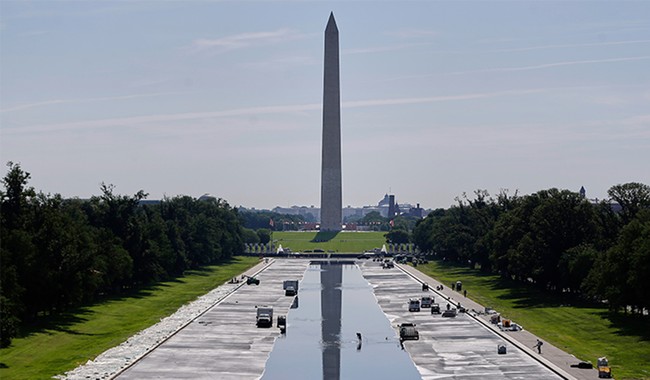
The Newsom press office tried to mock President Trump’s project to renovate the Lincoln Memorial reflecting pool, but fresh photos and updates made that jab look misplaced and politically tone-deaf. This piece walks through the timeline, the objections, the costs, and the awkward rebound for California’s governor, highlighting the facts and exact quotes involved without the usual spin.
The reflecting pool renovation became a flashpoint almost as soon as President Trump announced it, with opponents quick to lampoon the idea. Critics cried foul about cost and motive while ignoring decades of neglect and the visible condition of the pool. The president said the pool was in terrible shape, and many people who see the finished work say the criticism from Newsom’s team aged poorly.
Trump first teased a major cleanup in November and then confirmed in April that renovations would move forward, saying a friend from Germany remarked on how bad the pool looked. He described it plainly: “He said, ‘it’s filthy, dirty. The water is disgusting looking. It’s not representative of the country,'” which is exactly how he recalled the visit during a White House event. The president also noted the pool had been empty because “it was in terrible shape” and “leaked like a sieve for many years.”
The last overhaul of the reflecting pool wrapped up in 2012 under the Obama-Biden administration, cost $34 million, and took two years, largely because the structure had suffered significant sinking and leaking since its debut in 1923. Even after that expensive renovation, algae and deterioration returned quickly, which fed the argument that periodic, direct intervention is necessary. That history matters when judging a new effort to restore a national landmark, not just partisan chest-thumping.
On the ground this spring, Trump announced crews had largely finished the work and only the filling remained, with officials preparing to add water in an “American Flag Blue” color. Visual updates and photos circulated showing the pool’s new finish and the work crews in place, and these images changed the narrative for many observers. Attempts to score political points by presenting the site as a disaster after the work completed looked off-base almost immediately.
In mid-May, California’s press team tried to score an easy political jab by tweeting a picture that implied the project was a vanity mess, but that post was quickly undermined by later updates. The image they shared was treated as if it showed the completed project, when in fact the site was still in progress and not representative of the final result. Public reaction tended to focus on the mismatch between the social media attack and what people were seeing just weeks later.
Those who mocked the cleanup were soon shown updated views taken three weeks after the Newsom post, which revealed a finished look the critics had not expected. Conservatives and independents pointed out the irony: a governor who presides over billions in sticky, unfinished projects in his own state was eager to sneer at a federal restoration that addressed clear structural problems. That contrast has become a central talking point for supporters of the project.
Beyond the optics, the project drew scrutiny over estimated costs and legal challenges, but none of that erased the basic fact of visible neglect. There was even litigation aimed at blocking work, which became another predictable political beat, yet crews kept moving forward. At the end of the day, many casual observers judged the effort on whether the pool looked better and whether it stopped leaking, not on campaign messaging.
Critics also found themselves open to counterattacks about long-running California failures, like the state’s high-speed rail plan, which has ballooned into an enormous price tag projected at $231 billion in some estimates. Commentators used that comparison to question the moral authority of a governor who publicly sneered at federal spending while managing costly and controversial projects back home. Those hit-backs landed with voters who remember broken promises and unfinished ambitions.
Public relations missteps, especially from entrenched political offices, can do more harm than good when they call out an obvious improvement in a national monument. Mocking visible progress invites scrutiny of your own record in response, and that is exactly what happened for Newsom’s press team. The reflecting pool became less about aesthetics and more about who gets to lecture whom on stewardship and priorities.
https://x.com/WhiteHouse/status/2062652076862157126


Add comment