
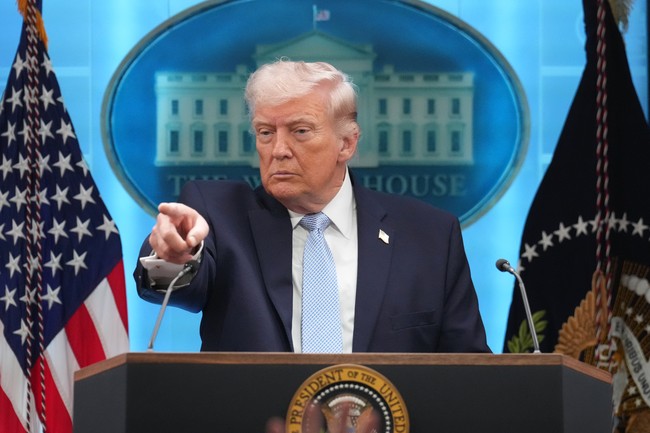
President Trump sharply accused a leaker of endangering an American airman after the downing of an F-15 over Iran, vowed to track the source, and promised consequences for anyone who put troops at risk by revealing sensitive operational details. He argued the media disclosure alerted Tehran to the presence of a missing crew member and turned civilians and enemy forces into bounty hunters. The episode heightened tensions, exposed gaps in information control, and prompted Republican calls for stronger accountability. This article lays out the timeline, the President’s response, and why the administration says the leak crossed a line into aiding the enemy.
In a White House briefing room marked by visible frustration, the Commander in Chief said the leak changed the dynamics of a dangerous rescue operation and increased risk to U.S. forces. He said the publication revealed that the United States could not initially reach the second crew member, information that Iran did not previously possess. “We’re looking very hard to find that leaker,” he said. “They basically said that we have one, and there’s somebody missing. Well, [Iran] didn’t know there was somebody missing until this leaker gave the information.”
The President made clear he intends to press the outlet that ran the story to identify its source, framing this as a matter of national security rather than a press freedom dispute. “We think we’ll be able to find it out,” Trump continued. “Because we’re going to go to the media company that released it, and we’re going to say, ‘National security. Give it up or go to jail.’”
Officials say the leak surfaced while the second crew member was alive and behind enemy lines, creating an urgent race to extract him before Iranian forces or civilians, stirred by state broadcasts, could capture or kill him. Iran’s state TV encouraged locals to search for any “enemy pilot” and tied the hunt to a cash reward, which officials warn turned ordinary people into involuntary collaborators of the regime. That public call by Tehran transformed a military recovery into a chaotic scramble with incentives that directly threatened the airman.
Trump stressed how the disclosure made already difficult operations much harder by mobilizing civilians and the Iranian Revolutionary Guard Corps with deadly intent. “All of a sudden, they know that there’s somebody out there,” he told reporters, describing how the leak multiplied risks for returning search teams. He noted that the sight of U.S. aircraft and rescue activity, once the leak hit, made the mission both more visible and more dangerous to those involved.
Details reported externally were first circulated by foreign outlets and then echoed by U.S. media, a pattern that officials say deserves scrutiny when it intersects with live operations. The swift pickup by several outlets meant Tehran learned of a missing U.S. airman from open reporting rather than from battlefield events, undermining tactical surprise. The result, according to administration voices, was that Iran could immediately marshal local forces and incentivize civilians to hunt for the downed pilot.
The President described Iran’s response as a coordinated effort by a hostile state to exploit the leak and offered a stark characterization of the regime’s intent. “So actually, the country Iran, put out a major notice — you all saw it — offering a very big award for anybody that captures the pilot,” he said. That public reward, Trump and other officials argued, amounted to a direct threat that made recovery efforts exponentially more perilous for U.S. personnel on the ground.
Beyond the immediate operational dangers, Republicans argue the episode raises broader questions about how sensitive information reaches the press and whether current safeguards are adequate. Senior aides contend that leaks in wartime or in active recovery scenarios are not mere mistakes but acts that can cost lives and strengthen enemy hands. The administration’s response signals an intent to tighten accountability and pursue those responsible through legal and administrative means.
The President did not stop at condemnation; he framed finding the leaker as a moral imperative and an operational necessity for national security. “So in addition to a hostile, very talented, very good, very evil military, we had millions of people trying to get an award, so when you add that to it, but we have to find that leaker, because that’s a sick person,” he said, summing up the administration’s anger and resolve. That language underscores how seriously the White House views the consequences of the disclosure.
Republican voices sympathetic to the administration say this episode is a warning about lax information practices and the dangers of enthusiastic, unvetted reporting during fast-moving military events. They argue that when reporting effectively arms the enemy, stronger consequences are justified and necessary. The President’s vow to pursue the leaker is being presented as a defense of troops and a necessary step to deter future disclosures that could aid hostile actors.
The fallout from the leak continues to reverberate, with national security officials reassessing protocols and the President keeping pressure on media and government channels to cooperate. The administration insists its priority is protecting service members and ensuring that operations are not compromised by premature public disclosures. The debate now centers on how to balance press access with the practical need to shield critical details during ongoing missions.


Surprising! I’ve been making 100 Dollars an hour since I started freelance on the Internet six months ago. I work long hours a day from home and do the basic work that I get from the business I met online. share this work for you opportunity This is definitely the best job I have ever done…
just use the info on this page .====> PayAtHome1.Com