
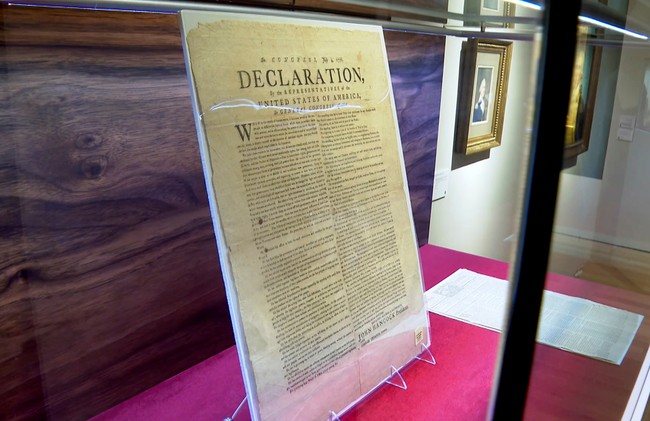
The discovery of a rare early printed copy of the Declaration of Independence in Britain has surfaced after 250 years, found by a volunteer cataloging Royal Navy records; the document was seized from an American privateer in December 1776 and quietly archived until its recent identification, offering a fresh chapter in Revolutionary War history and a reminder that important artifacts can remain hidden in plain sight.
A volunteer at Britain’s National Archives uncovered an early printing of the Declaration of Independence tucked among Royal Navy papers, a find that startled historians and the volunteer alike. The copy was printed in Exeter, New Hampshire, just days after July 4, 1776, and was intended to spread news of independence across the American colonies. Its presence in British naval records traces back to the capture of an American privateer late in 1776, when a bundle of papers was taken and cataloged with little fanfare. For two and a half centuries the sheet sat listed merely as “another paper,” waiting for someone to notice it.
LONDON — A rare copy of the Declaration of Independence lost for 250 years has been discovered in London, where it is the only known example of its kind outside the U.S.
Printed in Exeter, New Hampshire, just days after the Declaration was adopted on July 4, 1776, the document was intended to spread news of American independence throughout the American colonies.
The early copy remained tucked away in Britain’s National Archives until a volunteer cataloging records from the American Revolutionary War came across it in May among the papers of Royal Navy captains.
How did an American revolutionary document end up in the hands of the Royal Navy? The thread runs through the maritime conflict between privateers and the Royal Navy during the Revolution. Privateers were civilian vessels granted permission to attack enemy ships and take cargo, essentially licensed to wage economic warfare on behalf of the Continental Congress. These commissions, orders, logs, and other printed materials were common onboard and often read aloud to crews to maintain discipline and inform actions.
…Britain’s National Archives said in a news release Thursday…[that t]he Declaration was among a collection of papers the Royal Navy seized in December 1776 after it captured the American privateer vessel the Dalton, it said.
“It was an amazing addition to the story of the Dalton and the many other privateers that fought the British at sea,” Amanda Bevan, who leads the National Archives’ project cataloging Royal Navy correspondence from the American Revolution, said in an email Friday.
The specific vessel involved was the Dalton, an 18-gun privateer commanded by Eleazer Johnson. On Christmas Eve 1776 the Dalton was chased and eventually overtaken after a long pursuit by a much larger Royal Navy ship commanded by Capt. Thomas Fitzherbert. The Dalton’s captain and roughly 120 crew members were taken prisoner and sent to Plymouth, England. Among the items taken from the ship was a small packet of printed material that included the Declaration copy.
The seized papers also included the Dalton’s commission, which granted it permission from the Continental Congress to attack British vessels, and other official orders explaining the rules of warfare for privateers.
Bevan said it was common for such documents to be read aloud to crews to reinforce discipline.
The document remained in British custody and was cataloged with many other maritime items, effectively buried in a vast archive. Michael Scurr, a retired insurance executive and volunteer who has worked at the National Archives for 11 years, discovered the copy while cataloging Royal Navy correspondence from the American Revolution. His initial reaction captured the human side of archival work: a quiet, powerful amazement at finding something thought long missing.
On Christmas Eve 1776, the 18-gun vessel commanded by Eleazer Johnson was pursued for seven hours by the 64-gun HMS Raisonnable, commanded by Capt. Thomas Fitzherbert of the Royal Navy, before it was captured off Portugal. Johnson and his crew of about 120 men were imprisoned in Plymouth, England.
The seized Declaration, listed simply as “another paper” in the Royal Navy inventory, remained buried in British archives for centuries. It was eventually uncovered by Michael Scurr, a retired insurance executive who has volunteered at the National Archives for 11 years.
Scurr later described a physical sensation common to great finds: butterflies in the stomach when a page suddenly reveals its significance. He called his supervisor over and confirmed what he suspected, and the item was flagged as an extraordinary survival. The emotional payoff for volunteers and archivists is real; quiet work in dusty rooms can produce moments that rewrite small corners of history.
Volunteer Michael Scurr, recalled feeling butterflies in his stomach after he opened up the paper and realised what it was.
“I called over to my boss and said, ‘I think you need to come and have a look at this’,” he told BBC News.
Experts at the archive emphasized how rare this format is, noting that early reprints of the Declaration were meant for quick distribution, not preservation. Dr. Graham Moore described this particular printing as one of the rarest surviving forms and placed it among a small handful from New Hampshire. That scarcity helps explain why the piece is such an important find for historians studying how news and official proclamations spread through Revolutionary America.
Dr Graham Moore from The National Archives said the discovery is “one of the rarest forms of the Declaration we know about”, adding that it was not meant to be preserved due to the intention to distribute it quickly.
“After the original printing on 4 July, the news of the Declaration is travelling fast around North America and its being reprinted as it reaches each successive colony,” he told BBC News.
“The copy we have is one of only 11 surviving from the first ones printed in New Hampshire.”
The find reminds us that archives still hold surprises and that the wartime practices of seizing enemy papers created unexpected cross-currents of history. A document created to announce independence ended up in an enemy archive and, centuries later, reconnects to the public through the steady work of volunteers and archivists. Important artifacts can be hiding in plain sight because of hurried cataloging and the sheer volume of records kept over long conflicts.


Add comment